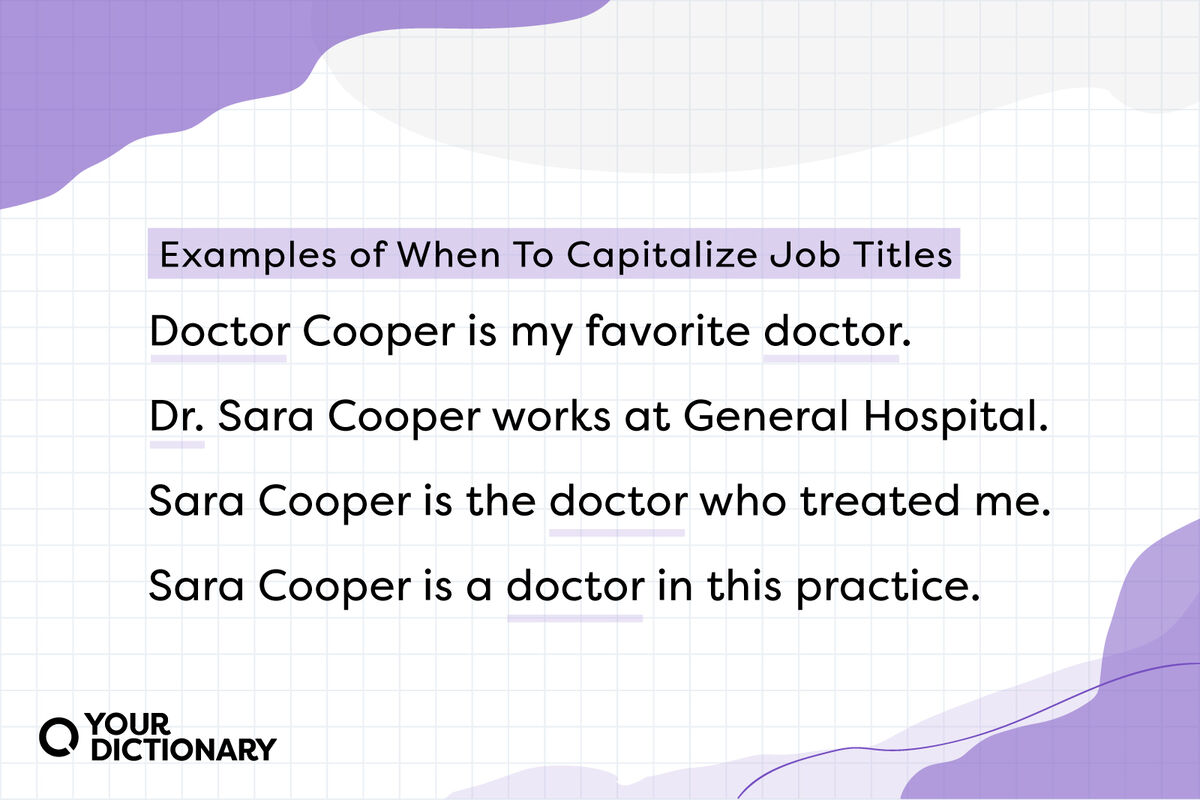
Knowing when to capitalize job titles can be tricky: Is it an official title or just describing someone's role? The rules for the capitalization of job titles depend on the order of the words, the use of the words, and whether or not the job title is used as part of the person’s name.
General Rules for Job Title Capitalization
When deciding how you should capitalize a job title, keep the following general rules and guidelines in mind. These guidelines hold true for all job titles. The answer to the question, "Do you capitalize president?" will be the same as for any other job title. These guidelines are consistent with all major style guides, including APA, AP, Chicago, and MLA.
Before Their Name
Capitalize a job title that comes immediately before the person’s name or is used as part of their name when addressing them. In this case, the job title is usually replacing their first name, though it can also be used in addition to their first name.
- Examples would be Professor Plum, Chairman Scarlett or President Barack Obama.
- The title might also give more information, like Dean of Students Thomas, Head of Internal Development Lee or Speaker of the House Tom Foley.
After Their Name
If the job title comes after the person’s name or is used instead of the person's name, then it is generally not capitalized. This would be the case with Sarah Smith, chairman of the board; Holden Lavesque, accounts receivable clerk; or the governor of California.
However, there are exceptions to this rule:
- When a title is used in a direct address it is capitalized: "Is he going to pull through, Doctor?"
- If a high-ranking job title is replacing the name, it may be capitalized out of courtesy. However, it is not the norm to do this. For example, "I saw the President today."
- In formal contexts, such as a signature line at the end of a letter, the job title may be capitalized: "Sincerely, Mary Contrary, President"
Job Title Abbreviations
The rule of capitalization of job titles applies to abbreviations too. So, General Grant would be written as Gen. Grant. You wouldn't use the abbreviated form after a person's name, though. It would be incorrect to write "Joan Smith, acct. mgr., is present." Here, you would write the full job title "account manager" and keep it lowercase.
Examples in Sentences
It can be helpful to see these rules used in context. Here are some examples of these rules in sentences:
- Dr. Sara Cooper works at General Hospital.
- Officer Brady arrived on the scene shortly after we called for help.
- Colonel Mustard killed Mr. Boddy.
- Professor Diggs, of the Archeology Department, is looking for Atlantis.
- Mr. Waters, vice president of operations, will make an announcement today.
- Mrs. Butterworth, the chairwoman of Pancakes Anonymous, is retiring.
- The managing editor, Will Writealot, got fired.
- Did you see the Queen of England at the celebrations?
- Can you name all the U.S. presidents?
- President Joe Biden is from Delaware.
- My kids have all the books written by Dr. Seuss.
Job Titles on Resumes and Cover Letters
Job titles aren't only included in writing that would fall under one of the major style manuals. They are commonly included in job search documents such as resumes, cover letters and reference lists. The same guidelines listed above apply to resumes, as well as a few special considerations.
- When a job title is used in a heading on a resume, it should be capitalized. (This would be the case if you use past job titles as headings on your resume, such as listing Director of Sales as a heading, then organizing previous jobs with this title below the heading.)
- Do not capitalize your job title when referring to it in the text of any job search document. (Your resume might say "...promoted to sales associate within six months of being hired to work as a sales assistant.")
- When a job title is used on a reference list or cover letter, it should be capitalized if it comes before the name of the person who held (or holds) the job. (I reported to Regional Director Dave Peele after being promoted to sales manager.)
- If the job title comes after the name of the person who is (or was) in that role, it would not be capitalized. (After being promoted to sales manager, I reported to Dave Peele, regional director.)
Job Titles in Email or Letter Signature Lines
People often include their job title in their email signature line or when closing a business letter. In this case, the job title would be capitalized.
- Steve Whitley, Assistant Manager
- Alexandra Davidson, Human Resources Director
Writing a Job Description
Do you capitalize job titles on job descriptions? The answer is: sometimes. The heading or title of a job description should list the title of the job. In that case, the title is capitalized. When referencing the job throughout the job description, however, the job title will not be capitalized.
- The title of a job description for a payroll clerk position would be written as Payroll Clerk.
- When listing the duties, the title would not be capitalized. It might say, "The payroll clerk's duties will include accurately and timely uploading timesheet data into the payroll system, setting up new hires for payroll and processing payroll each week."
Know When to Capitalize Job Titles
To summarize the capitalization of job titles, you should always capitalize the job title when it comes immediately before the person's name, in a formal context, in a direct address, in a resume heading, or as part of a signature line. It should not generally be capitalized if it comes after the person's name, or if there is a “the” before it. Now that you have mastered how to capitalize job titles, you're ready to master other capitalization rules. Start with mastering how to capitalize other kinds of titles.