
Fun language arts games are aimed at helping students improve and practice skills in reading, comprehension, spelling, vocabulary, writing, and composition. Incorporating language arts games in classroom activities can make English studies fun.
Building Language Arts Skills
Building language arts skills is fundamental for students, particularly during elementary school. A foundation for communication and lifelong learning, language arts are a vital educational component of a student's successful future. While some students may enjoy these studies, other children may struggle with the subject area.
With this in mind, discovering ways to make language arts fun is important on many levels - from keeping students who already like the subject challenged and engaged to making the subject more interesting and easier to comprehend for those who struggle.
Language Arts Games for Elementary School
Teachers can easily supplement their curriculum with fun language arts games in the elementary classroom. You can alter the format of a standard lesson to transform it into a fun game. Here are a few examples:
Dictionary Race
The teacher gives a difficult word, and the students must race to find the definition. This game can be modified in many ways, such as giving points to students and having a final standoff among the top contenders or testing the students to see how well they remember the definitions. This game requires that the classroom has enough dictionaries for each student.
Alphabetical Order Race
Divide the class into two teams. Give each team a group of identical index cards with words that need to be placed in alphabetical order, allowing one card for each person. As a team, have the students place the cards in alphabetical order. The team that finishes first wins.
Advertisement
Hink Pink
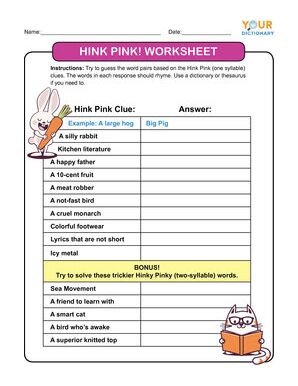
This is a fun language arts game for students to practice using synonyms and adjectives. To play the game think of rhyming pairs of adjectives and nouns, and give a non-rhyming clue. Students take turns to provide the hint, saying "hink pink" for single-syllable words or "hinky pinky" for words with two syllables. Other students must guess the correct set of words. For example:
- Hint - Hink Pink: An Angry Father. Answer: Mad Dad.
- Hint - Hinky Pinky: A Slim Small Horse. Answer: Bony Pony
This game is also known as "Stink Pink." To make the game even more challenging, increase the number of syllables to three with “Hinkaroo Pinkaroo.” Click the PDFs below for more ideas.
Part of Speech Treasure Hunt
Place differently colored Post-its or construction paper pieces with different parts of a sentence (e.g. yellow Post-its with subjects, green with predicates) written on them around the classroom. Have students hunt around the room to find the various parts of a sentence. Then see who can construct the craziest sentence out of them!
Advertisement
Missing Punctuation
Divide the class into two teams. Read a sentence aloud and have one child from each team write the sentence on the board including the correct punctuation. The team who writes it correctly first earns a point. The team with the most points wins.
Language Arts Games for Middle School
Just because your students are in middle school doesn’t mean they won’t enjoy some ELA games! Making spelling, vocabulary, reading, and writing fun is a challenging but worthwhile plan. Here are some ways to make your language arts lesson fun for teenagers.
Taboo
The party favorite is now a classroom favorite. Using the Taboo board game or with your own word list, split the class into two (or more) teams. Have one person at a time come up, select a card, and try to describe the top word without saying the bottom words in one minute. It’s a great way to use both vocabulary and speaking and listening skills.
Advertisement
Balderdash
Like Taboo, Balderdash can be played with or without the board game. First, split the class into four groups. Give each student or a dictionary. Have them write five words on five slips of paper and put them in a team bowl.
One representative from each team selects a word and reads it aloud. The other team members write down silly definitions – except the person who wrote the word in the first place. That team member writes the real definition. The reader chooses the best definition of these choices.
Charades
The classic acting-out game is especially fun for teenagers! Place vocabulary words in a box and have one person pick one out. They then act out the word in front of the class. (Hint: Verbs are the most fun to include!)
Advertisement
Part-of-Speech Bingo
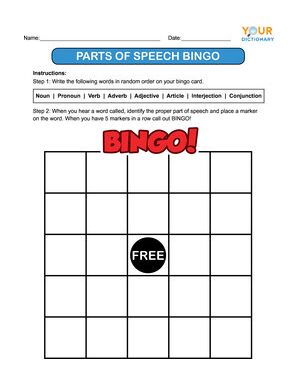
Challenge junior high readers’ knowledge of the parts of speech. Using a bingo sheet with different parts of speech (verbs, nouns, pronouns, adjectives, adverbs, prepositions, or interjections), students can mark the parts of speech that correspond to words you read aloud. Click below for a printable version of the bingo card as well as possible words to read.
Part of Speech Bingo
Click to View & DownloadPictionary
Whether you’ve got a document projector, a whiteboard and markers, or an easel and paper, you can play Pictionary. Have students draw their interpretations of vocabulary words or characters from a novel unit. Their teammates can shout out the answer – and trade points for extra credit!
Other Games That Teach Language Arts Skills
If you’re looking for more opportunities to make ELA fun, check out these additional ideas for classroom games. They are great for middle school, high school, or upper elementary school students.
Advertisement
Classic Classroom Games
Never underestimate the drama of a spelling bee! Some classroom games and activities stand the test of time because they are both educational and entertaining. Ideas include:
- Spelling games or spelling bees
- Word searches
- Crossword puzzles
- Acrostics
- Anagrams
- Missing letter or fill-in games
- Mad Libs
- Choosing the correct word (commonly confused words)
Language Arts Board Games
Board games are still popular in both classrooms and at home. There are many classic board games that help build English skills, as well as specialized educational games for language arts. Classic choices and fun family games include:
Making Learning Fun
It can be hard to engage older students in English language arts. That’s because many classrooms keep games for elementary lessons, thinking that middle schoolers are too old for those activities. But everyone loves to play – and everyone learns better when they’re having fun!
For more ideas on bringing games into the classroom, check out an article on grammar games that are perfect for any grade level.