Want to talk like Shakespeare? We can help. Don’t want to talk like Shakespeare? Fie on thee, thou damned and luxurious mountain goat! (Henry V, Act IV, scene iv. Shakespeare wrote amazing insults!)
But seriously, Shakespeare has topped the English literature bestseller lists for 400 years for good reason. He may be as out of date as your uncle’s second favorite pair of tights, but besides being fun, learning to talk like Shakespeare will teach you about how the English language works.
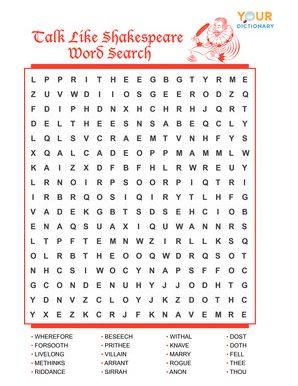
So put together your own perfect prose with the Shakespearean word lists, grammar tips, and game ideas shown below. Try your hand at our own Shakespearean word search too.
Shakespearean Words Still in Use
The nice thing about talking like Shakespeare is that you probably already do. Shakespeare's work is so old, and so persistently popular, that his plays and poems have shaped the English language as a whole. Here are a few fun phrases we still use today:
- All's well that ends well - Managed to pass that English final that worried you so badly? Congrats! All’s well that ends well. Also, All’s Well that Ends Well was the title of one of Shakespeare’s comedies. There’s no escape.
- Devil incarnate - Even if you consider Shakespeare the devil incarnate, you have to grant he’s an important influence on the language. Also, “devil incarnate” appears in both Henry V and Titus Andronicus. Even Shakespeare talked like Shakespeare. Very meta.
- Good riddance - Feel like wishing Elizabethan playwrights good riddance? Before you do, thank Shakespeare. The phrase comes from Troilus and Cressida.
- Greek to me - Is Elizabethan verse all Greek to you? This poetic way of describing something as gibberish is used in Shakespeare’s Julius Caesar.
- Livelong day - Stuck studying all the livelong day? We know the feeling. We also know “livelong day” appears in Julius Caesar. Admittedly, Caesar didn’t actually live that long. Getting stabbed 23 times by your best friends will do that.
- One fell swoop - Ever had something sudden happen in one fell swoop? That phrase comes courtesy of the dreaded Scottish play, Macbeth. Poetical pro tip for using the phrase: “fell” means evil. Only bad things happen in one fell swoop. It doesn’t specifically have to be “a mad king murdered my wife and children” bad. Shakespeare was just hardcore like that.
- Pound of flesh - If your English teacher is definitely getting a pound of flesh out of you, look to The Merchant of Venice for commiseration. The phrase uttered by Shylock is key to the play's plot.
- Salad days - Antony and Cleopatra gave us salad days, which you may feel wasting away while you study Shakespeare. Why is salad a metaphor for youth and inexperience? “Green in judgment, cold in blood,” per Cleopatra.
- Wild Goose Chase - Has finding a thesis statement for your English essay ever felt like a wild goose chase? Consider writing about Romeo and Juliet; their teen romance gone wrong coined the phrase.
We could go on. In fact, we did. For more Shakespearean goodness, check out our List of Words and Phrases Shakespeare Invented.
In Shakespeare's Words
Like any writer, Shakespeare had favorite words and phrases that appear repeatedly in his work. He also used several out-of-date constructions for common modern words. Here is a by-no-means-exhaustive glossary that will help you sound like a Shakespearean character:
- Arrant - Total, complete, absolutely. Shakespeare often uses arrant as an intensifier, emphasizing the meaning of a word. If somebody is an “arrant” something in Shakespeare, look twice. It’s gonna be important.
- Beseech - Beseech just means “ask.”
- Dost, Doth - Both words mean “does.” Dost is second-person (you, or more likely thou, dost the thing) and doth is third-person (he, she or it doth the thing). For more on person as it relates to verbs like doth, check out our article on verb conjugation.
- Fie - "For shame!" An exclamation used to express disapproval or outrage.
- Forsooth - Forsooth just means "for true." Truly. No doubt. For real.
- Knave, rogue, villain - Each of these words has a formal definition. Knave was another word for page, a knight’s servant. Rogue meant a masterless person, someone without a profession, and by extension a beggar. Villain derives from villein, a farm laborer. In Shakespeare, these words are all-purpose insults. Serious ones, too. They might seem mild now, but in Shakespeare’s day you didn’t use these words to someone’s face unless you were ready to have a knife fight in the street over it. Check out Romeo and Juliet Act I, scene i for an example of that very thing.
- Marry - In Shakespearean times it was used as an expression of surprise or emphasis, meaning "indeed" or "well."
- Prithee - Not a privy. Or a privet, indeed. Prithee is just a shortened form of the phrase “I pray thee.” For people in Shakespeare’s time, it was the equivalent of “please.”
- Thee, thou - Ask your local German about “sie” and “du.” They’re the same words in a different accent. Thee and thou both mean "you," in the objective and subjective case respectfully. In other words, thou does the thing, and thee has the thing done to it. Dost thou stab me, knave? No! I stabbeth thee! Fun fact: thee and thou are the familiar forms of the word, intended for casual, informal use. You is the fancypants version.
- Wherefore - This is a classic bit of Shakespeare trivia you can use to impress your friends (or at least your English teacher). Wherefore doesn’t mean where; it means why or for what purpose. When Juliet asks, “Wherefore art thou Romeo?”, she’s not trying to find him; he's in the bushes under her balcony. She’s asking why, oh why, her true love has to be from the family that her family hates so much.
Advertisement
Shakespearean Grammar and Phrasing
For all that he’s a big influence on a surprising number of modern phrases, Shakespeare’s been dead for over 400 years. Shockingly, some stuff has in fact fallen out of fashion.
Iambic Pentameter
The first thing to know about Shakespeare is that, for all that it doesn’t usually rhyme, he was writing poetry. His plays are in blank verse, which is to say, they don’t follow a rhyme scheme but do follow a poetic meter, specifically iambic pentameter.
If that’s all Greek to you (good eye; both those words originate from Greek), don’t worry. Poetic meter is just a pattern of which syllables you emphasize and how many you write per line. Iambic pentameter means that each line contains five (“penta”) iambs, and each iamb consists of one unstressed syllable followed by a stressed syllable:
unstressed-STRESSED / unstressed-STRESSED / unstressed-STRESSED / unstressed-STRESSED / unstressed-STRESSED /
Or better yet:
To BE / or NOT / to BE / that IS / the QUEST-ion.
Advertisement
Odd Contractions and Feminine Endings
A number of Shakespeare’s signature oddities come from trying to fit the pattern of iambic pentameter. His love of weird contractions - “do’t,” “is’t,” and so on - starts with trying to squeeze two words into one syllable. He cheats sometimes too, as with the sneaky unstressed syllable at the end of the Hamlet quote above. That sneaky unstressed syllable is called a feminine ending.
Feminine endings turn up all the time in Shakespeare; up to 10 percent of his lines sneak in an extra unstressed syllable at the end. The Bard didn’t hesitate to play fast and loose with his own rules. Don’t hesitate to do the same.
Inject Some Shakespeare into Your Games
Looking for an unusual party game? Consider working some Shakespearean spice into your favorite activities.
- You can't go wrong with a classic word search. Download and print our Shakespearean word search below and see how quickly you can find all 20 words.
- Consider making your own bingo cards using Shakespearean words.
- Improv! Try classic improv games like And Then or One Word Story with Shakespearean words, phrases, characters, and settings. Expect Shakespeare’s stuff to take on startling new meanings. That’s OK. Shakespeare would smile.
- List Shakespearean words in one column and jumble their modern day equivalents in a second column. The winner is the first person to correctly match all sets of words from both columns.
- Try using Shakespearean words in charades or Pictionary.
Make up your own games -- the ideas are endless.
Advertisement
Celebrate Shakespeare's Way With Words
The official Talk Like Shakespeare Day is April 23 each year. Nobody knows for sure when Shakespeare was born - it was kind of a while ago; the only official record is of his christening on the 26th - but April 23rd is his generally accepted birthday. On the official site, you’ll find tips about how to blog, tweet, and talk like William Shakespeare.
Haven’t had enough? Excellent! For more of Shakespeare’s verbal flourishes, have a look at our Shakespearean Translator. As Robert Graves famously said, “The remarkable thing about Shakespeare is that he is really very good - in spite of all the people who say he is very good.” Quite right, forsooth.