Clauses are units of grammar that contain a predicate (verb) and a subject (noun). Some clauses can stand on their own as sentences (independent), and some cannot (dependent). Beyond being broadly categorized as independent or dependent, there are many other types of clauses in English grammar. Discover different types of clauses and learn how they work.
Independent Clauses
An independent clause can stand as a sentence by itself or it can be combined with other clauses. As with all clauses, they contain a subject and a predicate. They can join with a dependent clause or other independent clauses to make a complex sentence.
- I love opening the windows while the warm breeze blows.
- Since we enjoyed this book, we'll be sure to pay it forward.
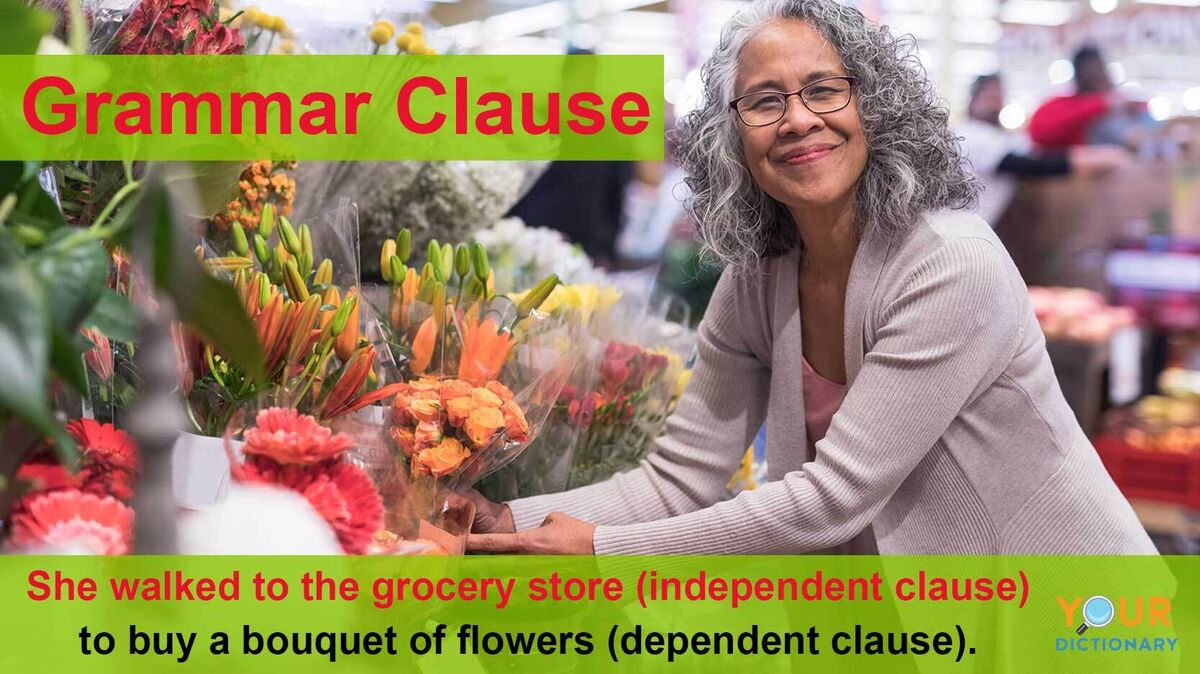
- She walked to the grocery store to buy a bouquet of flowers.
Main Clause
Every sentence has at least one main clause, which is a group of words that makes sense on its own. Main clauses are always independent clauses. Compound sentences have two main clauses that are related to each other, while complex sentences have a main clause and at least one dependent clause.
She bought a new computer. (main clause on its own)
She bought a new computer and she purchased a used printer. (two main clauses in a compound sentence)
She bought a new computer because she needed one. (main clause in a complex sentence)
Dependent Clauses
A dependent clause is not a complete sentence by itself. Standing alone, it would be considered a sentence fragment, or an incomplete sentence. A dependent clause needs to be combined with an independent clause to form a complete sentence.
- If that's a burrito, I'm having it.
- He's mean mainly because he's unhappy.
- Let's go for a walk while the sun's still out.
Adverb Clauses
Adverb clauses, also referred to as adverbial clauses, are dependent clauses that function like an adverb. They modify verbs, other adverbs or adjectives. These clauses are typically used to elaborate when, where, why, how, how much, or under what condition the action of the sentence took place.
- Since it's just me, I'll eat in tonight.
- My dog, although she is shy, loves people.
- I keep a suitcase packed, in case I find a great flight to Ireland.
Adjective Clauses
Adjective clauses are dependent clauses that modify nouns and pronouns. These clauses tend to begin with pronouns such as who, whose, that, or which.
- The winners, whose names are posted on the bulletin board, will receive round trip airfare to Mexico City.
- Money that is well spent will last forever.
- Exercise, which many people dislike, is good for you.
Noun Clauses
A noun clause is a group of words that band together and act like a noun. Nouns clauses are used when a single word isn't enough. They're always dependent clauses. They often begin with words like how, that, what, when, where, which, who, and why.
- How he behaved was not acceptable.
- She didn't know where she was.
- Her favorite part of the book was when the dragon turned into a boy.
Subordinate Clause
A subordinate clause is a dependent clause that only has meaning in the context of a main clause to which it is connected. For example, in the example,”She bought a new computer because she needed one,” the phrase “because she needed one” is a subordinate clause. It would not make sense without the main clause that tells what “one” refers to (a computer). They include subordinating conjunctions.
- We became very sleepy after eating lunch.
- Once he became manager, Mike became very standoffish.
- Upon arriving at the hotel, I plan to unpack and take a nap.
Conditional Clause
A conditional clause is a type of subordinate clause. This type of clause is used to convey something that is possibly or probably going to happen. It usually begins with a conditional conjunction such as “if” or “unless.”
- If traffic isn’t heavy, I expect to pick you up at 4 p.m.
- I’ll be home in time for dinner unless my boss decides I have to work late.
- We should have a lot of fresh tomatoes by August if all goes well with the garden.
Relative Clause
A relative clause is a type of subordinate clause that begins with a relative pronoun, such as which, that, whom, whose, when, where, or who. These clauses typically identify or provide detail about the noun that comes before them in a sentence.
- Our neighbor who moved in last year wants to borrow the chainsaw.
- Plant it in the back corner of the yard where the tree fell last winter.
- My dog that will eat just about anything really hates pumpkin flavored food.
Connecting Independent Clauses
You might've noticed that many independent clauses can be joined together simply by adding a comma, though some require a conjunction, either on its own or with a comma. Semicolons are another option for connecting independent clauses. They are best suited for joining two independent clauses or in connection with a conjunctive adverb.
Connecting Dependent Clauses
Dependent clauses can connect to independent clauses with no punctuation or with a comma. For example, commas are important for wrapping around clauses that function as parenthetical expressions, but are generally not otherwise needed to connect a dependent clause to one that is independent.
Importance of Clauses
By correctly using different types of clauses, you can quickly improve the quality of your writing as well as your ability to communicate with an audience. Clauses help you direct the attention of the reader so that your sentences are understood. Proper usage will also help you avoid dreaded sentence fragments and run on-sentences. To prevent punctuation issues, make sure you know how to properly punctuate sentences featuring all kinds of clauses. Review the basic punctuation rules for a refresher.