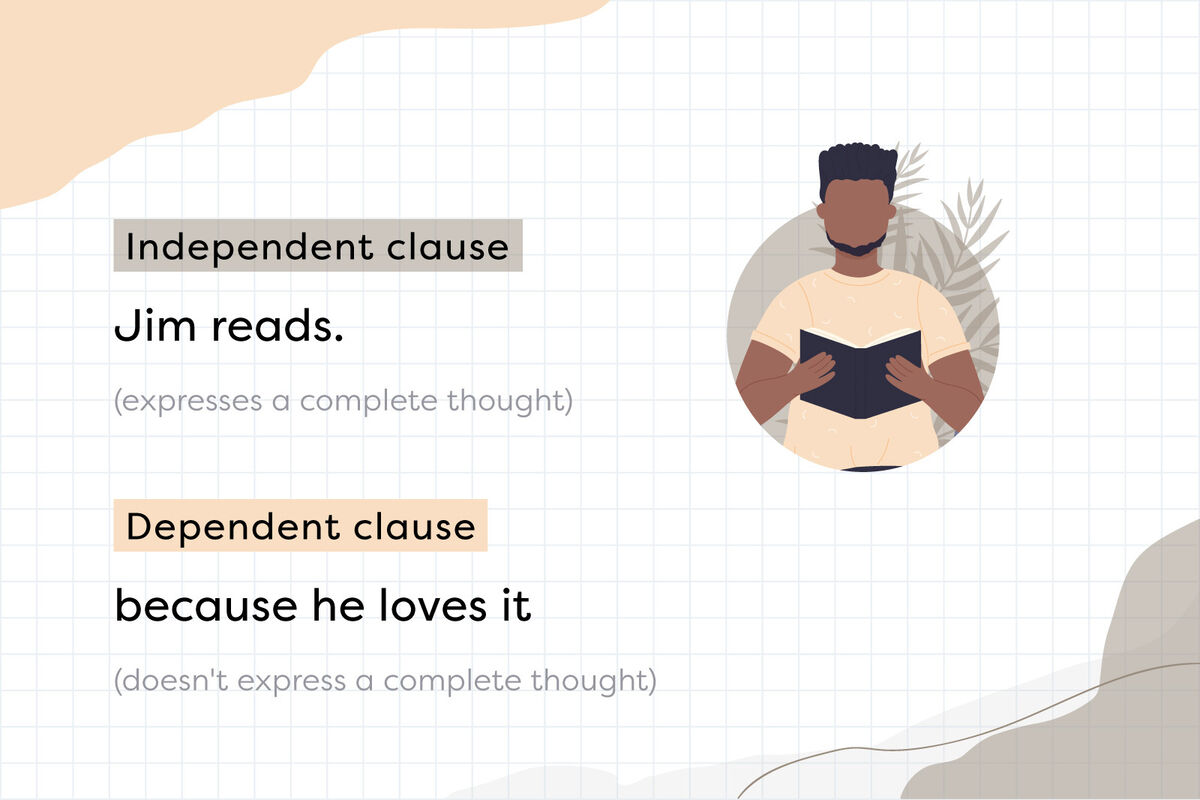
Independent and dependent clauses are the building blocks of sentences. A single independent clause expresses a complete thought and can be a sentence by itself. Dependent clauses don’t express a complete thought, but they add more information to a sentence. When you join independent and dependent clauses with conjunctions and proper punctuation, they create compound and complex (and compound-complex!) sentences that are fun and engaging to read.
Independent Clause Defined
An independent clause is a full sentence. It does not need to be joined to any other clauses because it contains all the information necessary to be a complete sentence.
Independent clauses have three components:
subject - tells the reader what the sentence is about
predicate (action) - tells the reader what the subject is doing
a complete thought - a full picture of what happened or was said
Examples of Independent Clauses
Independent clauses can be simple sentences that consist of a subject and a verb. For example:
-
Jim reads. (Jim is the subject, reads is the verb)
-
Sarah teaches. (Sarah is the subject, teaches is the verb)
-
Mark plays. (Mark is the subject, plays is the verb)
If you add direct objects to these sentences, they’re still independent clauses:
-
Jim reads the newspaper.
-
Sarah teaches high school.
-
Mark plays basketball.
Join independent clauses to other independent clauses with coordinating conjunctions (for, and, nor, but, or, yet, so) or semicolons. These new sentences are called compound sentences.
-
Jim reads the newspaper, so he understands what’s happening in town..
-
Sarah teaches high school and she volunteers at a homeless shelter.
-
Mark plays basketball; he’s not very good.
Common Errors Combining Independent Clauses
When you combine independent clauses without proper punctuation, you get a run-on sentence. For example, “Jim reads the newspaper he understands what’s happening in town” is a run-on sentence.
When two independent clauses are joined only by a comma (such as “Jim reads the newspaper, he understands what’s happening in town”), it creates a grammatical error called a comma splice. Avoid these common mistakes by combining independent clauses correctly.
Dependent Clause Defined
Like independent clauses, dependent clauses include a subject and a verb. But unlike independent clauses, they do not express a complete thought. They add more information to an independent clause to clarify meaning but can’t stand alone.
There are several different types of dependent clauses, including:
noun clauses - function as subjects or objects in a sentence
adverbial clauses - function as adverbs to modify verbs, adjectives or other adverbs
relative clauses - function as adjectives to modify nouns
You can spot a dependent clause by the presence of a subordinating conjunction (such as before, after, because, since, in order to, although, whenever, while, or even though).
Examples of Dependent Clauses
When dependent clauses stand on their own, they don’t make much sense. For example:
who gave me a present
because he loves her
that used to be a video store
However, when you add them to independent clauses, their meaning is clear:
I’d like to know who gave me a present. (who gave me a present is a noun clause that acts as a direct object)
He asked her to marry him because he loves her. (because he loves her is an adverbial clause that modifies the verb asked)
Let’s meet at the restaurant that used to be a video store. (that used to be a video store is a relative clause that modifies the noun restaurant)
Common Errors Combining Dependent Clauses
Dependent clauses can’t stand alone as a full sentence. If they’re not joined to another clause, they create a sentence fragment. For example, “because I forgot my homework” is a sentence fragment because it doesn’t express a complete thought. When you combine it with an independent clause to make “Because I forgot my homework, I got sent home,” it’s no longer a sentence fragment.
Vary Your Writing With Different Sentence Structure
If your writing is starting to sound a little boring, it’s probably because you’re only using one type of sentence. Mixing up your sentence can add interest to any piece of writing. Check out: