
Grammar is the study of words and how they can be used to form sentences. It can include the inflections, syntax and word formation of the language, as well as the pronunciation, meaning and linguistic history of a particular word. Grammar problems can cause a wide range of communication problems that can negatively impact personal and professional interactions.
Unclear Communication
Using incorrect grammar when writing or speaking can lead to unclear communication and miscommunication. Consider the following sentences:
- I don't want nothing from you.
- I don't want anything from you.
While the first sentence uses two negatives to create a positive construction, the second example uses one negative and one positive to create a negative construction.
- “I don’t want nothing” actually means that you do want something. If that’s what you mean, then the grammar in the first example above is correct, yet very confusing.
- If you are actually trying to tell a friend that you already have everything you need and so do not need anything from them, then the wording of the second sentence is correct.
There are many other examples of bad grammar that can lead to unclear communication.
Poor First Impressions
In addition to creating communication misunderstandings, incorrect grammar can also cause you to make a poor first impression. People tend to make assumptions about a person’s abilities based on how they come across in communication.
- If you are a jobseeker with grammatical errors in your resume, a recruiter may see you as less capable than a candidate with similar skills and a mistake-free resume.
- If there are grammatical errors in a company’s marketing materials, potential customers may see these mistakes as an indication that the company is sloppy or simply unreliable.
Avoid using negative grammar that could cause you to make a negative first impression on people that you meet.
Real World Examples of Grammar Problems
From contract disputes to erroneous tattoos and more, grammatical errors can cause serious problems.
Advertisement
Multi-Million Dollar Comma Error
What's the price of bad grammar? In October 2006, a contract dispute between Canadian cable company Rogers Communications and telephone company Bell Aliant revealed that a misplaced comma can be worth $2 million. Aren’t you glad that you’re not the person who made this punctuation error?
The contract said:
"This agreement shall be effective from the date it is made and shall continue in force for a period of five (5) years from the date it is made, and thereafter for successive five (5) year terms, unless and until terminated by one year prior notice in writing by either party."
Rogers Communications believed the placement of the second comma stated the contract was good for at least five years, while Bell Aliant said the comma indicated the deal could be terminated before if one year's notice was given. Canada's telecommunications commission sided with Bell Aliant. Bell Aliant was able to save over $2 million by ending the deal early. The comma should have been omitted if the contract was intended to last five years in its shortest possible term.
Advertisement
Having Auntie for Dinner
An omitted comma can also cause confusing communication. Consider the difference a comma makes when your intent (hopefully) is to invite your aunt to the dinner table.
- Let’s eat, Aunt Cathy.
- Let’s eat Aunt Cathy.
The first example is an invitation to join the group for a meal, while the second example will send Aunt Cathy running from the house!
Bad for Business
Businesses that have typographical errors and grammatical mistakes on their websites are costing themselves customers. A website’s bounce rate, the percentage of visitors to a site who leave without visiting additional pages beyond the one they landed on initially, is significantly impacted by how many errors are in the content.
- A recent study revealed that bounce rate can be 85% higher for sites that have mistakes in the text versus those that are error-free.
- Site visitors who landed on pages with errors also exited the page eight percent faster than those who landed on pages without mistakes.
- A high bounce rate is linked to lost business opportunities; ad-supported websites lose the advertising revenue when visitors leave quickly. Ecommerce sites lose the opportunity to sell products or services.
Advertisement
Permanent Ink
Fortunately for actress Emma Watson, who played Hermione in the Harry Potter series, the Times Up tattoo she got in 2018 was a temporary tattoo that easily washed off. That’s because the tattoo really should have said Time’s Up, in a combination of the words time and is. If you decide to get a permanent tattoo with a quote on it, be sure that the phrasing is grammatically correct and that there are no spelling mistakes!
Common Grammar Issues and Mistakes
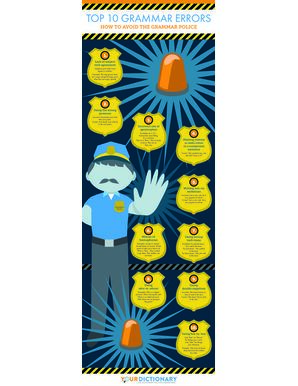
What types of mistakes indicate poor grammar? There are many common grammatical errors including:
- run-on sentences that combine two or more complete thoughts without the proper punctuation between clauses
- sentence fragments lack a subject or verb
- incorrectly using apostrophes to form a contraction (it’s for it is) when you’re really trying to indicate possession (its)
- using two negatives in one sentence to indicate the opposite of what you actually mean
- sentences with an unclear antecedent (the noun to which a pronoun refers)
- misplaced modifiers that either modify two separate words or appear to modify the wrong part of the sentence
- overuse of prepositional phrases such as “without a doubt” or “on occasion”
Advertisement
Resources for Improving Your Grammar Skills
Hopefully these examples clearly illustrate the importance of using correct grammar. The more you learn about grammar, the better your communication skills will be. This will help improve how other people perceive you and your abilities, while also preparing you for success in the business world.
- Master the basic grammar rules and consistently follow them in your spoken and written communication.
- Expand your expertise by learning some of the more advanced rules of grammar.
- Continue improving your grammar mastery with regards to style and usage.
- Review 18 of the most common grammar mistakes so you can be sure to avoid them.
Proper Grammar Matters for Everyone
Learning the basics of English grammar is worthwhile even if you don’t plan to work as a professional writer. Grammar is an important part of face-to-face communication, and almost all jobs involve at least some writing. Now that you’re familiar with some of the many problems caused by incorrect grammar, spend some time exploring what else is necessary for effective written communication.