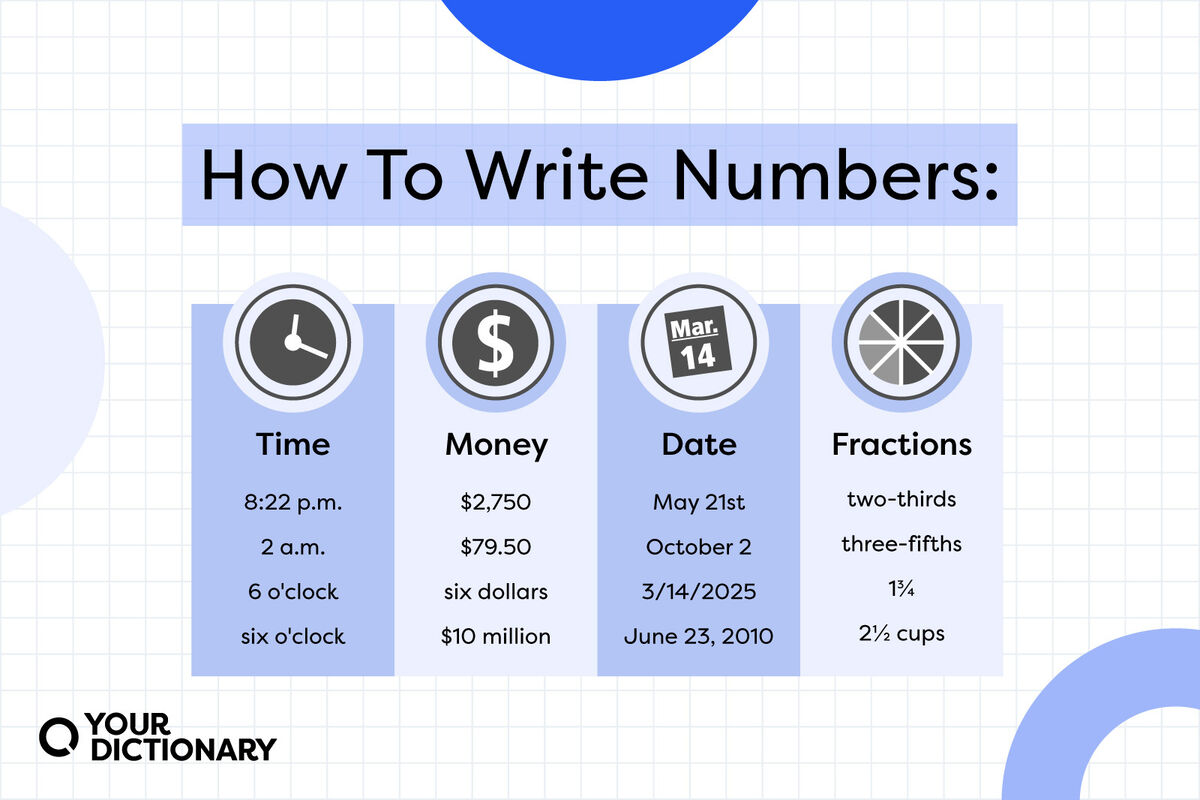
Numbers don't just show up in math assignments — they also appear in everyday writing. Like many facets of the English language, there are rules for writing numbers. Certain numbers are spelled out with letters, and others are only written as numerals. You've probably come across more than your fair share of Top 10 lists; why is it not a Top Ten list? Learning how to write numbers in English will reveal the answer!
Rules for Numbers That Are Spelled Out
There are several situations in which number words should be spelled out. Of course, as is often the case in English, there are some exceptions to the rules outlined below. As with other grammar rules, rules for writing numbers change according to certain style guides (for example Chicago Manual of Style, AP, MLA, etc.). Discover several general rules for spelling out numbers.
Spell Numbers Under 10
When writing numbers under 10 in a sentence, they should be spelled out. This is true regardless of where they fall in a sentence.
- Martin has two younger sisters and five older brothers.
- Mary read four new books last week and seven newspaper articles.
Spell Numbers That Begin Sentences
Whenever there are numbers at the beginning of a sentence, those numbers should be written out.
- Sixty children came to the class trip last year, but this year there were 80.
- Twelve credit hours is considered a full-time course load in college.
Hyphenate Spelled-Out Compound Numbers
When compound numbers are spelled out, such as when they are at the beginning of a sentence, they should always be hyphenated.
- Fifty-two miles were all she had left on her journey to Scotland.
- Forty-nine percent of teachers live in the city.
Hyphenate Spelled-Out Fractions
Fractions at the beginning of a sentence must be spelled out. Within a sentence, they can be expressed as numerals or words. When spelled out, they should be hyphenated.
- One-third of the group comes from China.
- She filled her gas tank with two-thirds of a gallon.
Guidelines for Numbers That Require Numerals
Part of learning how to write numbers in English requires learning the situations in which numbers should not be spelled out. Instead, they should be presented as numerals. Of course, these rules for using numerals all assume that the number isn't positioned at the very beginning of a sentence or question.
Use Numerals in Headings and Titles
When you include a number in a heading or a title, it's better to use a numeral rather than spelling out a word. That's why you'll see Top 10 in the title of listicle articles rather than Top Ten. This rule is true even when the number is the first word of the title.
- 15 Best Restaurants in San Francisco
- Top 6 Must-Remember Rules
Use Numerals for Numbers 10 and Above
When you include numbers 10 or higher in sentences, those should be expressed as numerals, unless they are at the very beginning of the sentence.
- I am planning to take a Caribbean cruise with 10 of my closest friends.
- She's bought about 12 pairs of shoes and 16 dresses in the last three months.
Use Numbers for Mixed Fractions
While fractions are ordinarily spelled out, there is an exception to this rule for mixed fractions. A mixed fraction combines a whole number and a fraction. These require numerals unless positioned at the beginning of a sentence.
- The recipe calls for 2½ cups of nuts.
- Our class art project calls for 1¼ cups of glitter.
Use Numbers for Days of the Month
Dates should be expressed using numbers. There are a few special rules for properly writing dates. When writing just the day of the month, you can use a cardinal (4) or ordinal (4th) number. Both are correct.
- Are you coming to the game on May 21st?
- Her birthday is October 2.
Use Numbers for the Full Date
When writing out the full date, you can use numbers for the month, da,y and year. Or, you can opt to spell out the month, with numbers for the day and year.
- Join our spooky Halloween party: 10/31/2018.
- The play is on March 23, 2010.
Please note that it is not correct to use ordinal numbers (1st, 2nd, 3rd) with full dates. It would be incorrect to state "March 23rd, 2010." There are special rules for writing the date in military format.
Use Numbers for Percentages
When writing percentages, use numbers paired with the % sign.
- According to the latest survey, 52% of teachers live in the city.
- It's good to know that only 7% of Americans say they are unhappy.
The word percent should generally only be used when spelling out percentages in words, which you would only do at the start of a sentence.
Use Numbers for Decimals
Decimals should be written as numerals.
- There were 3.73 inches of rain last month.
- The mountain accumulated 8.98 inches of snow today.
It is best to avoid beginning a sentence with a decimal, as these types of numbers would be awkward to read if you had to spell them out. Often, you can reword what you want to say by putting the phrase "A total of" in front of the decimal as a way to keep from starting the sentence with a decimal.
Rules for Writing Numbers and Money
When it comes to money, numbers follow their own set of rules. Money amounts are usually written as numerals, but can be written out when the amount is vague or rounded up — "it cost two or three dollars."
The most important guidelines to keep in mind are:
- Currency symbols should be placed before the number, with no spaces.
Example: She earned $2,750 for that project. - Thousands should be separated by commas.
Example: Marcy inherited $35,000 from her late uncle. - Decimals should be separated by periods.
Example: Seamus only spent $149.99 on that new smart TV. - When you reach large numbers in the millions and billions, write out the full word (instead of all those zeros).
Example: That new company earned $10 million in 2018. - Do not write out the currency if you've already indicated an amount with a currency symbol.
Example: I have $895 left in my checking account. (It would be redundant to say "$895 dollars")
Special Cases: Multiple Rules and Exceptions
There are some special instances where numbers may be written in multiple ways.
Avoid Mixing Number Words and Numerals in Lists
When numbers are in a list, it is generally ideal to keep all the numbers in the list consistent, even if some numbers are under 10 and some are over. However, if you are following a style guide that dictates to always spell out numbers under ten (such as AP), you should follow the rules even though that would result in an inconsistent list. Otherwise, consistency is best.
- inconsistent: She has four brothers aged seven, nine, 12, and 15.
- consistent: She has four brothers aged 7, 9, 12, and 15.
- inconsistent: Mary's traveled to three European countries and 14 deserted islands.
- consistent: Mary's traveled to 3 European countries and 14 deserted islands.
Vary Format With Two Side-by-Side Numbers
When you're writing a sentence that has two numbers side-by-side that aren't part of a related list, you'll need to adjust the text for clarity. In this case, it is best to write one number as a word and the other as a numeral.
- best: There are going to be 12 ten-year-old kids at my house this weekend.
- confusing: There are going to be 12 10-year-old kids at my house this weekend.
- less confusing, but not ideal: There are going to be 12, 10-year-old kids at my house this weekend.
Another option would be to rearrange the sentence to separate the numbers. You could say, "There will be 12 kids who are 10 years old at my house this weekend."
Writing Numbers on Checks
When you are writing a check that will be used to draw funds on a bank account or credit card cash advance, a special rule applies. In this case, you will need to indicate the amount numerically in the designated spot beside the dollar sign. Then, you'll need to spell it out. You can use words for the dollars and cents, or opt to express cents as a fraction out of 100, since it takes 100 cents to make a dollar. Be sure to include the word "and" between the dollars and the cents.
- When writing a check for $1,044.12, the full text should be written as one thousand forty-four dollars and 12/100.
- If you are writing a check for $182.40, you could write one hundred eighty-two dollars and fifty cents or one hundred eighty-two dollars and 50/100.
- If you are writing a check for $79.00 even, the text could say seventy-nine dollars and 00/100, seventy-nine dollars and no cents or seventy-nine dollars only.
Rules for Referring to Decades
When referring to a certain decade, there are a few different options. You can use a word, the full date, or an abbreviated date.
- She lived in San Francisco in the eighties.
- During the 1980s, she lived in San Francisco.
- She lived in San Francisco in the '80s.
Guidelines for Writing Time (a.m. and p.m.)
When writing the time along with a.m. to designate morning or p.m. to designate evening, use the numeral to designate time. For the precise time, add the minutes after a colon (8:22 p.m.) When referring to an even hour, just list the hour rather than including that there are zero minutes (use 2 a.m. instead of 2:00 a.m.). Don't use words for the time when using a.m. or p.m. (unless the time is the first word in the sentence).
- correct: The accident happened at 8:22 p.m. last night.
- correct: They did not leave the party until 2 a.m.
- incorrect: They did not leave the party until two a.m.
How To Specify Time With "O'clock"
The phrase o'clock stands for "of clock," though that exact phrase is not standard English language usage. However, o'clock can be used when you're referring to an even increment of time. It should not be used with a.m. or p.m. Instead, you could specify "in the morning," "in the evening," or "at night" to clarify the meaning. When using o'clock, you can use numerals or words to designate time, opting to comply with the rules of any style guide you are following (if applicable).
- We have to get up at 6 o'clock in the morning to be on time for school.
- We have to get up at six o'clock to be on time for school.
- She gets home around eight in the evening.
Guidelines for Midnight and Noon
It is common to spell out noon and midnight instead of writing 12 p.m. and 12 a.m, though any of those options are correct. However, you should not combine both options.
- correct: We came home around midnight and slept until noon the next day.
- correct: I slept until 12 p.m. and then went to bed again at 12 a.m.
- incorrect: I need to be home by 12 a.m. midnight.
- incorrect: She is bringing lunch to me at 12 noon.
When in Doubt, Spell It Out
When in doubt about whether to spell out or write a number, it's usually best to spell it out. However, for larger numbers, you can always err on the side of the numeral form.
- The publishing company sold 10 million copies of my book last year.
- There are 1,500 sequins on that wedding dress!
Master Writing Numbers in English
Now that you are familiar with when to spell out numbers, take the time to discover some more rules for writing numbers. For example, explore the rules for using commas in numbers. Then, take an even deeper dive into numbers and explore those that can be expressed as a quotient by reviewing these rational number examples.