Using Good and Well in General Sentences
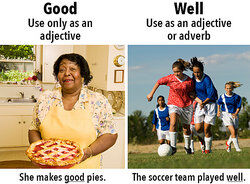
The word "good" is an adjective. It is always used with a noun. Good should never be used as an adverb. For example:
- She is a good singer.
- We are good students.
- He is a good listener.
- They are good neighbors.
- He did a good job.
The word "well" is an adverb. It is used to modify a verb, adverb or another adjective and answers the question "how?". For example:
- He plays the guitar well.
- He did well on the exam.
- She speaks English well.
- We don't know our neighbor very well.
- He did the job well.
Using Good and Well with Linking Verbs
The words "good" and "well" can be used as a predicate adjective, which follows a linking verb and refers back to the subject of the linking verb. Linking verbs are used to describe states of being, like the verb to be, or to describe senses, like to feel. The sentences “I feel sad,” and “He is fast” both use a linking verb.
When using linking verbs that refer to the senses such as appear, taste, sound, smell, look, and seem, use "good." For example:
- The food tastes good.
- The house smells good.
- She looks good in that dress.
- The car appears good on the exterior.
- The idea seems good to me.
When using linking verbs that describe health such as be, feel or look, use "well." For example:
- I am not feeling well.
- She didn't look well last night and missed work today.
- He was not well and left early.
- He used to be sick but now he is well.
When describing someone's emotional state, use the word "good." Some examples include:
- He didn't feel good when he lied to his mom.
- I'm feeling good about the test results.
- He feels good about his decision.
- We feel good about our choice for candidate.
What should you do if you are asked the question "How are you?" If you want to answer regarding your health, the correct response is "I feel well." If you want to answer regarding your emotional state, the correct response is "I feel good."
More Examples of Good and Well in Sentences
Some more examples will help you better understand the use of "well" and "good" in sentences include:
- He did well on today's test.
- He did a good job on today's test.
- She has the flu and does not look well.
- She was sad and did not feel good today.
- I feel good about our relationship.
- Our relationship is going well.
- I can see pretty well.
- My eyesight is good.
End the Confusion
Since the words "good" and "well" have similar meanings, it is not unusual to confuse the two, especially in casual conversation. Keep it simple and end the confusion by remembering that well describes actions and good describes nouns.