Descriptive adjectives describe things in a more interesting way. They make food seem delicious, people seem wonderful, and books seem fascinating — depending on the type of descriptive adjective (or adjectives) you use.
What Is a Descriptive Adjective?
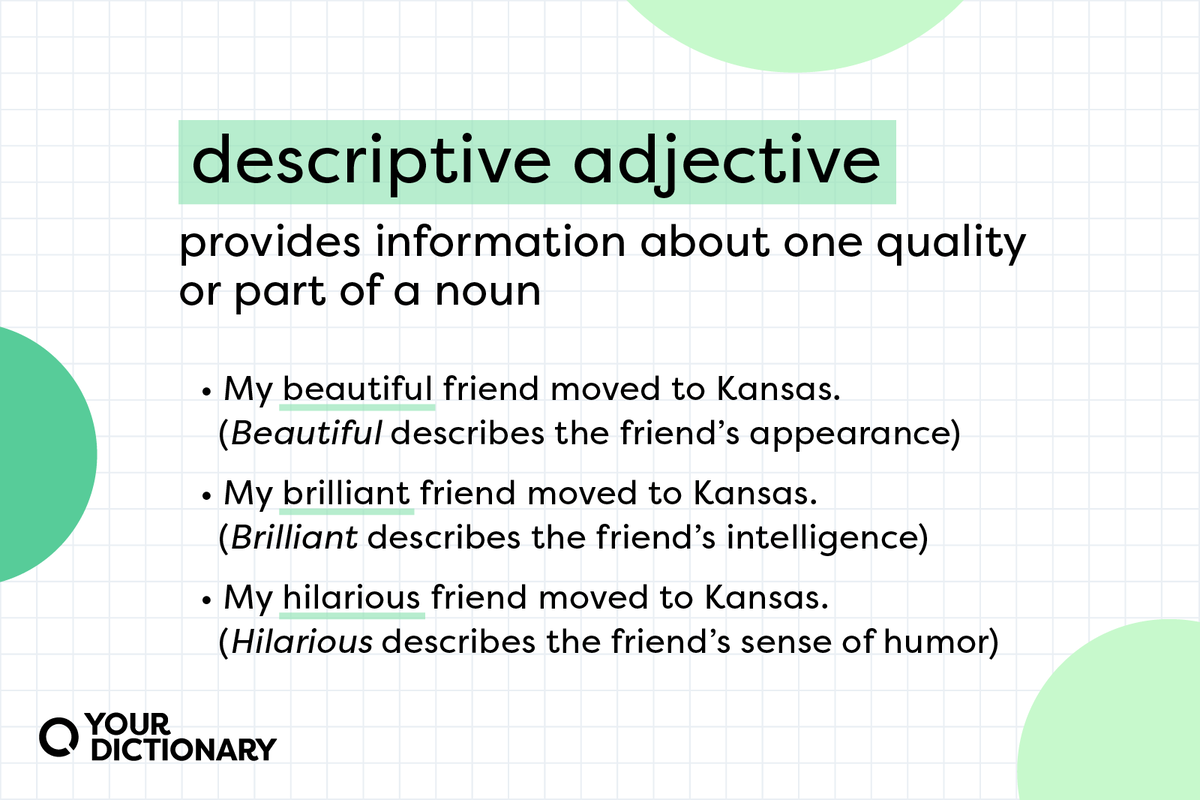
Adjectives are words that describe nouns. Descriptive adjectives provide information about one quality or part of a noun.
-
My beautiful friend moved to Kansas.
(Beautiful describes the friend’s appearance) -
My brilliant friend moved to Kansas.
(Brilliant describes the friend’s intelligence) -
My hilarious friend moved to Kansas.
(Hilarious describes the friend’s sense of humor)
You can use descriptive adjectives before the noun (my beautiful friend) or you can add them after the noun with a linking verb (my friend is beautiful).
Fast Fact
Not all adjectives are descriptive adjectives. Some types of adjectives are known as limiting adjectives, which specify which noun you’re talking about rather than adding additional information.
Types of of Descriptive Adjectives
Descriptive adjectives can add more details about feelings and emotions, the taste of something, and a person’s appearance. You might also use adjectives to describe sounds and time.
Since they describe different aspects of a noun, you can use simple adjectives, compound adjectives, or proper adjectives — or all of them — to describe a noun.
Examples of Simple Adjectives
Simple adjectives are the most grammatically basic (and common) type of descriptive adjective.
- aggressive
- alert
- ancient
- anxious
- attractive
- average
- bad
- beautiful
- beige
- big
- bitter
- blue
- bumpy
- busy
- careful
- cheap
- clear
- cold
- combative
- cotton
- crooked
- dangerous
- delicious
- dry
- dull
- dusty
- elderly
- excited
- expensive
- fancy
- fresh
- fuzzy
- graceful
- granite
- green
- handsome
- hollow
- hot
- hungry
- lazy
- low
- massive
- melodic
- modern
- new
- oval
- petite
- puny
- purple
- quiet
- rainy
- rich
- safe
- shiny
- soft
- sore
- strong
- superior
- terrible
- tiny
- tired
- ugly
- weak
- weary

Words that Describe Personality Traits
Examples of Compound Adjectives
Compound adjectives consist of two words connected by a hyphen. Using compound adjectives helps you get even more specific with your descriptions.
- baby-faced
- bow-legged
- broken-hearted
- bull-headed
- four-sided
- freckle-faced
- hard-hearted
- hard-nosed
- heavy-handed
- high-heeled
- ice-cold
- left-handed
- life-giving
- long-legged
- long-winded
- next-door
- pigeon-toed
- quick-witted
- red-blooded
- self-centered
- short-tempered
- sure-footed
- thin-skinned
- tight-fisted

Descriptive Words for Food: Taste, Texture and Beyond
Examples of Proper Adjectives
Proper adjectives come from proper nouns. They specify which nation, region, religion, or era a noun comes from.
- American
- Antarctic
- Atlantic
- Buddhist
- Californian
- Canadian
- Chinese
- Christian
- Cuban
- Ecuadorian
- English
- French
- German
- Greek
- Hindu
- Indonesian
- Italian
- Mayan
- Mexican
- Pacific
- Peruvian
- Roman
- Romanian
- Shakespearean
- Spanish
- Turkish
- Victorian
- Welsh

Descriptive Words for Scents: List of Smell Adjectives
Putting Adjectives in Order
When using multiple descriptive adjectives in a sentence, there is an order in which you should arrange them. Adjectives that describe opinion typically precede adjectives that describe color, size, shape, and more.
For example, the sentence "The ugly red office chair sat in the corner" is preferable to "The office red ugly chair sat in the corner."
List of Descriptive Words: Adjectives, Adverbs, & Participles