
Children and adults alike will be happier to learn when they are having fun: that is why adjective games for kids are a really effective way to teach adjectives in the classroom. Students will develop a stronger vocabulary when learning is a fun process and they can frequently use their newly learned adjectives.
1. Fifty Awesome Adjectives
This is a great game for kids to expand their vocabulary and improve their creative writing skills.
- Ask students to bring in a picture of one of their favorite places, perhaps a memorable vacation spot, their home, or a relative's house.
- Give them a piece of paper and ask them to write sentences describing the place using as many adjectives as possible.
- Encourage them to be creative in their descriptions. Instead of a bland statement like, "There are four trees in the garden," you want something like, "There are four tall, twisty trees with thick, bushy, green leaves in the shady garden." The goal is to include 50 different adjectives in their description of the place.
- Once that's done, ask them to trade descriptions with one another.
- Ask each student to mark each adjective they find with a highlighter. If the other student finds at least 50 awesome adjectives, they can put a sticker on the description.
- Put the descriptions, along with the pictures, on a bulletin board in the room. Students can be proud of their achievements and see the photos of their favorite places often.
If someone is truly stuck and cannot find enough adjectives, you can allow them to look up new words using a thesaurus so their vocabulary expands. That way, everyone wins, and students grow!
2. Alphabetical Adjectives
Start at the beginning of the alphabet, and have your class brainstorm as many adjectives as they can that begin with each letter.
To make the most of this learning game:
- Keep a record of how many they come up with for each letter. When you play again, you can determine if your students are coming up with more adjectives than they could last time.
- Play this game with a different letter every day.
- For inspiration, you might choose stories or classroom objects that the students can describe.
Once your students have run out of adjectives, offer a few more of your own which they have not listed: you can have a list ready so that you are prepared to help them out.
3. Adjective Battleship
Bring in groups of small objects that are similar in some ways but different in others. For example, bring in toy cars that are all the same color but different shapes. Or, you might bring in three green apples that are all different sizes.
Break students into pairs, and give each pair a set of three objects. One student secretly picks an object, and the other student guesses which one the first student chose. The second student must ask questions that use adjectives. For example:
- Is it big?
- Is it round?
- Is the doll's face happy?
- Does the doll look confused?
This will give students the opportunity to become more accurate in describing things.
Advertisement
4. Describe My Outfit
Ask each student to bring in a photo of themselves from home. Alternatively, they can draw a picture of what they are wearing that day. Then, students can write a paragraph describing what they are wearing using as many descriptive adjectives as possible.
Advantages of this approach include:
- This game will get them out of the rut of describing their clothes as "pretty" and "nice" - the two adjectives teachers hear far too often!
- Encourage students to avoid using the word “very” in their descriptions. Instead of saying their dress is “very bright,” they may describe it as “vivid” or “vibrant.”
- If you make sure that your students describe themselves in a positive way, you will also encourage them to develop their sense of self-esteem.
Advertisement
5. Musical Adjective Games
Get each student to suggest a favorite song; tell them to write down the singer and song title so you can find it easily and play it in class. Before playing the game, check if the song is appropriate for the classroom, listening for inappropriate themes or language.
Ask the students to describe the music aloud with lots of adjectives - loud, quiet, happy, sad, fast, slow. Even more creative adjectives, such as scary, smooth, and silly, can be used too. Encourage your students to listen creatively!
Variations on this musical word game include:
- Search for a song you know on YouTube that has a lot of adjectives in the lyrics. Then, ask students to write down as many adjectives as they can hear, or get them to raise their hand each time they hear an adjective.
- Another option is to have them stand up and sit down each time they hear an adjective, like when singing "My Bonnie Lies Over the Ocean."
Advertisement
6. What's That Smell?
Each student can get a chance at playing the game as other students watch and play along. In several plastic containers, put a small amount of fragrant objects that might be familiar smells to your students.
Some object ideas you might consider include:
- Apple slice
- Cheddar cheese
- Mint leaves
- Chocolate
- Rose petals
Blindfold the student and tell them to smell the contents of the jar. Then, ask them to focus on their sense of smell and describe the object with as many adjectives as possible.
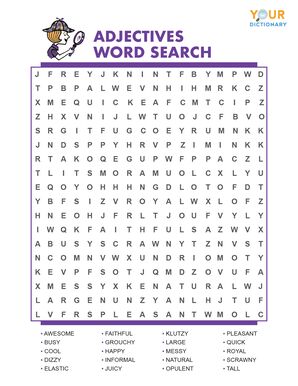
7. Word Search
Word searches are a great example of adjective games for adults; it’s not only children who can pass the time with this activity.
An adjective word search empowers students to learn new adjectives and reinforce old ones. An online word search is a fun activity for students to work on in their own time, but a word search can also be done in class; groups of students can help each other to complete it.
Print out our Adjective Word Search below for some classroom fun today!
Advertisement
Tips on Selecting Adjective Games
When choosing adjective games to play in the classroom, make sure they are centered around correct grammar usage, building vocabulary, and boosting creative skills. Students do not need to know the technical aspects that they are learning through games: in fact, the best games are the most fun and stimulating ones.
Adjective Experts
If nouns are one of the most important parts of speech in the English language, then adjectives are pretty spectacular, too. After you play these games and review these modifiers with your students, use this adjective quiz to test their knowledge. And, as a curveball on a Friday afternoon, you can also review these Latin Adjectives in Current Use to broaden your students’ vocabulary even further.