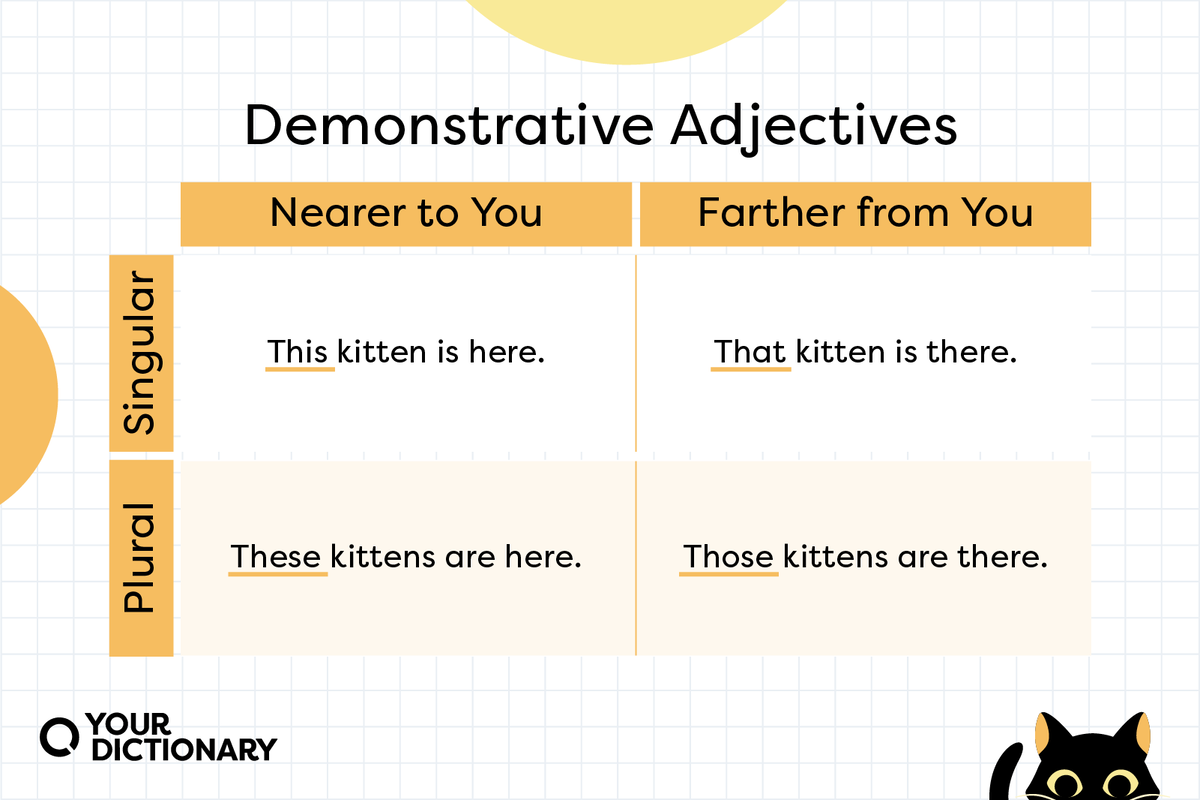
Demonstrative adjectives (this, that, these, and those) show exactly which noun you’re talking about in a sentence. They “demonstrate” a noun’s physical location or placement in time while emphasizing its importance.
Demonstrative Adjective Examples
Demonstrative adjectives come right before the nouns they modify.
Choose the correct demonstrative adjective by identifying the location of the noun (near or far from you) and how many there are (singular or plural).
|
Demonstrative Adjective |
When To Use It |
Example Sentence |
|
this |
with a singular noun that is nearby or current |
This puppy keeps licking me. |
|
that |
with a singular noun that is farther away |
That house across the street is lovely. |
|
these |
with a plural noun that is nearby or current |
These shoes fit me very well. |
|
those |
with a plural noun that’s farther away |
Those boots are too expensive. |
Fast Fact
Yon and yonder are less common demonstrative adjectives, mostly seen in older literature like the famous line from Shakespeare’s Romeo and Juliet. (“What light through yonder window breaks?”)
They both refer to a thing or things at a distance (like that or those) and can be used as either plural or singular adjectives.
How To Use Demonstrative Adjectives
While it may seem tricky to know which demonstrative adjective to use, it's more intuitive than it seems.
It all depends on how close the noun is to you, both in physical space and in time.
Demonstrative Adjectives Show Physical Location
Demonstrative adjectives often show a noun’s physical location. This and these are closer to the speaker, while that and those are farther away.
- Did you want this piece of cake?
- No, I want that one.
- Do these dogs live here?
- Yes, those dogs live here.
- This book is my favorite.
- I've never read that book.
- How much are these earrings?
- Those earrings cost $30.
Demonstrative Adjectives Show Placement in Time
You can also use demonstrative adjectives to describe when something is happening.
This and these describe a very close time, while that and those describe a time that’s further away.
- Can you meet up this Friday?
- I remember that day, even though it was years ago.
- These weeks of vacation have been so relaxing.
- Those high school years were the best time of my life.
Demonstrative Adjectives vs. Demonstrative Pronouns
This, that, these, and those are also demonstrative pronouns. Like all pronouns, demonstrative pronouns replace other nouns in a sentence.
When this, that, these, or those come before a noun, they’re demonstrative adjectives. When they replace the noun, they’re demonstrative pronouns.
|
Demonstrative Adjective |
Demonstrative Pronoun |
|
Hand me that pencil, please. |
Hand me that, please. |
|
Do you want to see this movie? |
Do you want to see this? |
|
Look at those geese! |
Look at those! |
|
These chips are too spicy for me. |
These are too spicy for me. |
Need to Know
When you use demonstrative pronouns, the noun you're replacing is either obvious or it's been stated before.
If the noun is still present, you're using a demonstrative adjective.
Can Numbers Be Demonstrative Adjectives?
Ordinal numbers (such as third, fourth, or fifth) can act as demonstrative adjectives.
They indicate which noun you are talking about, just like other demonstrative adjectives.
- My first paycheck was for $500.
- The seventh day of the week is Sunday.
- The Civil War in the United States took place in the nineteenth century
- After my third piece of pizza, I was stuffed.
- For her fiftieth birthday party, we bought my mom a huge cake.
Cardinal numbers (regular numbers used for counting) are not considered demonstrative adjectives. When they indicate how many of an item there is ("two kittens" or "sixteen candles"), they are descriptive adjectives.
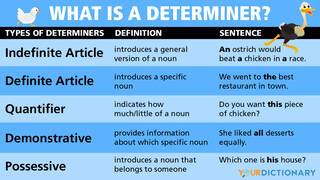
What Is a Determiner?