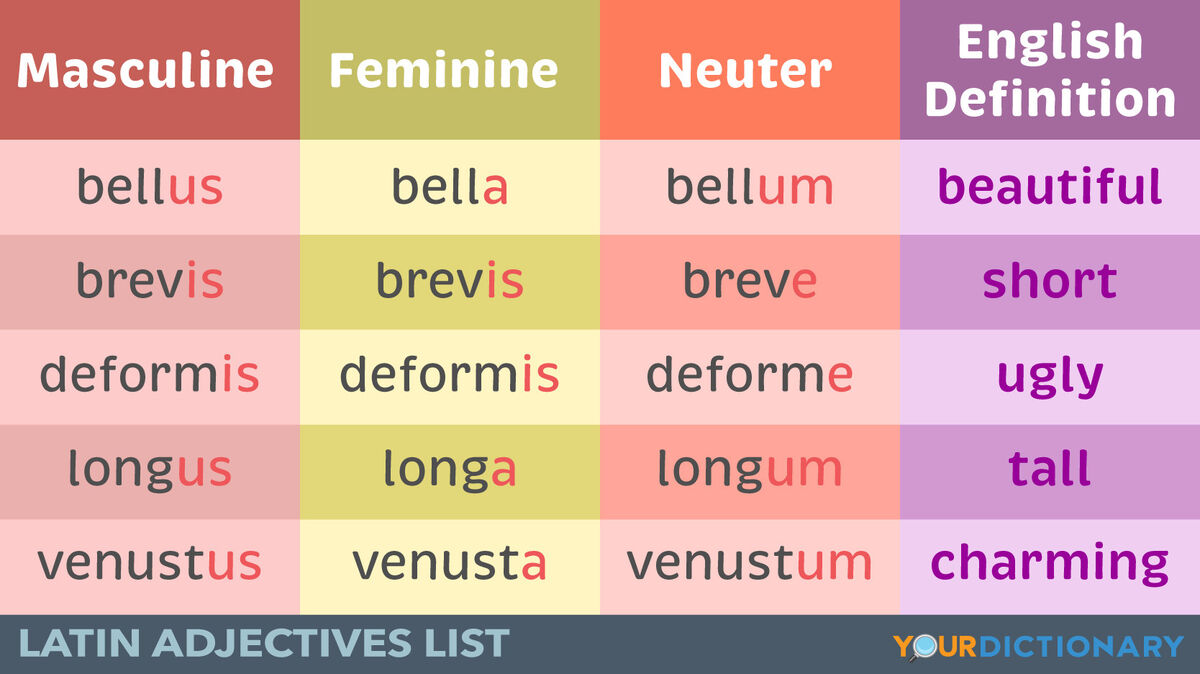
Even if you're just getting started in Latin, it's nice to have some adjectives under your belt. That way, you can describe the nouns you're learning to use in your sentences! Check out these Latin adjective lists that include adjectives for colors, sizes, quantities, and appearances. You'll also find Latin adjectives we still use in English today.
Latin Adjectives for Color
You may be surprised to find that many Latin color words are still in the English language in some form or another. Read through these Latin adjectives in the nominative case for color to see how many you already know.
Latin Word (Masculine, Feminine, Neuter) | English Definition |
albus, alba, album | white (not glossy) |
āter, ātra, ātrum | black (not glossy) |
aurantius, aurantia, aurantium | orange |
aureus, aura, aurum | gold |
caeruleus, caerulea, caeruleum | blue |
candidus, candida, candidum | glossy white |
fuscus, fusca, fuscum | brown |
lūteus, lūtea, lūteum | yellow |
niger, nigra, nigrum | black |
purpureus, purpurea, purpureum | purple |
ravus, rava, ravum | gray |
roseus, rosea, roseum | pink |
ruber, rubra, rubrum | red |
viridis, viridis, viride | green |
Latin Adjectives for Size
There are many ways to describe the size of a noun in Latin. Some of these words appear in everyday English as well — for example, the English word "massive" comes from the Latin massa, which means "having a large mass."
Latin Word (Masculine, Feminine, Neuter) | English Definition |
minisculus, miniscula, minisculum | extremely small |
exiguus, exigua, exigum | very small |
minimus, minima, minimum | tiny |
parvus, parva, parvum | small |
vegrandis, vegrandis, vegrande | not very big |
praegrandis, praegrandis, praegrande | very big |
magnus, magna, magnum | large or great |
enormis, enormis, enorme | enormous |
immanis, immanis, immane | huge |
immensus, immensua, immensum | immense |
vastus, vasta, vastum | vast |
Latin Adjectives for Emotion
The Latin term for "emotion" is animi motus, which literally means "movement of the mind." Use these Latin emotion adjectives to describe how someone feels. You may even recognize some familiar roots!
Latin Word (Masculine, Feminine, Neuter) | English Definition |
amorabundus, amorabunda, amorabundum | loving |
excitus, excita, excitum | excited |
confūsus, confūsa, confūsum | confused |
detestabilis, detestabilis, detestabile | hateful |
felix (all three genders) | happy |
invidus, invida, invidum | jealous (envious) |
iratus, irata, iratum | angry (irate) |
laetus, laeta, laetum | joyful |
miser, misera, miserum | miserable |
solus, sola, solum | lonely |
somnolentus, somnolenta, somnolentum | sleepy |
territus, territa, territum | scared (terrified) |
tristis, tristis, triste | sad |
Latin Adjectives for Quantity and Amount
When you want to discuss how much or how little of something there is, you need a Latin adjectives list for quantity and amount. Take a look at these adjectives in all three grammatical genders to find the word you're looking for.
Latin Word (Masculine, Feminine, Neuter) | English Definition |
nullus, nulla, nullum | none |
unus, una, unum | one (single) |
perpauci, perpaucae, perpauca | very few |
pauci, paucae, pauca | few |
nonnullus, nonnulla, nonnullum | some |
plures, plures, plura | several |
multis, multis, multe | many (multi) |
plerus, plera, plerum | most (plurality) |
omnis, omnis, omne | every |
innumerabilis, innumerabilis, innumerabile | countless (innumerable) |
Latin Adjectives for Appearance Adjectives in Latin
Some of the most beautiful Latin words describe the most beautiful objects and people in classical history. Check out a Latin adjectives list for appearances to include in your next personal description.
Latin Word (Masculine, Feminine, Neuter) | English Definition |
bellus, bella, bellum | beautiful |
brevis, brevis, breve | short |
cānus, cāna, cānum | gray-haired |
casualis, casualis, casuale | casual |
decens, decens, decens | proper (decent) |
decorus, decora, decorum | well-mannered |
deformis, deformis, deforme | ugly |
elegans, elegans, elegans | elegant |
flāvus, flāva, flāvum | yellow-haired or blonde |
formalis, formalis, formale | formal |
iuvenis, iuvenis, iuvene | young (juvenile) |
longus, longus, longe | tall |
rūfus, rūfa, rūfum | red-haired |
venustus, venusta, venustum | lovely, charming |
veteris, veteris, vetere | old |
Well-Known Latin Adjectives in Current Use
Some Latin adjectives in current use are so common, we forget they’re actually Latin words at all. You'll find many of these words used every day in the legal profession.
- ad hoc - for this (We set up an ad hoc committee to plan the party.)
- alter - the other, one of two (John really has an alter ego.)
- bona fide - real or genuine; “good faith” in Latin (This is a bona fide job offer.)
- bonus - additional; "good" in Latin (The basketball player earned a bonus shot.)
- emeritus - having retired or been discharged from a position but still retaining the title; “having fully earned” in Latin (My father is a professor emeritus at Boston University.)
- extra - outside, in addition to (Can I have extra guacamole?)
- gratis - free; "kindness" in Latin (She's fixing my stairs totally gratis.)
- in promptu (impromptu) - spontaneous; "readiness” in Latin (We took an impromptu trip to Denver last week.)
- sinister - adverse, wrong, malicious; "left" in Latin (He had a sinister gleam in his eye.)
- verbatim - literal; "word in Latin (I repeated the instructions verbatim.)
There are lots of Latin words found in the English language today. Many English words incorporate Latin roots to create meanings based on original Latin words.
Basic Rules for Latin Adjectives
In English, verbs are conjugated to match the noun in subject-verb agreement, but adjectives don't change. However, in Latin and Latin-based languages (such as Spanish or Italian), adjectives must agree with the nouns they describe.
Noun-adjective agreement includes agreement between:
- number of nouns (singular or plural)
- case (nominative for subjects, genitive for possessive nouns, dative for indirect objects, accusative for direct objects, ablative for prepositional objects, or vocative for questioning)
- grammatical gender (masculine, feminine or neuter)
It's not as complex as it seems. Once you know the part of speech you're describing with your Latin adjective, you can conjugate it correctly. You can also determine the Latin adjective's declension by determining what type of noun it is modifying.
Expand Your Vocabulary
Latin may seem like a dead language. However, many of the romance languages are based on Latin, and the English language also borrows from the Latin language quite a bit. Take a thorough view of Latin vocabulary words that you can integrate into your writing. Or, if you’re ready to expand beyond Latin adjectives, take a look at common Latin words and phrases we use in English.