The English language would be very dull without adjectives. They dress up nouns whenever there is a need to punch things up a notch. With an adjective, that heartache someone is feeling is no longer just a heartache, it's a crippling heartache or debilitating heartache that is tearing them apart, or maybe just a small heartache that they'll get over quickly. Whenever you're speaking or writing, use words to describe feelings, emotions or tone to get your point across with a little extra oomph. When it's time to do so, call in the big dogs: the adjectives.
Adjectives Accentuate the Point
Adjectives help express the tone, feelings and emotions of words by accentuating the point. Considering the example of heartache above, it's not hard to see that it would be difficult to quickly ascertain how severe (or minor) a person's heartache is without the use of adjectives. Of course, context clues would eventually reveal more, but adjectives allow situations to be described succinctly.
Adjectives for Feelings
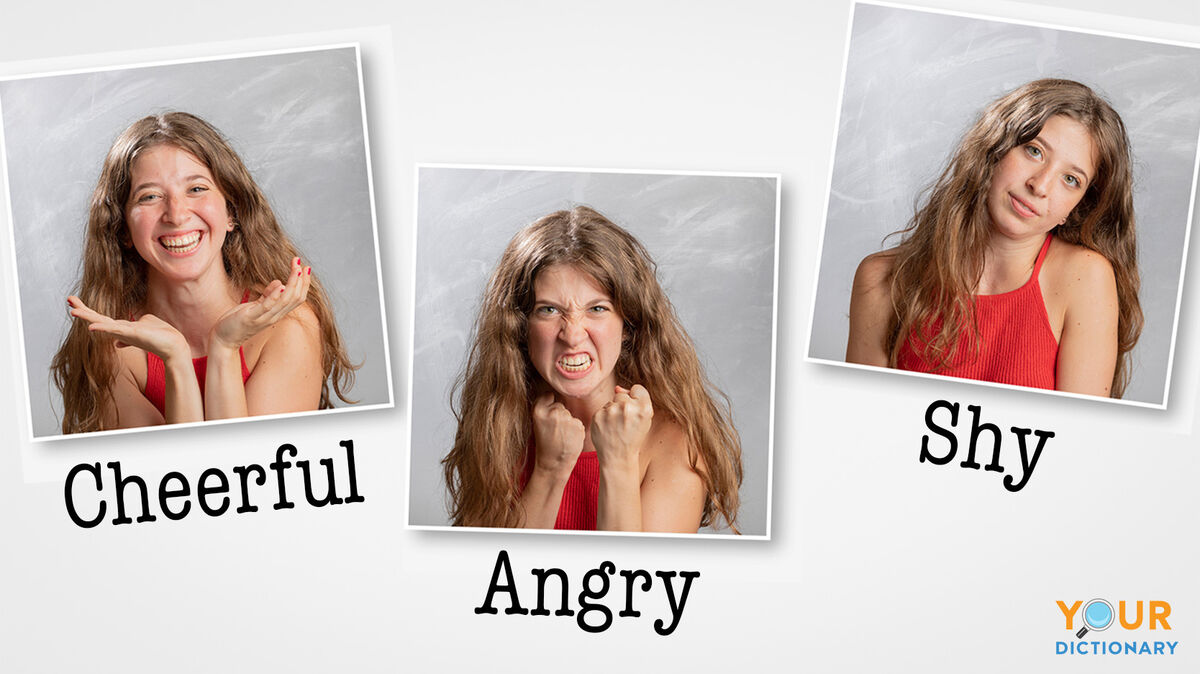
A person's feelings can sometimes be observed or experienced visibility. For example, the way a person smiles can reveal something about how they are feeling, such as that they're sad, mad, happy, or ecstatic. Feelings tend to house emotions, often amplifying a particular situation.
- adjective for negative feelings - The uncomfortable girl flushed with embarrassment.
- adjective for positive feelings - The delighted girl flushed with anticipation.
List of Descriptive Feeling Words
Some feelings are clearly positive or negative, while others depend on the rest of the sentence to make the meaning clear. Sharing a list of feeling words with kids can help youngsters learn how to express how their feelings. Grownups sometimes also need help.
| Positive Feeling Words | Negative Feeling Words | Context-Specific Words |
| amazed | aggravated | anxious |
| attractive | awful | awestruck |
| bold | chilly | bashful |
| brave | dejected | cautious |
| bubbly | dirty | composed |
| cheerful | dreadful | easygoing |
| comfortable | heavy | horrified |
| delightful | irritated | intelligent |
| excited | pessimistic | numb |
| festive | tearful | puzzled |
| free | tense | quizzical |
| jolly | terrible | ravenous |
| optimistic | tired | reluctant |
| proud | ugly | settled |
| wonderful | weak | shy |
Advertisement
Adjectives for Emotions
Emotions and feelings are very similar. In fact, the definition of feeling is to have an emotion. The only difference is that emotions tend to refer to that which isn't tangible or easily seen, while feelings are sometimes observable.
- adjective for negative emotions - The miserable boy walked home in the rain.
- adjective for positive emotions - The jubilant boy walked home in the rain.
List of Descriptive Emotion Words
It may be possible to guess that someone is either sad or happy, but emotions aren't always expressed. Rather, they are sensed. Check out these examples for positive and negative emotions, as well as ones that depend on context.
| Positive Emotion Words | Negative Emotion Words | Context-Specific Words |
| appreciative | angry | accepting |
| blissful | disenchanted | calm |
| contented | distressed | confident |
| ecstatic | glum | cool |
| elated | gloomy | earnest |
| glad | grumpy | easy |
| happy | grouchy | evenhanded |
| joyful | miserable | indifferent |
| jubilant | mad | neutral |
| merry | moody | nostalgic |
| respectful | nervous | passive |
| sweet | sad | reserved |
| serene | sadistic | satisfied |
| upbeat | selfish | sentimental |
| vivacious | sour | surprised |
Advertisement
List of Adjectives for Tone
A person's tone is often an indicator of their feelings or emotions, but it wouldn't be described with emotion or feeling words. Instead, words that describe tone focus on how the person's disposition or mood is conveyed. For example, describing tone can help clarify whether a statement or story is positive is negative.
- adjective for a negative tone - Carla sarcastically stated that she is happy for Sarah.
- adjective for a positive tone - Carla excitedly exclaimed that she is happy for Sarah.
List of Descriptive Tone Words
Discover some examples of words that convey positive and negative tones, along with some tone terms that could be positive or negative, depending on the context in which they are used.
| Positive Tone Words | Negative Tone Words | Context-Specific Words |
| agreeable | annoyed | acerbic |
| animated | bitter | ambivalent |
| bright | disgruntled | ardent |
| clever | disgusted | candid |
| encouraging | evil | cautionary |
| fresh | guilty | conciliatory |
| gentle | hostile | knowledgeable |
| hopeful | hurtful | mysterious |
| kind | nasty | pragmatic |
| loving | obnoxious | regretful |
| open | oppressive | resigned |
| pleased | overbearing | satirical |
| supportive | resentful | secretive |
| sympathetic | sarcastic | solemn |
| warm | sardonic | strong |
Advertisement
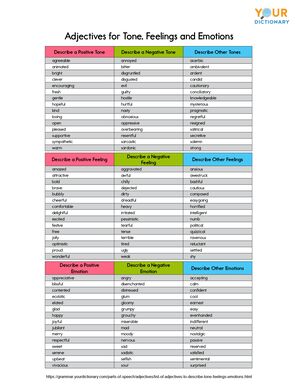
Printable Word List for Emotions, Feelings and Tone
You don't have to commit all of these words to memory in order to use them in appropriate situations. This printable is a full list of words to describe emotions and feelings, as well tone. This is only a selection of the thousands of adjectives in the English language, but it should be enough to help you verbally convey a certain tone, feeling or emotion!
Tips for Using Adjectives
It can be difficult to find just the right words to describe feelings, emotions or tone. You never want to come across sounding trite or use an adjective that's too weak to express the gravity of a particular situation. However, it's important to use adjectives in moderation. Don't douse every noun in sugar. Instead, sprinkle a little sweetness on the situations or words that will truly benefit from a tasty addition.
- use for clarity - Adjectives should help clarify your meaning, not muddy the waters. Take a quick scan through your work. Do your adjectives illustrate the point or situation? Are they at all unnecessary? For example, do you really need to say "the hot, sweaty baseball player" or would "the sweaty baseball player" be sufficient?
- avoid overindulgence - Don't use a slew of different adjectives, such as in the following statement: "The timid, nervous teacher slowly approached the noisy classroom with fearful trepidation." If you start using too many adjectives, your writing will be flowery and hard to read. Not only are you going to confuse your readers, but your writing will appear choppy or even phony.
- take your time - Don't be afraid to take some time to figure out how to best describe a situation. For example, you might have to analyze the tone of a short composition for a school assignment. Sit back for a while and let the words really sink in before you choose words to describe the tone.
Using adjectives properly is a bit like building your vocabulary. The more you read, the more you'll discover new words and meanings, including adjectives, and how they are used to highlight emotions.
Advertisement
Descriptive Adjectives for Descriptive Writing
Hopefully, these tips will help you not only use words to describe feelings in your own conversations or writing but also teach them to your children or students. Using adjectives appropriately can enhance conversations and writing. While adjectives are on your mind, take the time to discover the many different types of adjectives. Then get to know other types of descriptive words, such as adverbs and gerunds.