Predicate adjective is a complicated term that simply means “adjective in the second part of the sentence.”
Predicate adjectives provide more information about the subject of a sentence — and depending which one you use, you can change the meaning of your sentence quite a bit.
What Is a Predicate Adjective?
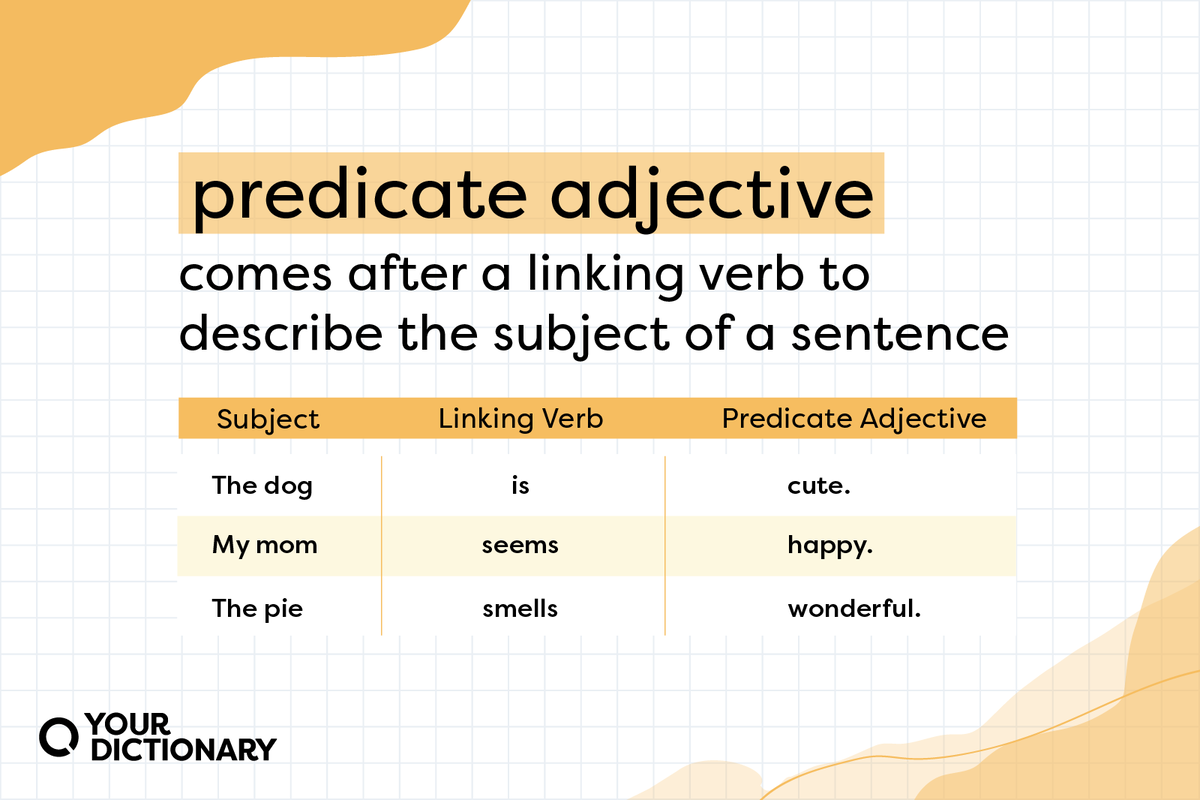
A predicate adjective comes after a linking verb to describe the subject of a sentence. They’re just like other adjectives, but instead of appearing before the noun, they’re found in the predicate of the sentence (after the subject).
- The dog is cute.
(Predicate adjective cute modifies the subject dog) - My mom seems happy.
(Predicate adjective happy modifies the subject my mom) - That pie smells wonderful.
(Predicate adjective wonderful modifies the subject that pie)

What Are the Different Parts of a Sentence?
Using Linking Verbs with Predicate Adjectives
In order to use a predicate adjective, you need to connect it to the subject with a linking verb. Linking verbs include all versions of the verb to be (am, are, is, being, were, was) as well as:
- make
- become
- seem
- grow
- prove
- look
- feel
- smell
- taste
- sound
- appear
- stay
- keep
- remain
When you see one of these verbs in a sentence, it'll help you spot the predicate adjective. Just remember, these verbs are only linking verbs when they're followed by adjectives, nouns, or pronouns that rename the subject.
Examples of Predicate Adjectives
Once you understand more about predicate adjectives, you'll find that they're easy to spot in a sentence. Take a look at several example sentences that use the linking verbs above.
- Elizabeth is hungry.
- Grapes become shriveled in the sun.
- You seem tired today.
- The boy grows older each day.
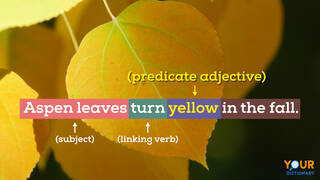
- The mood ring turns purple in the sun.
- The homework proves difficult for her.
- The painting looks beautiful.
- My blanket feels soft.
- The pizza smells delicious.
- It tastes better.
- The music sounds quiet.
- The weather appears nice.
- The mood stayed relaxed and happy all night.
- The family kept calm.
- The judge remains steadfast in his decision.
You can also use adjective phrases as predicate adjectives if you include linking verbs.
For example, in the sentence "Elizabeth is extremely hungry," extremely hungry is a verb phrase linked to the subject (Elizabeth) with the helping verb is.
Examples of Predicate Adjectives
Participles as Predicate Adjectives
Participles (also known as participial adjectives) are verbs that function as adjectives by describing more about a noun. You can use both past participles and present participles as predicate adjectives.
- My cousin is annoying.
- That cake looks tempting.
- Skyler felt disappointed.
- The restaurant was closed.
- Our cat is missing.
Helpful Hack
It's also effective to use participial phrases as predicate adjectives. In the sentence "Skyler felt disappointed about losing the race," the participial phrase is disappointed about losing the race. It describes even more about what the subject (Skyler) is doing.
Predicate Adjectives vs. Predicate Nominatives
Predicate adjectives are a type of subject complement, which gives more details about the subject. The other type of subject complement is a predicate nominative — a noun that renames the subject.
|
Predicate Adjective |
Predicate Nominative |
|
My sister is creative. |
My sister is a florist. |
|
Mr. Patel was rich. |
Mr. Patel was a millionaire. |
|
This investment could be risky. |
This investment could be a risk. |
Notice that the subject complements here are nouns, not adjectives. While they tell us more about the subject, they are effectively renaming those nouns, not describing them.
Predicate Adjectives vs. Attributive Adjectives
Now you know that predicate adjectives come after the noun they're modifying. But what about those adjectives you've seen before the noun? Those would be attributive adjectives.
|
Predicate Adjective |
Attributive Adjective |
|
My car is black. |
My black car is parked around the corner. |
|
This soup tastes delicious. |
This delicious soup would be perfect for lunch. |
|
Your brother has been so helpful today. |
Your helpful brother filed all my paperwork for me. |
Using predicate adjectives helps you describe more about the subject, but using attributive adjectives allows you to convey more information in a sentence.
How To Order Adjectives in a Sentence