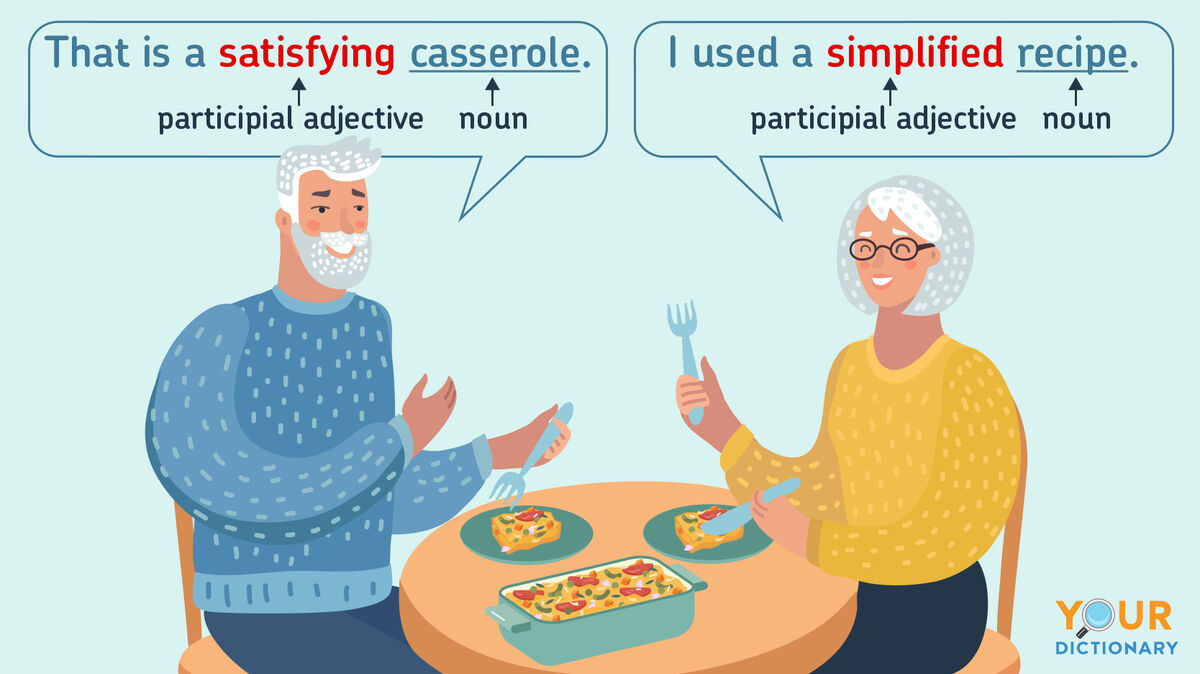
Like all adjectives, participle adjectives are descriptive terms that describe nouns or pronouns. They can be hard to distinguish because they often look like participle verbs or participle nouns. Sometimes, they look like comparative adjectives, but they do not always serve this function grammatically. Discover how to identify and correctly use this special type of adjective.
Identifying a Participial Adjective
The participial adjectives are a major subclass of adjectives. They can be distinguished by their endings, usually either -ed or -ing, which is the case for most participles no matter what part of speech they represent.
Participle adjectives get their name because:
- they have a participle ending (-ed, -ing)
- they function as adjectives by describing nouns or pronouns
While participial adjectives usually have the same endings as other participles, there are, of course, some exceptions to this general rule. For example, the words "misunderstood" and "unknown" both function as participial adjectives, yet do not end with -ed or -ing. These terms are special cases.
Examples: How Participial Adjectives Function in Sentences
Participial adjectives are really meant to function like any other adjective. In other words, their purpose is to simply help describe a noun or pronoun. They might come from a verb form, or they might merely imitate the structure of a verb, but they always function as a descriptive adjective. In the examples below, the participial adjectives are bold and the nouns they describe are underlined.
- The tempting cookie platter made my mouth water.
- The fascinating book was a thrilling read.
- The interesting story made a compelling point.
- My frustrating experience at the restaurant made me angry.
- This is a satisfying casserole.
- That chirping cricket is very loud.
- This annoying movie is making me want to scream.
- My hardworking, tired mother deserves a break.
- Sally was bored by the conversation.
- The agitated customer is raising his voice.
- I'm considering going back to school, even at my advanced age.
- The amused teacher listened to the child explain that the dog ate his homework.
- The excited dog barked and jumped.
- The spiced cookie was delicious.
- I used a simplified recipe.
- The emptied cabinet is waiting to be filled.
- Baked chicken has fewer calories than fried chicken.
Participial adjectives form a very large portion of all of the adjectives in the English language. They allow people to be more precise when describing people, places, things, and experiences when speaking or writing.
Present vs. Past Participle Endings
What is the difference between the present and past participle in the context of adjectives? It's the same as with verbs. Generally, the past participle (ending in -ed) is used to describe how someone feels. The present participle (ending in -ing) is used to describe what made them feel that way. Of course, not all participles refer to how people feel, so this, like other explanations of English grammar, doesn't hold true in every situation.
Words to Modify Participial Adjectives
Participial adjectives do not just come in one form. You can modify participial adjectives to increase or decrease their intensity and use them to compare different nouns. This can be accomplished by using intensifiers like very, extremely, more, and less. It can also be accomplished by forming comparative and superlative forms. In the examples below, the modified participial adjective phrase is bold and the noun the phrase describes is underlined.
- very annoying - Our very annoying waiter will be lucky if we leave a tip.
- extremely annoying - He has an extremely annoying habit of smacking gum.
- less annoying - This somewhat less annoying story is still difficult to read.
- more annoying - It was more annoying to me that he did not cancel in advance.
- most annoying - The most annoying thing was that she did not speak up for me.
In all of the forms above, the word "annoying" serves as the participial adjective. It is treated differently in each case.
Not All Participial Adjectives Come From Verbs
You might be wondering why there so many descriptive words that come from verbs? Actually, some participial adjectives are derived from verbs, while others simply look like verb forms because of their -ed or -ing endings.
- The verb “to excite” becomes excited and the verb “to determine” becomes determined.
- That's not the case with talented. There is no “to talent” verb that forms the participial adjective talented.
This happens most often with participial adjectives that end in -ed. Most participial adjectives that end in -ing do have a corresponding verb form (think of words like annoying, exasperating, worrying, thrilling, misleading, gratifying, and many others.)
Combining Nouns With Participles
Some participial adjectives are created by putting a noun together with a participle to form a compound word that functions as a participial adjective.
- drug-induced coma - The word "drug” is a noun. In this example, it is combined with the verb participle “induced” to create a participial adjective that describes a type of coma.
- energy-saving technology - The term "energy” is a noun. Here, it is combined with the verb participle “saving” to create a participial adjective that describes a type of technology.
Discover More Types of Adjectives
Adjectives are a lot more complex than one might think. Yes, adjectives describe nouns or pronouns. But they do it in several different ways. Now that you're familiar with participial adjectives, dig even deeper into descriptive words by exploring the many different types of adjectives. It's amazing how many ways there are to describe a person, place, thing, concept, or idea. Of course, the next step will be to explore the different forms of nouns. Chances are, there are more than you think!