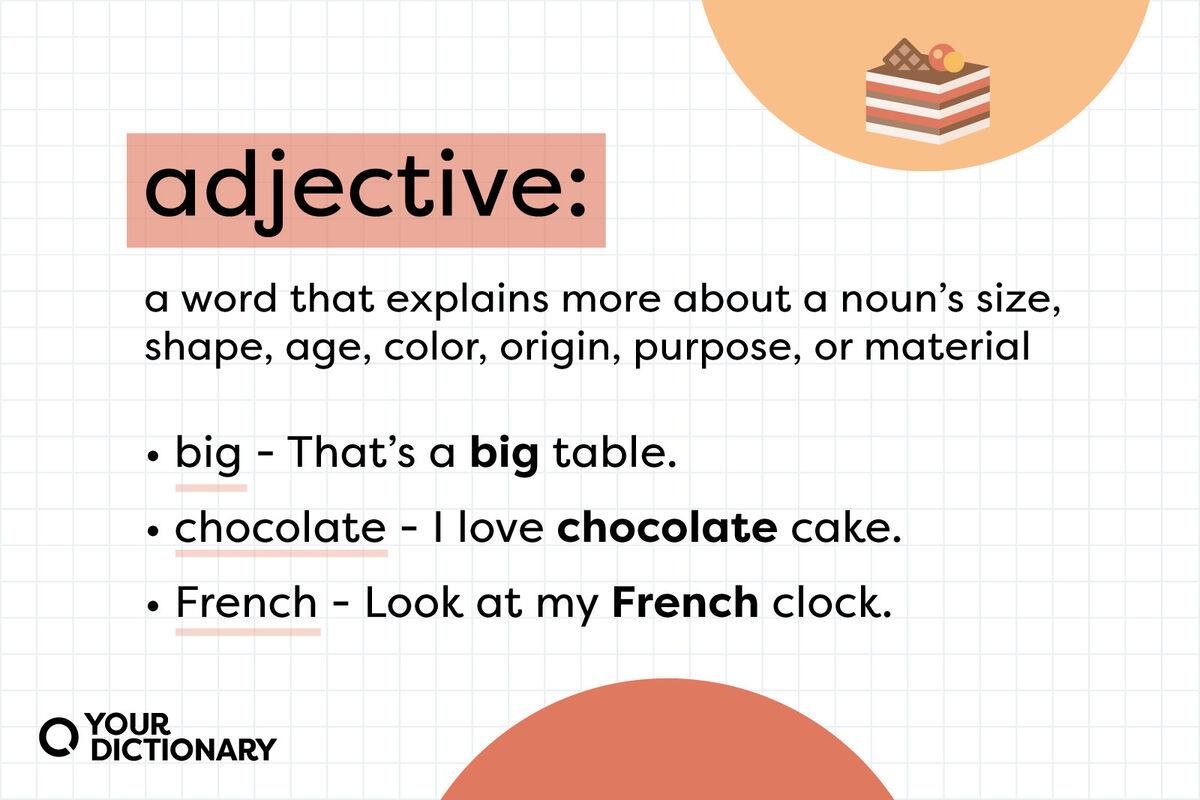
An adjective describes or modifies a noun, which is a person, place, thing, or idea. Without adjectives, there’s not much difference between a serene vacation and a disastrous vacation. But using adjectives is a little more complicated than adding pretty words into your sentence.
What Is an Adjective?
As one of the eight parts of speech, adjectives provide further information about a noun. Specifically, they explain more about a noun’s size, shape, age, color, origin, or material.
Examples of adjectives modifying the same noun (table) include:
- It's a lovely table. (expresses opinion)
- It's a big table. (shows size)
- It's a round table. (shows shape)
- It's an old table. (shows age)
- It's a brown table. (shows color)
- It's an English table. (shows origin)
- It's a wooden table. (shows material)
- It's a broken table. (make an observation)
- It's a coffee table. (expresses purpose)
The Correct Order for Using Multiple Adjectives
And you’re not limited to just one adjective per noun. When using cumulative adjectives that describe different parts of a noun, you can use any combination of adjectives (just make sure you’re putting them in the correct order).
- It’s an old coffee table.
- It’s a brown English table.
- It’s a lovely wooden coffee table.
- It’s a big round English coffee table.
What Do Adjectives Do?
It’s easy to say that adjectives’ main job is to make your writing more engaging, because it’s true. But they’re not just sentence decoration — each type of adjective is an important part of speech.
Adjectives Modify Nouns and Pronouns
Adjectives modify, or further describe, nouns. For example:
- Marcy chose the chocolate cake. (The adjective chocolate modifies the noun cake)
- The antique clock ticks all night. (The adjective antique modifies the noun clock)
But adjectives can also modify pronouns.
- He is so funny. (The adjective funny modifies the pronoun he)
- It smells really bad. (The adjective bad modifies the pronoun it)
Adjectives Act as Complements
When an adjective comes after a noun and a linking verb, such as is, becomes, or seems, it’s a complement. Not every complement is an adjective, but some adjectives can be complements.
Subject complements modify the subject of a sentence.
- Mike seems hungry. (The adjective hungry modifies the subject Mike)
- My neighbor is kind. (The adjective kind modifies the subject my neighbor)
Object complements modify the object of a sentence.
- You make me happy. (The adjective happy modifies the object me)
- Ken found the meal delicious. (The adjective delicious modifies the object the meal)
Adjectives Answer Questions
Adjectives answer questions such as "Which one?" "How many?" and "What kind?" to help describe a noun. For example:
- Which cat did you see? It was the gray cat.
- What kind of potatoes did you buy? I bought red potatoes.
- How many cars were in the parking lot? There were few cars.
- How many people like ice cream? Most people like ice cream.
- Which spoon did you use to stir the soup? I used the wooden spoon.
- What kind of coffee do you like? I like black coffee.
Adjectives Compare Nouns
Sometimes, adjectives can both describe and compare two different nouns. Comparative adjectives (adjective + -er, or sometimes the word more) compare the qualities of two nouns.
- Granite is harder than marble.
- The action movie looks more interesting than the romance.
When there’s no comparison because a noun is the highest degree of an adjective, use a superlative adjective (adjective + -est, or sometimes the word most).
- Diamond is the hardest material on Earth.
- That’s the most interesting movie I’ve ever seen.
How To Identify Adjectives in a Sentence
You know what adjectives do — but how can you spot one? There are a few tricks to finding adjectives in a sentence.
Look for Common Adjective Suffixes
Many English adjectives are actually different parts of speech with certain suffixes added to them (such as adore into adorable).
These suffixes usually mean “having the quality of,” and they include:
- -ible - invisible, responsible
- -al - educational, gradual, illegal, nocturnal, viral
- -an - American, Mexican, urban
- -ar - cellular, popular, spectacular, vulgar
- -ent - intelligent, potent, silent, violent
- -ful - harmful, powerful, tasteful, thoughtful
- -ic - athletic, energetic, scientific
- -ine - bovine, canine, equine, feminine, masculine
- -ile - agile, docile, fertile, virile
- -ive - informative, native, talkative
- -less - careless, endless, homeless, timeless
- -ous - cautious, dangerous, enormous, malodorous
- -some - awesome, handsome, lonesome, wholesome
Look at Adjective Placement in a Sentence
Although adjectives typically come before a noun, there are lots of places to find them.
Adjectives can be:
- before a noun (blue plate)
- between an article and a noun (the blue plate)
- between a possessive adjective and a noun (Carol’s blue plate)
- between a demonstrative adjective and a noun (that blue plate)
- between another determiner and a noun (several blue plates)
- after a noun and a linking verb (the plate is blue)
More Adjective Examples and Ways To Practice Using Them
There's a lot to learn about adjectives. Explore all the different types of adjectives, then use activities and worksheets to put all that knowledge to use.
- Learn how to use an adjective clause and an adjective phrase.
- Try some adjective games to help you learn this part of speech in fun ways.
- Check out some adjective lesson plans or a cool adjective quiz to help students learn how to use adjectives.