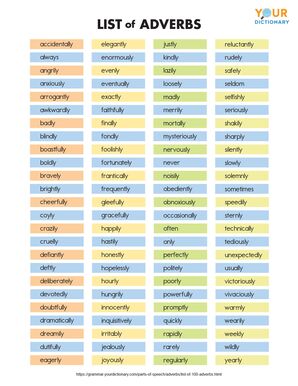

Adverbs are an essential part of a writer's toolbox. Although they shouldn't be overused, strong adverbs used in writing can often convey specific details that other parts of speech cannot. The proper use of adverbs can help your speech or writing stand out. In fact, making good use of adverbs will strengthen your writing and help ensure readers see value in your work.
What Is an Adverb?
An adverb is a word used to modify verbs, adjectives and other adverbs. Adverbs are like the seasoning in sentences. They help describe how things appear and how things happen. They help a reader visualize an action with an appropriate level of intensity.
Adverbs help control what others see when you speak or write. They are one of the necessary components of good writing. When used correctly, they can add a whole new dimension to your work. Check out how using a strong vs. weak adverb can improve your writing.
What Makes a Strong Adverb?
Written words should paint a picture in the reader's mind, and adverbs help make that happen. Adverbs add oomph to punches and power to kicks. Having a list of adverbs to call on can help add a degree of energy or spice to your verbiage.
However, not all adverbs are strong. Some adverbs like "really" or "very" aren't adding to your imagery and could be removed or substituted. You can see this in action by comparing "really" vs. "unbelievably" in a sentence.
- She moved really slowly.
- She moved unbelievably slowly.
While "really" isn't telling the reader much about how slow "she" is, using "unbelievably" gives you a vivid understanding. Her movement was so slow as to be unbelievable, which is very different from just being a bit slower than expected. As you can see, choosing adverbs is important.
Advertisement
Strong Adverbs Modifying Verbs
Now, it's time to look at a list of adverbs for writing to make it stronger. It's easy to say that "The quick brown fox jumped over a lazy brown dog," but how did he do it? That's the thing everyone is dying to know. A strong verb can often stand on its own, but adverbs can strengthen and color verbs to add vividness and clarity to any sentence. When adverbs modify verbs, they describe the way something is happening. In the examples below, the adverb is in bold and the verb is underlined.
| Adverb | Meaning | Example Sentence |
| swiftly | done in a fast way | The older orangutan swiftly kicked the annoying youngster. |
| grudgingly | done in a reluctant or unwilling way | John grudgingly shared his snickerdoodles. |
| staunchly | done in a strong, firm or loyal way | Jackson was staunchly opposed to the proposition. |
| thoroughly | done in a complete way | Mary was thoroughly annoyed by her poodle's constant yapping. |
| impatiently | done in a way that shows irritation or annoyance | I impatiently tapped my foot as I waited for my toddler to finish getting dressed. |
| briskly | done in a quick, active, or energetic way | Mr. Miller briskly explained how to fill out the exam answer sheet. |
| ambitiously | done with the intention of meeting high aspirations | Donna ambitiously volunteered to organize the food bank's annual fundraiser. |
| creatively | done in an original or imaginative way | Jacob creatively added curly purple hair, green glasses and red eyes to his puppet. |
Advertisement
Powerful Adverbs Modifying Adjectives
How tired were you? How ugly was it? Readers and audiences beg for the answers to such questions. Adverbs give them those answers, adding more information to an adjective, while lending intensity to writing and speech. In the following examples, the adverb is in bold and the adjective is underlined.
| Adverb | Meaning | Example Sentence |
| diametrically | being at opposite extremes | His views are diametrically opposed to mine. |
| unusually | out of the ordinary | Mary's dog was unusually hyperactive. |
| brutally | extremely unpleasant | The meeting was brutally dull. |
| extremely | to a great degree; very | My father works in an extremely tall building, on the 84th floor. |
| surprisingly | happens unexpectedly | The boy was surprisingly strong. |
| highly | to a high degree or level | He is a highly intelligent man with the ability to speak six languages. |
| mildly | to a slight extent | I prefer mildly spicy chili, but my friend only cooks with extra hot chili powder. |
| vividly | strong or bold appearance; bright | This vividly colored fabric is perfect for the quilt I want to make. |
Advertisement
Strong Adverbs Modifying Other Adverbs
Sometimes, even adverbs need help. When you want to bring attention to a level of rapidity or to a degree of languidness, you may need an adverb to describe another adverb. When you want to describe one adverb with another, just put them next to one another. In the examples below, the modifying adverb is in bold and the main adverb is underlined.
| Modifying Adverb | Meaning | Example Sentence |
| incredibly | unbelievably | The obtuse man spoke incredibly slowly. |
| abnormally | out of the realm of normalcy | Mary's hyperactive dog barked abnormally often. |
| unexpectedly | surprisingly | She arrived for the meeting unexpectedly early. |
| unbelievably | hard to believe | She ran unbelievably quickly, setting a new school record. |
| joyfully | with great pleasure | After three days of rain, we spent the day joyfully out at the park. |
| frequently | often | Safety is frequently atop the minds of first-time parents. |
| safely | in a safe manner | I waited until the baby was safely upstairs in her crib before cooking dinner. |
| quietly | without noise; quiet manner | She walked quietly behind her brother. |
Advertisement
Even More Impactful Adverbs
While many adverbs end in the suffix -ly, this is not always the case. Don't let yourself think that all adverbs end in -ly or that all words that end in -ly are adverbs, as that is not the case. There are several types of adverbs used in writing. Download and print this list of 100 adverbs for a list of additional powerful adverbs. It includes a wide variety of commonly used adverbs, both with and without the -ly ending.
Tips for Using Strong Adverbs
Take care to avoid overusing adverbs in your writing. When you use adverbs too much, readers may become annoyed and bored rather than enthralled or excited. Apply the tips below to make sure that you are using adverbs just enough.
- Use adverbs when they are most needed.
- If the adverb isn't helping, remove it.
- If the adverb is weak, replace it with a strong adverb.
- If the verb or adjective works great without the adverb, remove it.
- The adverbs "really" and "very" are overused a lot. Make sure they are truly necessary before adding them.
Advertisement
Powerful Adverbs: It's a Balancing Act
When it comes to adverbs, it's all about balance. Best Selling American author Stephen King is known for cautioning aspiring writers to use adverbs sparingly. He once compared using adverbs to having dandelions in your yard. One on your lawn looks pretty and unique, but the weeds can easily overtake the lawn if they're not rooted out. To reinforce what you've learned, take a look at some examples of adverbs in sentences. Now that you've got a handle on adverbs to improve your writing, shift your focus to action verbs. They just might have you shouting with joy!