
A conjunctive adverb connects two independent clauses or sentences. Typically, adverbs modify other words (verbs, adjectives and other adverbs). Conjunctive adverbs, however, are used to modify two independent clauses and join them together, behaving more like coordinating conjunctions. Keep reading to learn more about conjunctive adverbs and to see several conjunctive adverbs examples.
Conjunctive Adverbs in Action
A conjunctive adverb, which can also be called an adverbial conjunction, brings together two complete thoughts like a conjunction. They use the second clause to modify the first clause like an adverb. Conjunctive adverbs can follow a semicolon or a period and typically have a comma after them.
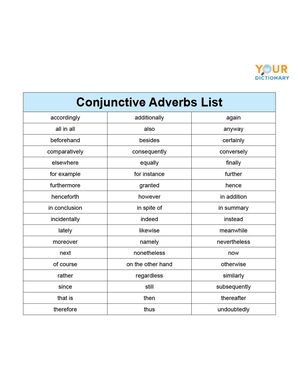
Download the printable reference list below for examples of common conjunctive adverbs.
It can help to group conjunctive adverbs according to their specific function: addition, cause and effect, clarification, comparison, concession, contrast, emphasis, sequence, summary, and time. Take a look at the examples below to see how you can use conjunctive adverbs in a sentence.
Adding Ideas
When you need to add an idea to your first clause, conjunctive adverbs are a great way to transition between them. Here are some possible conjunctive adverbs to show addition:
- additionally
- also
- besides
- furthermore
- in addition
- moreover
Check out examples of these conjunctive adverbs:
- We should talk about Taylor’s grades; additionally, we should discuss her behavior.
- Chris enjoys making snow angels; also, he loves throwing snowballs.
- That car was too slow for me; besides, it was too expensive.
- You are grounded for three weeks; furthermore, you cannot text anyone on your phone.
- Male songbirds compete for food; in addition, they compete for mates.
- I loved that writer’s latest novel; moreover, her book of poetry is beautifully written.
Advertisement
Cause and Effect
Conjunctive adverbs can show the cause and effect of an action. In these cases, the first clause is the cause, and the conjunctive adverb transitions to the effect. These conjunctive adverbs include:
- accordingly
- consequently
- hence
- then
- therefore
- thus
Here are some examples of each of these conjunctive adverbs in sentences:
- The weather forecast predicts rain; accordingly, I will bring my umbrella.
- The thunder and lightning were intense; consequently, the crowd dispersed.
- Brian didn’t study for the test; hence, he failed.
- We need to research forms of renewable energy; then, we can move on from fossil fuels.
- We had very different opinions; therefore, we went our separate ways.
- Your mother and I were married fifteen years ago; thus, our family began.
Advertisement
Clarifying a Point
A strong point often requires examples or evidence to back it up. Conjunctive adverbs are a great way to transition from your point to the evidence you need. For example (which is a conjunctive adverb!):
- for example
- for instance
- namely
- that is
You can use these conjunctive adverbs in the following sentences:
- Many species will be impacted by construction; for example, blue jays live in these trees.
- Gayle is a gifted artist; for instance, she sculpted the statue at Town Hall.
- I can think of many ways for you to help; namely, you can clean up this mess.
- This book isn’t enjoyable to read; that is, it starts too slowly.
Comparing Two Ideas
You can use conjunctive adverbs to compare two similar ideas. The first clause poses one idea, and the second idea comes after the conjunctive adverb. Comparative conjunctive adverbs include:
- likewise
- similarly
You can use these conjunctive adverbs like this:
- Oliver loves to repair cars; likewise, his brother Simon enjoys it.
- The grapes are wilting in the sun; similarly, the tomatoes are overheated.
Advertisement
Conceding a Point
When you’re making a point, conjunctive adverbs can help you concede a counterargument. Use these words before acknowledging the other side:
- granted
- of course
Here are some examples of sentences with these conjunctive adverbs of concession:
- The polls favor one candidate over another; granted, polls have been wrong before.
- I trust my son to come home by curfew; of course, he’s been late twice this week.
Contrasting Ideas
Demonstrating contrast is another helpful function of conjunctive adverbs. They form a relationship between two opposing ideas. Examples of conjunctive adverbs that show contrast include:
- however
- instead
- nevertheless
- rather
- regardless
- still
Here are examples of these conjunctive adverbs in different sentences:
- I wanted to see a scary movie; however, my friend wanted to see a comedy.
- We had planned on going out to dinner; instead, we cooked dinner at home.
- Enrique didn’t like to study; nevertheless, he worked hard to pass History.
- This turkey isn’t very good; rather, it’s dry and unappealing.
- Jeremy prefers baseball to football; regardless, he always watches the Superbowl.
- Conjunctive adverbs act like conjunctions; still, they are adverbs.
Advertisement
Emphasizing a Point
Conjunctive adverbs can effectively emphasize a point. These adverbs connect two ideas that are similar, with the second idea being a bit more emphatic. Check out these conjunctive adverbs that create emphasis:
- again
- certainly
- indeed
- moreover
- of course
Try using each conjunctive adverb in a sentence to reinforce your point.
- Our kids really need a new traffic signal on the corner; again, it keeps the children safe.
- Stay away from the water; certainly, you don’t want to fall in.
- This is a wonderful investment; indeed, you’ll make your money back and then some.
- Eric hated cleaning the toilet; moreover, it was a waste of time.
- Decreasing homework leads to higher school engagement; of course, we want our students to be engaged.
Advertisement
Sequencing Events
Putting events in sequential order can make them easier to understand. Conjunctive adverbs are helpful ways to transition between the order of events. Examples of these conjunctive adverbs include:
- first
- next
- finally
See how you can use these conjunctive adverbs in these sentences:
- Let’s have a chat; first, I’ll pour you a cup of coffee.
- We have to get you new shoes; next, I have to get the groceries.
- Katie put the finishing touches on her project; finally, she signed her name.
Summarizing an Argument
Once you’ve finished making a point or an argument, it’s effective to sum things up. Use the following conjunctive adverbs to summarize what you’ve just said:
- all in all
- in conclusion
- in summary
Here are some examples of these conjunctive adverbs that sum up a statement:
- We packed up the car and drove home; all in all, it was a great trip.
- Many children have been injured this year; in conclusion, the playground is unsafe.
- Dogs are great protectors and companions; in summary, we should get a dog.
Advertisement
Show Time
Finally, conjunctive adverbs can also signify time. They compare when the first clause occurred versus when the second clause occurred. Examples of conjunctive adverbs that show time include:
- beforehand
- meanwhile
- lately
- now
- since
You can use these conjunctive adverbs in sentences like these:
- The new policy is much better; beforehand, everyone had to enter their own forms.
- Sir Harold climbs the tower to rescue the princess; meanwhile, the dragon lurks nearby.
- Kyle was grateful for the award; lately, he'd been feeling unappreciated.
- The dogs used to play together on the sidewalk; now, they can play at the dog park.
- Our family welcomed a new baby; since her birth, we’ve been so happy.
Start Sentences With Conjunctive Adverbs
A conjunctive adverb can also be the first word in a sentence, as long as it connects the rest of the sentence with the sentence before it. Take these examples from the sections above and see how they work as two sentences.
- We should talk about Taylor’s grades. Additionally, we should discuss her behavior.
- I wanted to see a scary movie. However, my friend wanted to see a comedy.
- Many species will be impacted by construction. For example, blue jays live in these trees.
- Let’s have a chat. First, I’ll pour you a cup of coffee.
- The new policy is much better. Beforehand, everyone had to enter their own forms.
Notice that there are still commas after each conjunctive adverb, even when it starts in a sentence. If your sentences with conjunctive adverbs sound awkward, consider splitting them into two sentences.
Advertisement
Practice Your Conjunctive Adverbs
Now that you’ve seen examples of conjunctive adverbs and their functions, you’re ready to try them out on your own. Work on these conjunctive adverb worksheets to see how well you understand the concept. You can also review different types of conjunctions to vary your sentence structure and writing style.