Adverb clauses provide more information about a verb, adjective or adverb. They're an important part of a well-written sentence, paragraph or story. But how can you find an adverb clause in your reading? Check out these clause modifier examples to learn how to identify an adverb clause, and challenge yourself with an adverb clause quiz.
Finding an Adverb Clause
An adverb clause is a group of words that functions as an adverb to answer the questions "how," "how much," "when," "how often," and "where." Adverb clauses begin with a subordinating conjunction, such as after, since or unless. They contain a noun and a verb, but can’t stand alone as a complete sentence.
The easiest way to find an adverb clause is to follow a few simple steps. Use the sentence "We will go to the park after it stops raining."
- Find the main clause in the sentence, which includes the subject and main verb ("We will go to the park")
- See if there's a subordinating conjunction in the sentence. ("after")
- Underline the conjunction and all the words that follow it until you reach a comma or period. ("after it stops raining.")
- Is there a noun and a verb in the clause? (If not, it may be an adverb phrase.)
- Does the clause answer a question about a verb, adjective or another adverb in the sentence?
The clause "after it stops raining" answers the adverbial question "When will we go?" Therefore, it's an adverb clause because it modifies the verb "go" and includes a noun and a verb. If you remove the clause from the sentence, it still makes sense but provides less information.
Examples of Adverb Clauses
Now that you know what an adverb clause is and how to spot one, you can easily see how these modifiers convey information. In every adverb clause example below, the clause begins with a subordinating conjunction.
- After Mary set the table, she took the turkey out of the oven. (subordinating conjunction is "after," noun is "Mary," verb is "set")
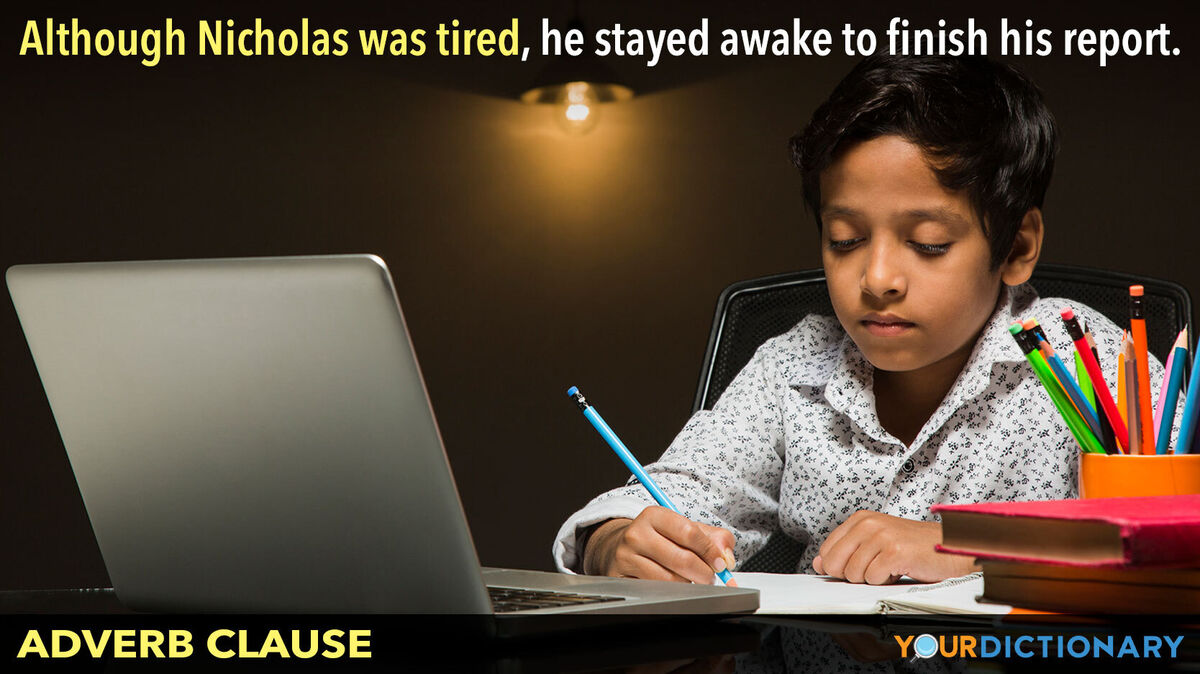
- Although Nicholas was tired, he stayed awake to finish his report. (subordinating conjunction is "although," noun is "Nicholas," verb is "was")
- If you didn't wash the dishes, you will be in trouble. (subordinating conjunction is "if," noun is "you," verb is "didn't wash")
- The family was not going to go on vacation this year unless they scraped together enough money. (subordinating conjunction is "unless," noun is "they," verb is "scraped")
- The dog ran around the house while the cat took a nap. (subordinating conjunction is "while," noun is "the cat," verb is "took")
Notice that you can start or end a sentence with an adverb clause. Changing the position of adverb clauses is an effective way to add sentence variety to your writing.
Advertisement
Adverb Clause Quiz
Are you ready for a challenge? Test your knowledge of adverb clauses with a short quiz.
Where's the Adverb Clause? Practice Questions
Read each sentence below. Determine if each sentence has an adverb clause or not. Answers are below.
- I've been waiting for you since noon.
- We ordered a pizza before we knew you were making dinner.
- After all that work, Melissa didn't get the promotion.
- Unless you improve your grades, you can't play in the football game.
- Let's go out for lunch after the game.
- Although my cat is ten years old, she still acts like a kitten.
- We always go skiing once a year.
- My cousin is learning French because he's going to Paris next year.
- Perla was dressed like a witch for Halloween.
- Since you're going to the store, could you pick up some milk?
Advertisement
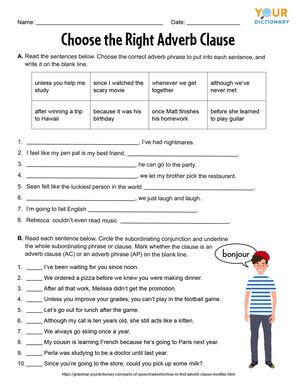
Printable Worksheet for Where's the Adverb Clause?
If you'd like more of a challenge, download and print the adverb clause worksheet below. It includes additional grammar exercises as well as a full answer key.
Answers to Where's the Adverb Clause?
How did you do? Check your answers to the practice questions. The adverb clauses are in bold.
- I've been waiting for you since noon. (No adverb clause)
- We ordered a pizza before we knew you were making dinner.
- After all that work, Melissa didn't get the promotion. (No adverb clause)
- Unless you improve your grades, you can't play in the football game.
- Let's go out for lunch after the game. (No adverb clause)
- Although my cat is ten years old, she still acts like a kitten.
- We always go skiing once a year. (No adverb clause)
- My cousin is learning French because he's going to Paris next year.
- Perla was dressed like a witch for Halloween. (No adverb clause)
- Since you're going to the store, could you pick up some milk?
Advertisement
Add Flavor to the Action in Sentences
Adverb clause modifiers add flavor to our sentences in so many ways. They add specificity and detail to a piece of writing that makes a series of words feel vivid and alive. Learn more about the difference between adverb and adjective clauses to fill out your dependent clause understanding. You can also check out the differences between phrases and clauses to avoid any potential mix-ups.