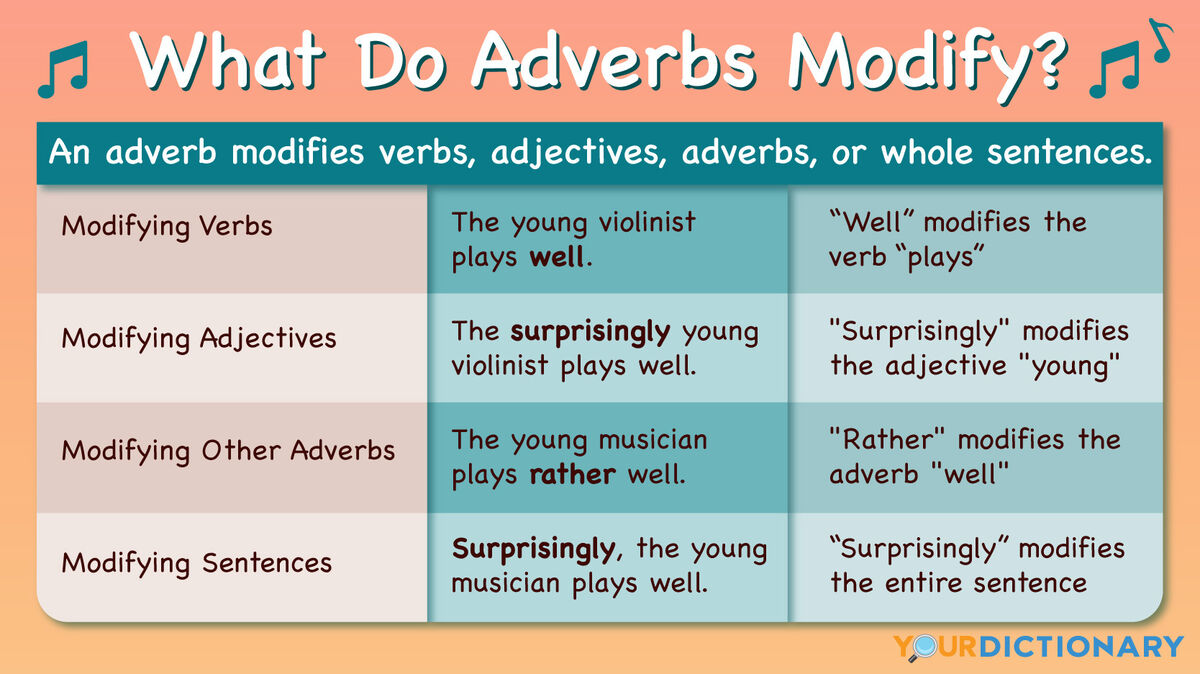
An adverb is a part of speech that modifies another word in the sentence. Adverbs add additional information about verbs, adjectives and other adverbs to help the reader understand more about your writing. But what do adverbs modify besides these parts of speech? Keep reading for examples of how adverbs modify other words, phrases or even entire sentences.
When Adverbs Modify Verbs
You're most likely to find adverbs when they're modifying verbs. While many adverbs end in -ly, making them easy to find, there are several adverbs that have different endings. Different types of adverbs can modify verbs to give more detail about why, how, where, when, how often, and to what extent an action is performed. For example, in the sentences below, the verbs are underlined and the adverbs are in bold.
- My grandfather types slowly. (How does he type?)
- We leave tomorrow. (When do we leave?)
- Please go away. (Where should I go?)
- Our teacher speaks informally. (How does he speak?)
- Our family never eats meat. (How often do you eat meat?)
Adverbs can come before or after the verbs they modify, depending on the rest of the sentence. As long as you avoid splitting infinitives, you can place these adverbs where they feel the most natural.
When Adverbs Modify Adjectives
Adverbs can also modify adjectives. While adjectives describe nouns and pronouns, adverbs can enhance or clarify the adjectives to make them even more clear and exact. For example:
- The dog was very loud. (How loud was it?)
- The essay is the least important part of the exam. (How important is it?)
- Sean is the most interesting person I've ever met. (How interesting is Sean?)
- This soup is quite hot. (How hot is it?)
- My recently divorced neighbor asked me out. (When was she divorced?)
In these cases, the adverbs are functioning as intensifiers. They strengthen the meaning of these adjectives to paint a vivid picture for the reader. These adverbs always come before the adjectives that they modify.
When Adverbs Modify Other Adverbs
What does an adverb modify besides verbs and adjectives? Adverbs can also modify other adverbs. They can work as intensifiers or provide more information. For example:
- The young violinist plays rather well. (How well does she play?)
- If you eat ice cream too quickly, you'll get a headache. (How quickly should I eat it?)
- Your description is quite horribly accurate. (How horribly accurate is it?)
- My plate was almost completely full. (How completely full was it?)
- Frederick is sometimes very pleasant to be around. (How often is it very pleasant?)
When you see one adverb modifying another, you've found an adverbial phrase. These phrases are helpful in making your word choice specific and descriptive.
Sentence Adverbs
In some cases, adverbs can modify the entire sentence that follows them. For example:
- Unfortunately, he lost his bike and had to walk to work.
- Generally, students who do well on the SAT get good grades in college.
- Interestingly, the cow raised the flock of chickens as her own.
- Actually, we didn't go to the party.
- Thankfully, the car's brakes functioned as they should.
In each of these cases, the adverb at the beginning of the sentence modifies all of the actions that follow. In the first sentence, for example, it's not only unfortunate that he lost his bike, but also that he had to walk to work.
Putting the Adverb in Its Place
When you keep in mind that adverbs modify verbs, adjectives and other adverbs, you can use them effectively in your writing to add explanatory information. Keep in mind that adverbs tend to modify everything that follows them in the sentence as you write. That will help you choose the best placement for clarity, and your sentences will make perfect sense to your reader. For help choosing the right adverb to tell when, where or how the action happened, explore examples of adverbs.