What do team, gaggle, and murder have in common? They’re not the topics of your new favorite podcast. Team, gaggle, and murder are collective nouns — and they get special treatment in a sentence.
What Is a Collective Noun?
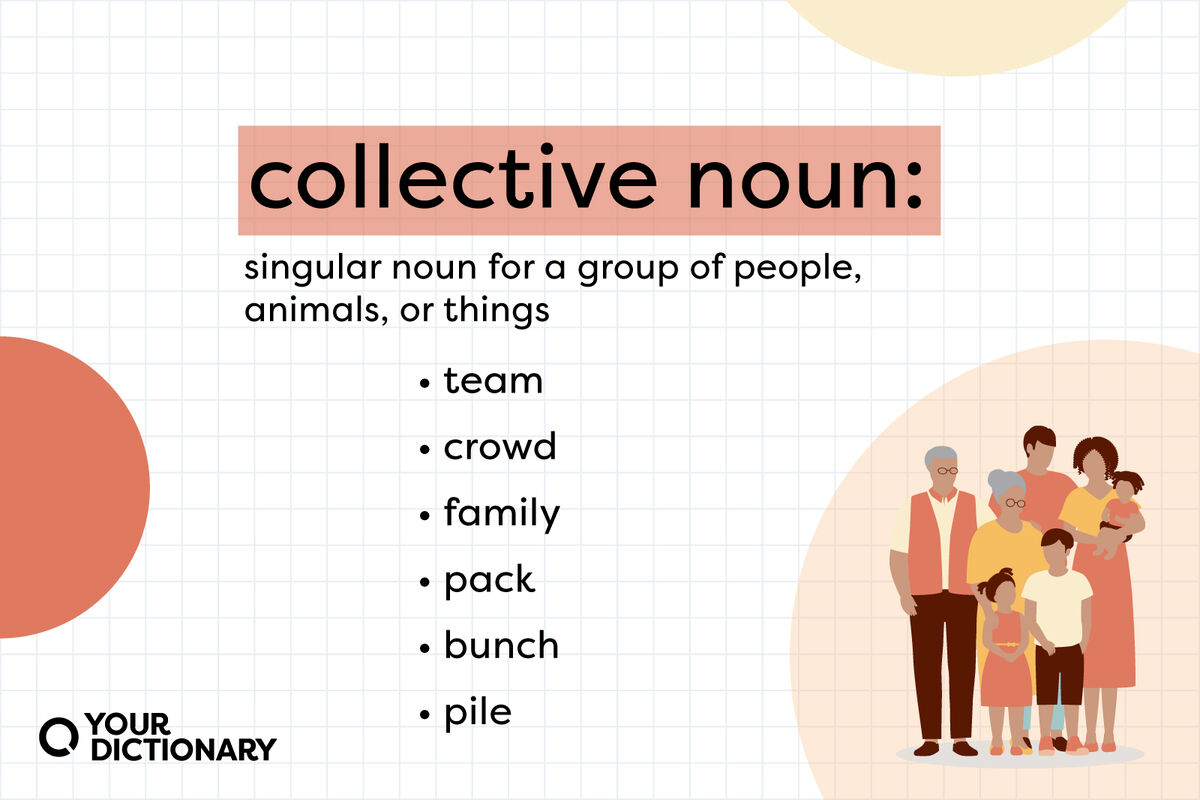
Collective nouns are nouns for groups of people or things. They’re different from plural nouns, which show more than one noun.
Collective nouns are actually singular nouns that describe a collection of nouns. Team is a group of players, gaggle is a group of geese, and murder (believe it or not) is a group of crows.
- Collective noun - The team gets ready for the game.
- Plural noun - The players get ready for the game.
- Collective noun - A gaggle honks at us as we swim by.
- Plural noun - Geese honk at us as we swim by.
- Collective noun - The murder glares at us from the tree.
- Plural noun - The crows glare at us from the tree.
Collective nouns can also be plural when you’re talking about more than one group. For example, in “The teams get ready for the game,” multiple teams are getting ready. But if you’re only talking about one collective noun, it’s always singular.
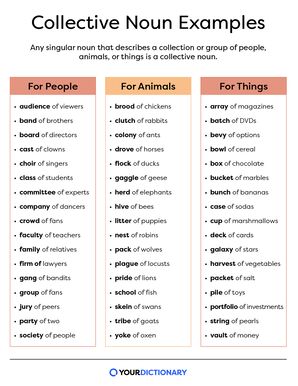
Examples of Collective Nouns for People
Team is just one of the many examples of collective nouns for people who are in a group and acting as a single entity.
- The class voted for their favorite essay topic.
- Have you talked to the committee about these problems?
- The audience leapt to their feet and cheered when the concert began.
- Our family loves going bowling on Thanksgiving.
- The jury discussed the case for five days before coming to a verdict.
- My staff is concerned about layoffs in the next quarter.
Examples of Collective Nouns for Animal Groups
You’ll also find many unique collective nouns to identify a specific group of animals, be they mammals, birds, or insects. Common collective nouns for animal groups include:
- The ants brought the crumbs back to the colony.
- A flock of ducks gracefully swooped over the lake.
- I’m getting one puppy, but I wish I could adopt the whole litter.
- Which lion is the oldest in the pride?
- The alpha wolf is responsible for taking care of his pack.
- One shark can eat an entire school of fish in one meal.
Advertisement
Examples of Collective Nouns for Things
Collective nouns don’t all refer to groups of people or animals. Groups of other things can also be referred to as a unit.
- We bought a bunch of bananas at the corner store.
- My doctor’s office has an array of magazines available for reading.
- Can you clean up that pile of toys?
- I love your new string of pearls.
- Mark brought a deck of cards to the party.
- Let’s pick up a case of sodas before we go home.
Tips for Using Collective Nouns
Knowing the names for different collective nouns is interesting, but how on earth do you use them? Even though they’re describing more than one noun, collective nouns are still considered singular (in American English only; in British English, collective nouns are plural).
- Can the noun describe more than one person, animal, or thing? It’s a collective noun — use a singular verb.
- Is there an “s” after the noun? It’s a plural noun — use a plural verb.
- Is there an “s” after the collective noun? Now it’s a plural noun — use a plural verb.