It’s usually pretty easy to tell when a toddler feels possessive. They grab their toys, bare their teeth, and howl “Mine!” (That’s your cue to walk away.) But how can you tell if a noun is possessive? It’s a lot easier — and quieter — than dealing with a clutchy kid.
What Is a Possessive Noun?
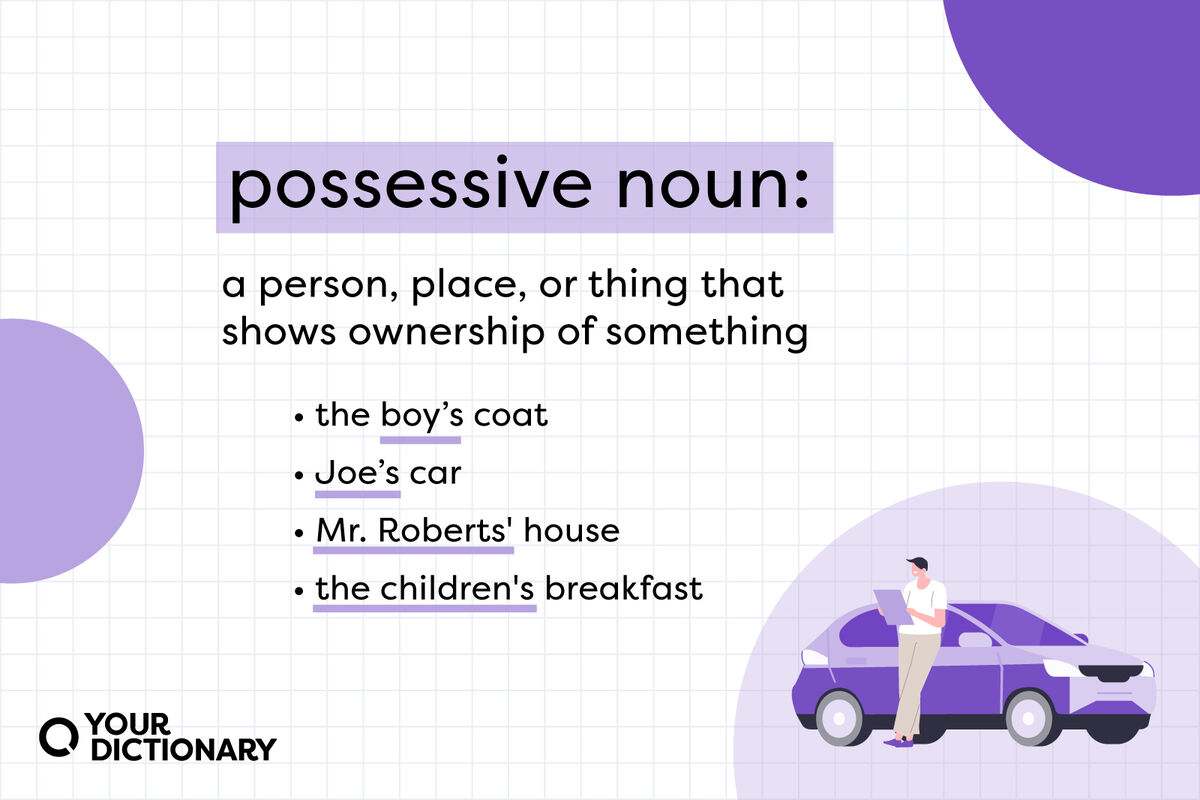
A possessive noun shows that a noun owns or possesses another noun. You can spot one in a sentence because it has an apostrophe before or after the letter "s." For example:
- the boy's coat (the coat of the boy)
- Jaime's feet (the feet of Jaime)
- the Smiths’ cat (the cat of the Smiths)
How To Form Possessive Nouns
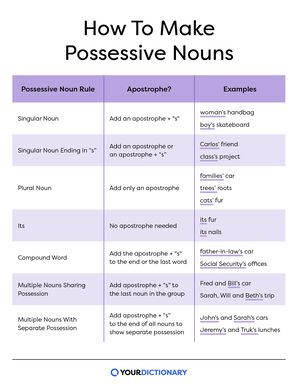
Any noun can be possessive — but there are a few rules you need to follow, depending on the type of noun.
Singular Possessive Nouns: Add Apostrophe Plus S
For most singular nouns, you can make them possessive by adding an apostrophe + "s" to the end of them.
- The puppy's collar is red.
- Joe's car looks like mine.
- We designed the company's logo.
If a singular noun ends in "s," you can either add an apostrophe + "s" to the end or just an apostrophe. Both are correct, as long as the noun is not the same in singular or plural forms (such as pants or scissors).
- Mr. Roberts' house is down the street. (Correct)
- Mr. Roberts’s house is down the street (Also correct)
- This species’ prey is dying out. (Correct)
- This species’s prey is dying out. (Incorrect — species is the same in singular and plural forms)
Plural Possessive Nouns: Add Apostrophe After S
Plural nouns that end in “s” only need an apostrophe to make plural possessive nouns.
- The companies' workers went on strike together.
- You need to clean out the horses' stalls.
- The two countries' armies amassed on the border.
When words are plural but do not end in "s," add an apostrophe and “s” (just like singular nouns).
- Have you made the children's breakfast?
- Miranda cleaned the sheep's pen.
- We support women's rights.
How To Use a Possessive Noun
Think of the apostrophe in a possessive noun as a hook reaching out to take ownership of the nearby object. The boy grabs his coat; Jaime grabs his feet; the Smiths grab their cat. Without the little hook grabbing onto the "s," the noun is simply plural (boys, Jaimes, Smiths).
Advertisement
What Comes After a Possessive Noun?
Because apostrophes only have two purposes (showing possession and creating contractions), be careful about what follows a possessive noun. It should only be another noun.
- My dog’s paws are wet. (The paws belong to the dog)
- The painter’s supplies are still here. (The supplies belong to the painter)
If you add an adjective after a possessive noun instead of a noun, it’s now a contraction for “(noun) is,” which changes the meaning of your sentence.
- My dog’s wet. (My dog is wet.)
- The painter’s still here. (The painter is still here)
Common Problems With Possessive Nouns
Apostrophe + “s” for singular nouns, just an apostrophe for plural nouns (most of the time). Sounds easy enough, unless you consider all the other nouns — and pronouns — that also have possessive forms.
Advertisement
Making Compound Nouns Possessive
Compound nouns are two or more words that join together to make a new noun. When a compound noun is possessive, add the apostrophe and “s” (or just the apostrophe) after the last word, whether it’s hyphenated or not.
- My mother-in-law's recipe for meatloaf is incredible. (Not mother’s-in-law)
- She stood before three attorney general's offices and knew her time was up. (Not attorney’s general)
What To Do When Multiple Nouns Are Possessive
If multiple nouns possess the same thing, add the apostrophe and “s” after the final noun. For example, if both Drew and Pearl own a car together, it’s “Drew and Pearl’s car.”
- Italy and France’s deal helped to end the war. (The countries share the deal)
- Mark and Susan’s house is under construction. (Mark and Susan share the house)
The rule changes if each noun possesses their own version of the thing. Each noun gets an apostrophe and “s” in this case. If Drew and Pearl own their own cars separately, it’s “Drew’s and Pearl’s cars.”
- Italy’s and France’s economies are improving. (Each country possesses their own economy)
- Mark’s and Susan’s dogs don’t get along together. (Each person owns their own dog)
Advertisement
Making “It” Possessive
If you find it’s vs. its confusing, you're not alone. After all, if you add apostrophe + “s” to singular nouns, shouldn’t the same apply to singular pronouns like it?
The answer is no. Its is a possessive pronoun and determiner all by itself, just like his or hers. It’s is a contraction of “it is.”
- We weren't sure about its steps.
- They followed its trail.
- The scientist wasn't sure of its origins.
Don’t Get Possessive; There’s Enough Grammar To Share
Just because your nouns make their ownership clear doesn’t mean you need to get possessive, too. Share your grammar knowledge with possessive noun worksheets that come with their own answer keys. Or if you want a challenge, try out a possessive noun quiz.