What does happiness look like? How does anger smell? Can you taste education? Believe it or not, some nouns aren’t accessible with the five senses. These nouns are called abstract nouns — and even though you can’t see, smell, touch, taste, or hear them, they’re still all around you.
What Is an Abstract Noun?
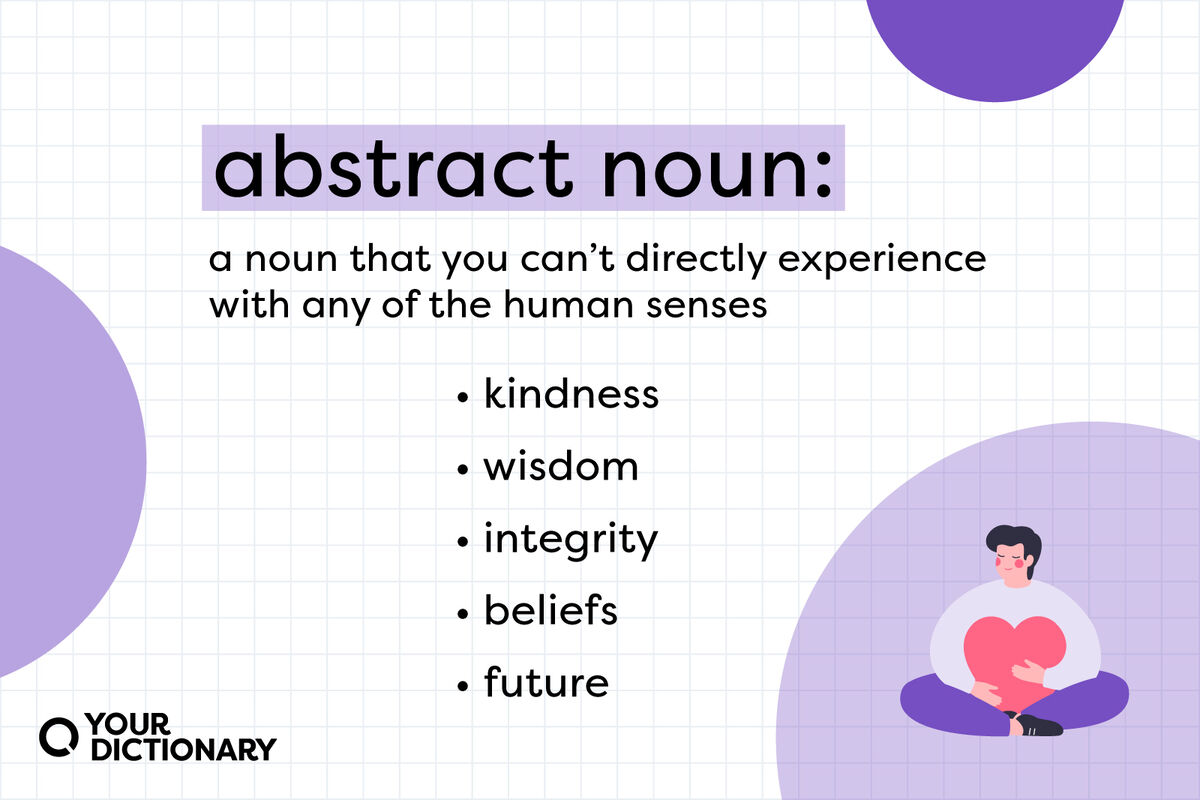
We define abstract nouns as nouns that you can’t directly experience by any of the human senses. These nouns represent an aspect, concept, idea, experience, state of being, trait, quality, or emotion. You may feel them emotionally, but not with your sense of touch.
Examples of abstract nouns that you may not have considered to be nouns (or abstract) include:
- humor (you can hear laughing, but you can’t see humor)
- kindness (you can see a person being kind, but not kindness itself)
- fury (you can hear someone yelling, but you can’t see fury)
- wisdom (you can read a book, but you can’t see wisdom)
- memories (you can see photos, but you can’t see memories with your eyes)
- democracy (you can hear senators debating, but you can’t see democracy)
Abstract nouns are similar to abstract art. They’re both hard to define or explain, but when you see it, you know. The word abstract refers to something that exists apart from concrete existence, which is why the term describes nouns that we can't perceive in a sensory way.
Abstract vs. Concrete Nouns
When you think of a noun, you think of a person, place, thing, or idea. Abstract nouns are ideas, but those first three categories — person, place, and thing — are concrete nouns. You can experience concrete nouns by seeing them, hearing them, touching them, smelling them, or tasting them — unlike abstract nouns.
Abstract Noun Examples in Sentences
Consider how many emotions, attributes, ideas, and events you talk about, and you may be surprised to find how many abstract nouns appear in your writing and conversation every day.
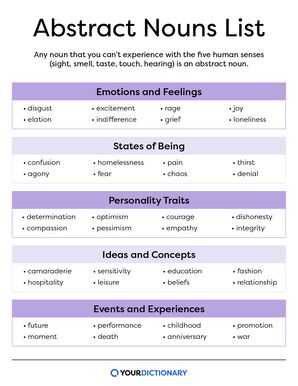
Abstract Nouns for Emotions and Feelings
Abstract nouns are the noun form of emotion adjectives. For example, happiness is the abstract noun form of happy, and misery is the abstract noun form of miserable.
- She could not hide her disgust.
- I can't describe my elation after the party.
- Her excitement is contagious.
- The toddler screamed with rage when his mother told him “No.”
- Shawn’s indifference is shocking.
- Our family felt intense grief after our father died.
- Getting a goldfish really helped my loneliness after I moved.
- We were overcome with joy when we heard the wonderful news.
Advertisement
Abstract Nouns for States of Being
Whether a person’s state of being is temporary or permanent, you can describe it with an abstract noun.
- What is the congressman’s plan for homelessness in the city?
- Rachel has been in agony since injuring her back.
- Are you still in a lot of pain?
- Many citizens suffer from poverty while their neighbors enjoy their wealth.
- The student stared at the teacher in confusion.
- We tried to calm the puppy’s fear with soft voices and treats.
- After the dogs got out of the yard, it was pure chaos.
- Drink some water to quench your thirst.
- I think I’m still in denial about getting accepted to college.
Abstract Nouns for Personality Traits
You can use abstract nouns to describe a person’s personality traits or states of mind.
- Maya approached the job interview with determination.
- My grandmother’s compassion helped me through many difficult times.
- Our team has been in a state of confusion since the office manager resigned.
- Tyler felt a sense of optimism when he left the beach.
- Laura’s pessimism often makes her friends feel uncomfortable.
- It takes a lot of courage to stand up to a bully.
- Patty shows empathy by listening to her friends.
- Once an employee shows signs of dishonesty, it may be time for them to leave.
- The girls showed integrity by telling their teacher the truth.
Advertisement
Abstract Nouns for Ideas and Concepts
Abstract nouns can also represent various concepts or ideas.
- There is great camaraderie among the team.
- I greatly appreciate the hospitality you have shown to me.
- This issue needs to be handled with great sensitivity.
- Everyone deserves a bit of leisure.
- Where did you receive your education?
- Even if you don’t agree, you must respect others’ beliefs.
- Cheri really understands fashion; that’s why she’s so trendy.
- Hans and I ended our relationship last Monday.
Abstract Nouns for Events and Experiences
Abstract nouns can name events, experiences, and movements from different time periods.
- What are your goals for the future?
- Qualifying for the Olympics is an incredible moment in an athlete's life.
- That was quite a performance she put on.
- After my uncle’s death, our family didn’t talk as much.
- I spent my childhood in Greece and Italy.
- We’re celebrating our anniversary later in the spring.
- Did you get a promotion?
- This will be the most important battle of the war.
Advertisement
Different Types of Abstract Nouns
Abstract nouns can also be other types of nouns. Although abstract nouns are always common nouns (as in war), they might appear in the names of proper nouns (as in the Civil War).
Depending on the noun, they can also be:
- singular nouns (as in charity or wealth)
- plural nouns (as in morals or thoughts)
- countable nouns (as in governments or laws)
- uncountable nouns (as in hesitation or power)
Forming Abstract Nouns Using Suffixes
You can create many abstract nouns by adding a suffix or making another alteration to a root word (which could be a concrete noun).
For example, the word adult is a concrete noun. However, adulthood is an intangible state, so that word is an abstract noun. Additional examples include:
- -acy - adequacy; bureaucracy
- -ance - defiance; intolerance
- -ism - favoritism; racism
- -ity - civility; variability
- -ment - ailment; argument
- -ness - fitness; fondness
- -ence - deference; violence
- -ship - kinship; scholarship
- -tion - coalition; devotion
- - ty - certainty; unity
Advertisement
Recognizing When a Noun Is Abstract
It can be difficult to recognize when a noun is abstract because there are so many words that can function as different parts of speech. The words love and taste, for example, can be verbs or abstract nouns, depending on the sentence.
- I love my husband. (Love functions as a verb)
- Send them my love. (Love functions as an abstract noun)
- Do you taste cilantro in the salsa? (Taste functions as a verb)
- You have great taste in clothes. (Taste functions as an abstract noun)
Keep in mind that when a word represents an action, it is a verb. When a word represents a person, place, thing, concept, or idea, it's a noun. If you can't directly perceive it, then it's an abstract noun.
Tips for Keeping Concrete and Abstract Nouns Straight
Sometimes an abstract noun really does seem concrete. Take destruction, for example — when you envision broken buildings, crashed cars, burning fires, and clouds of smoke, it really seems like you can see destruction.
However, destruction is simply the abstract noun that describes a state of being. You’re not seeing destruction; you’re seeing all those concrete nouns (buildings, cars, fires, smoke) and describing them with the abstract noun destruction.
If the difference between concrete and abstract nouns still confuses you, consider these helpful tips.
- Can you buy it from a store?
- Can you make it in an oven?
- Can you take a picture of it?
- Can you describe how it smells?
- Can you put it in a box?
- Can you watch it in a movie?
If the answer is “no” to these questions, congratulations — you’ve got an abstract noun!