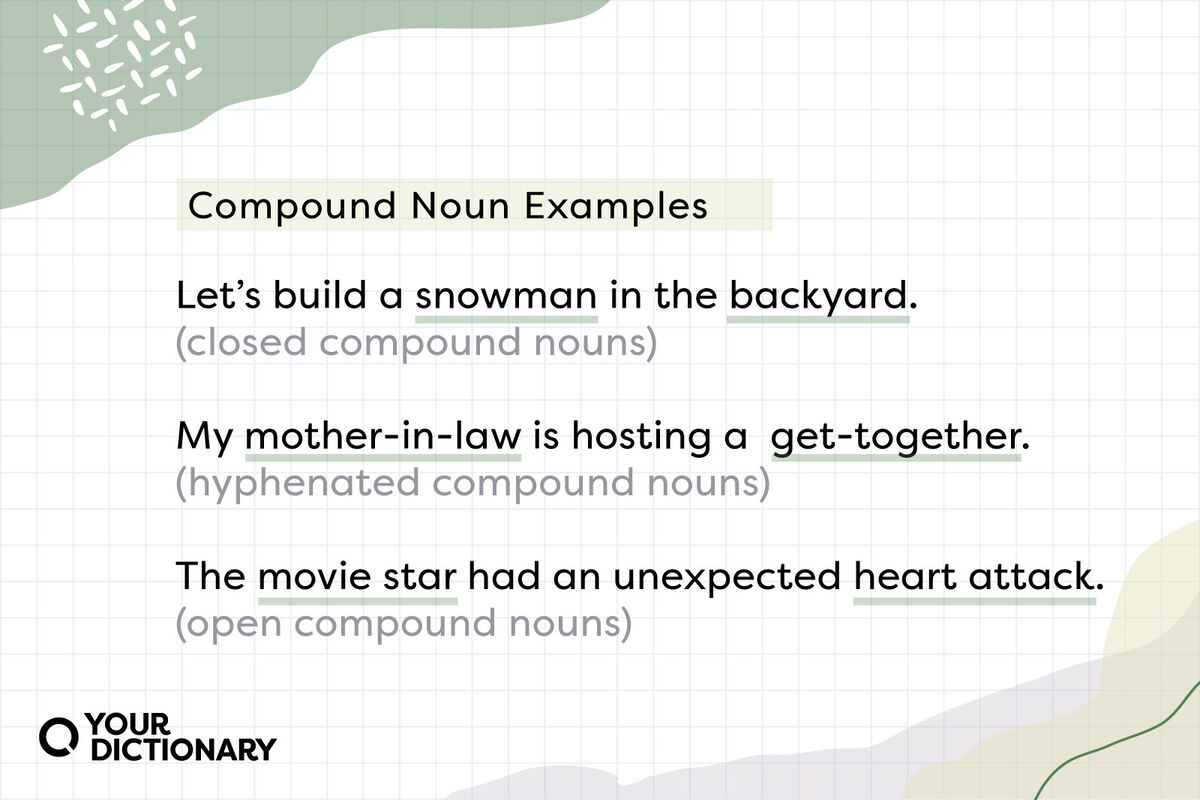
When two or more words join together to make a single noun, like keyboard or bookstore, that's a compound noun. The new noun has a new meaning that may be quite different from its starter words. But compound nouns don’t have to be stuck together — depending on the noun, they can be hyphenated (like ten-year-old) or even open (like ice cream).
What Is a Compound Noun?
A compound noun is a compound word that functions as a noun. The first part typically states the type or purpose, and the second part states who or what is being named. For example, in the word firehouse, the word "fire" indicates what type of “house” it is (a house for fighting fires). The meaning of the new word is different from each of its parts individually.
There are three types of compound nouns: closed compound nouns, hyphenated compound nouns, and open compound nouns.
Closed Compound Noun Examples
Many compound nouns are closed, meaning that there is no space or hyphen between the two parts. Examples of closed form compound nouns in sentences include:
- The lighthouse directs ships away from the rocks.
- Watch the butterfly on the flower over there.
- You should secure your furniture in case there's an earthquake.
- I’ll call my grandmother and ask for her recipe.
- Where is the bathroom?
- If you still have a headache, you should get some rest.
Hyphenated Compound Noun Examples
Certain compound nouns can also be in hyphenated form. These include:
- Janice works out so much that she has a six-pack.
- Give a balloon to the five-year-old in line.
- You're such a sweet son-in-law for giving me this card.
- How old is your great-grandfather?
- Marcos was the runner-up in the spelling bee.
- Let’s ride on the merry-go-round after the show is over.
Open Compound Noun Examples
You'll also find compound nouns in open form with a space between the words. Some examples are:
- Can we stop by the post office later today?
- This tax cut is just for the middle class.
- She is the first female attorney general of our state.
- Please trim the apple tree before you leave.
- Can you bring the plates to the dining room?
- I met my best friend when we were in high school.
How To Form Compound Nouns
While many compound nouns consist of two nouns, you can use any parts of speech to create a compound noun — as long as it functions as a noun in the sentence. The other parts of speech used to create compound nouns may be adjectives, prepositions or verbs. Typical compound noun rules include:
|
Parts of Speech |
Examples |
Typically Closed, Hyphenated or Open? |
|
noun + noun |
toothpaste, doughnut, fish tank |
closed, but sometimes open (depending on the word) |
|
adjective + noun |
top hat, bluebird, redhead |
closed, but sometimes open (depending on the word) |
|
noun + adjective |
spoonful, truckload, wireless |
closed |
|
preposition + noun |
underworld, bystander, afterlife |
closed |
|
noun + preposition |
hanger-on, passer-by |
hyphenated |
|
noun + prepositional phrase |
ten-year-old, father-in-law, lady-in-waiting |
hyphenated |
|
verb + noun |
chopstick, swimsuit, washing machine |
closed, but sometimes open (depending on the word) |
|
noun + verb |
haircut, snowfall, photo shoot |
closed, but sometimes open (depending on the word) |
|
adjective + adjective |
turquoise blue, golden yellow |
open |
|
adjective + verb |
dry-cleaning, public speaking, wet sanding |
hyphenated or open (depending on the word) |
|
preposition + verb |
output, backbone, overthrow |
closed |
|
verb + preposition |
touchdown, check-in, drawback |
closed or hyphenated (depending on the word) |
Why Are Some Compound Nouns Hyphenated?
Just because a compound noun is hyphenated today doesn’t mean it will stay that way. As compound nouns become more commonplace, they tend to lose their hyphens. Consider these words that once were rare, but now may be part of your daily conversation:
- on-line is now online
- take-out is now takeout
- e-mail is now email
- health-care is now healthcare
Another rule of thumb is that British English typically uses a hyphen more than American English (such as in pre-school vs. preschool). Also, common words are more often closed than uncommon words.
Plural and Possessive Rules for Compound Nouns
How do you make these compound nouns plural or possessive? There are no hard and fast rules concerning the plural form of compound words, especially since some hyphens are omitted over time. However, some of the more common patterns include:
- In hyphenated words, the "s" usually goes at the end of the noun, as in daughters-in-law or mayors-elect.
- Sometimes the “s” is at the end, as in go-betweens and higher-ups.
- In the open form, the "s" is often added to the noun, as in bills of fare, secretaries of state, notaries public, and full moons.
To make a compound word possessive, you usually add apostrophe + s to the end of the word, as in mother-in-law's car or five-year-old's birthday.
Compound Noun vs. Noun Phrase
Compound nouns are slightly different than noun phrases, which are modifier + noun phrases. For example, a hot dog is a type of sausage typically eaten on a bun. It may be hot, but it's certainly not a dog.
The combination of these two words means something entirely different than the mere combination of the adjective "hot" and the noun "dog," which would refer to an overheated canine. Observe the difference below:
- I want to eat a hot dog when we go to the county fair.
- The hot dog was grateful to find a shady spot for a nap.
The first sentence uses "hot dog" as a compound noun, but the second does not. You can usually tell the difference by carefully reading the sentence context and by listening to the pronunciation. Compound nouns typically have a stress on the first word ("HOT dog" — the food) while noun phrases have no stress on either word ("hot dog" — a dog that is hot.)