Noun clause sounds like the grammar-loving, word-nerd brother of Santa Claus. (It’s not — but as word nerds ourselves, we can’t help wishing for the types of presents Noun Clause might give out.) The decidedly less-festive noun clause is a group of words that adds more information to a sentence. Though you’re more likely to find a noun clause after a linking verb than at the North Pole, it’s still an important element of a sentence.
What Is a Noun Clause?
A noun clause is a group of words acting together as a noun. They follow linking verbs to describe or modify the subject of the sentence. Unlike noun phrases, noun clauses contain both a subject and a verb.
- Do you know what time it is?
- Tom can invite whomever he chooses.
- I don’t understand what you’re talking about.
- Whether Roman accepts the job or not is his business.
Tip for checking if something is a noun clause: Try replacing the clause with other nouns or pronouns. For example, in the last sentence, you can replace the entire noun clause Whether Roman accepts the job or not with the pronoun it.
However, “It is his business” is much less detailed and specific than “Whether Roman accepts the job or not is his business.” Noun clauses add important information and detail to your sentences.
How To Identify a Noun Clause in a Sentence
Because noun clauses can appear almost anywhere in a sentence, they can be tricky to spot. They usually start with one of these subordinating conjunctions or relative pronouns, so that’s a good place to start.
- how
- that
- what
- whatever
- when
- where
- whether
- which
- whichever
- who
- whoever
- whom
- whomever
- why
While these words can be found in clauses other than noun clauses (such as adjective clauses), noun clauses almost always start with one of these words.
How To Use a Noun Clause in a Sentence
Now that you know how to spot a noun clause, learn how to determine its function within the sentence. They can go anywhere a noun can go, including subjects, objects, complements, and more.
Examples of Noun Clauses as Subjects of Sentences
When a noun clause functions as the subject of a sentence, it performs the action in the sentence. In these cases, it usually comes right before the verb.
- What Alicia said made her friends cry.
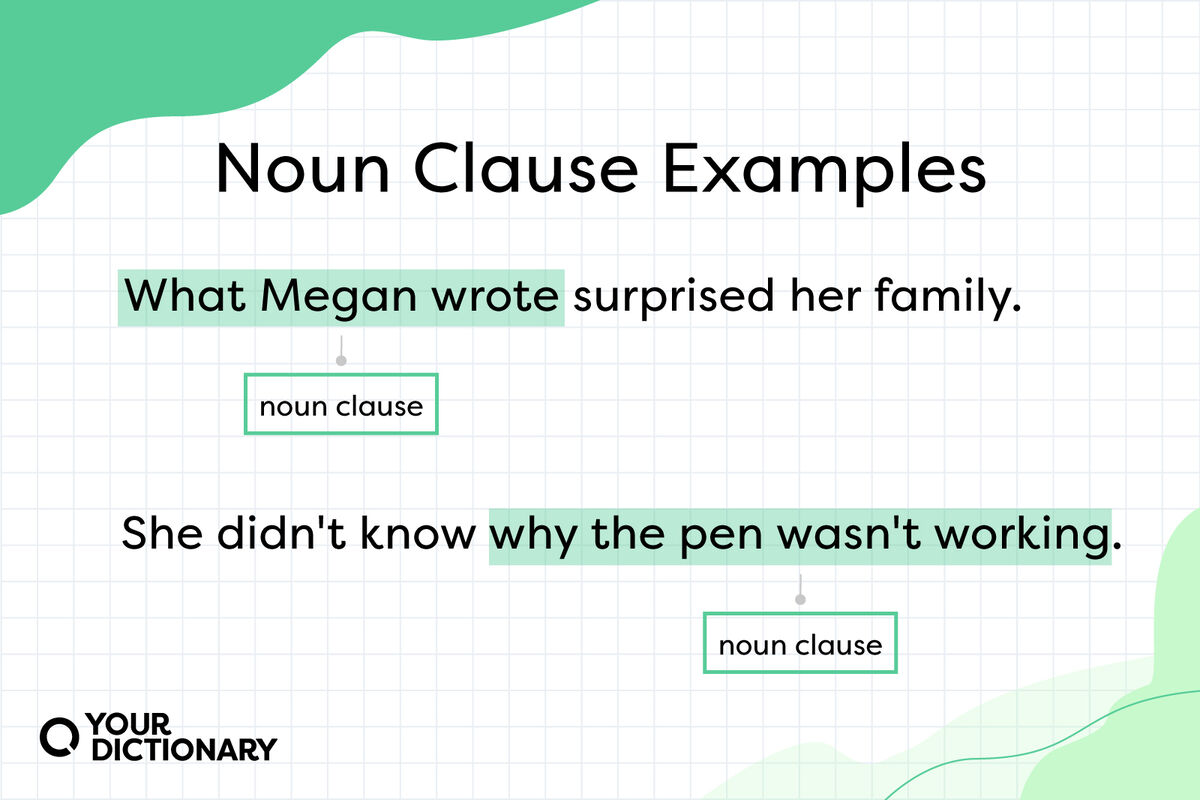
- What Megan wrote surprised her family.
- How the boy behaved was not very polite.
It’s easy to assume that Alicia, Megan, and the boy are the subjects of these sentences. But that’s not quite correct. Alicia didn’t make her friends cry; what Alicia said made her friends cry.
Examples of Noun Clauses as Objects of Sentences
Just like all nouns, noun clauses can act as the direct object of a sentence. They follow verbs to inform the reader of where the action is going.
- The pharmacist checked that the prescription was correct.
- He didn't know why the stove wasn't working.
- They now understand that you should not cheat on a test.
Remember that it’s the noun clauses, not the nouns in them, that are the objects of the sentences. The pharmacist didn’t check the prescription; he checked that the prescription was correct.
Examples of Noun Clauses as Subject Complements
A noun clause can also serve as a subject complement to rename the subject of a clause. Subject complements are also called predicate nominatives or predicate nouns.
- Carlie's problem was that she didn't practice enough.
- Harry's crowning achievement at school was when he became class president.
- Darla's excuse for being late was that she forgot to set her alarm.
Notice that like noun clauses as objects, these noun clauses also follow the verb in a sentence. But like all subject complements, noun clauses as subject complements follow forms of helping verbs (is, have, do).
Examples of Noun Clauses as Objects of Prepositions
Noun clauses also act as objects of a preposition in prepositional phrases.
- Harry is not the best provider of what Margie needs.
- Josephine is not responsible for what Alex decided to do.
- Allie did some research about how Marie Curie discovered radium.
Each of these sentences could be complete before the addition of the prepositions. However, the prepositions are introduced to provide further detail and the noun clauses act as the objects of these prepositions.
Examples of Noun Clauses as Adjective Complements
A noun clause can also function as an adjective complement. These noun clauses complement an adjective or adverb, and usually follow them as well.
- It’s very disappointing that you left the party early.
- They're perfectly happy where they live now.
- Geoffrey runs so fast that he can outrun his dog.
Similar to the examples containing prepositions, each of these sentences could be complete after the adjective. The adjective complements provide further detail and, in each of these instances, these adjective complements are noun clauses.
Noun Clause vs. Noun Phrase
The difference between clauses and phrases is simple: Clauses have subjects and verbs, and phrases don’t. The same is true for noun clauses and noun phrases. Both function as nouns, but noun phrases don’t include subjects and verbs.
Additionally, noun clauses begin with subordinating conjunctions and relative pronouns; noun phrases begin with nouns or personal pronouns.
- Noun Clause - Whatever you decide is fine with me.
- Noun Phrase - Chinese food is fine with me.
- Noun Clause - Miranda knows that she should apologize.
- Noun Phrase - Miranda knows my youngest brother.
- Noun Clause - Have you seen where the battle took place?
- Noun Phrase - Have you seen this new movie?
Noun Clauses Are Coming to Town
Noun clauses may not be as jolly or generous as Old Saint Nick, but they’re just as helpful and accommodating. And best of all, you don’t need to wait until winter to find them — they appear wherever you need them (just like that sentence!) to clarify your writing. Get even clearer with a guide to the grammar rules you need to follow, as well as the ones you can actually break.