Noun phrases are like those kids in cartoons who stand on each other’s shoulders and hide under a trench coat. All stacked up like that, they look like an adult — but they’re really just a bunch of kids pretending to be an adult. Noun phrases work the same way. They look and act like nouns, but really, they’re just a combination of words pretending to be a noun.
What Is a Noun Phrase?
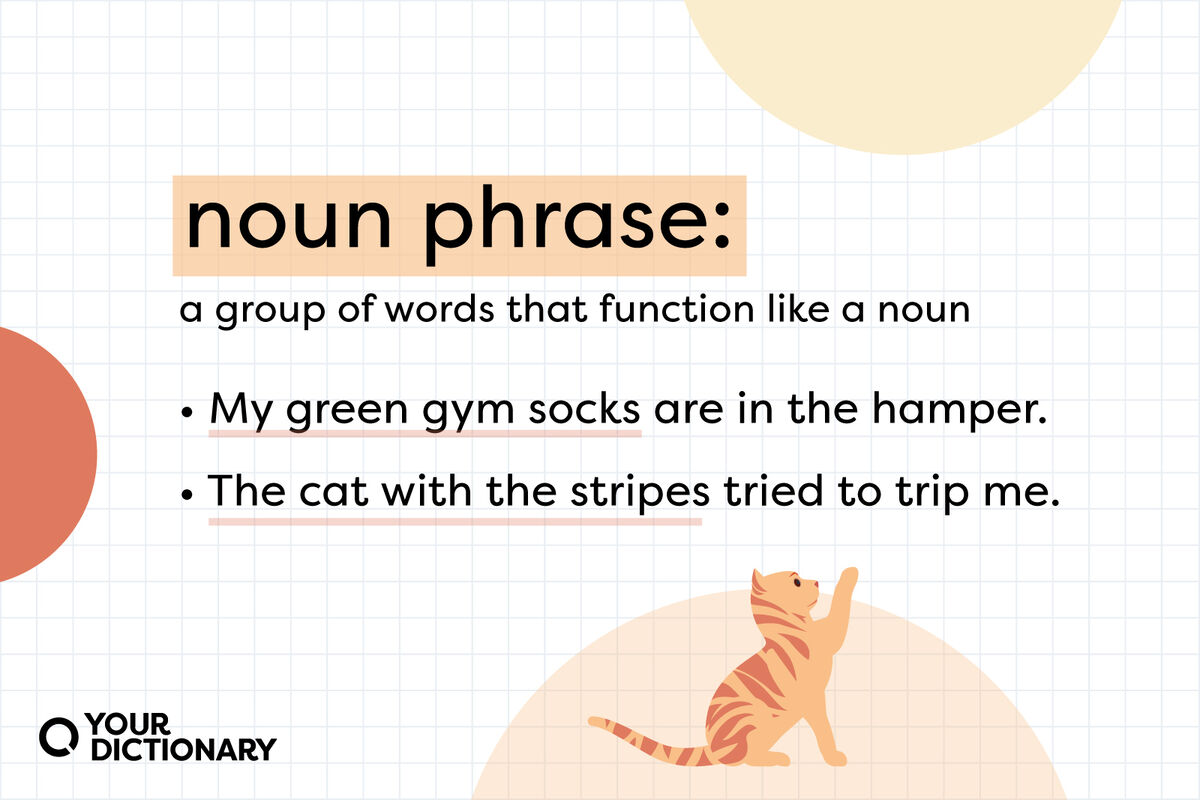
A noun phrase is a group of words that functions like a noun. Also known as nominals, noun phrases act as subjects or objects in a sentence. Noun phrases can’t function as a complete sentence — they don’t have a verb.
Examples of noun phrases include:
- a bird
- the little boy
- man of his word
- lawyer with a kind smile
- that happy puppy
- running around the neighborhood
- my green gym socks
- the building on the corner
Types of Noun Phrases
All noun phrases include nouns (or words that function as nouns). But there are lots of other parts of a noun phrase that provide more information to a reader.
Noun Phrase Examples With Premodifiers
Noun phrases can include premodifiers, which are describing words that come before a noun. Premodifiers can include articles (such as the and an) and adjectives (such as intelligent or blue).
- An elephant raised its trunk at me. (Article an modifies elephant)
- Can you hand me a sharp pencil? (Article a and adjective sharp modify pencil)
- You’re such an understanding friend. (Article a and adjective understanding modify friend)
Other types of determiners can be premodifiers, including possessive determiners (my, our, his), demonstratives (this, those, these), and quantifiers (most, five, some).
- Her cousin lives down the street. (Possessive determiner her modifies cousin)
- That dog growled at me. (Demonstrative that modifies dog)
- Several people witnessed the aliens. (Quantifier several modifies people)
Noun Phrase Examples With Postmodifiers
Postmodifiers are describing words that come after a noun. In a noun phrase, these modifiers may be different types of phrases, including prepositional phrases and participial phrases.
- People with rude manners upset me. (Prepositional phrase with rude manners modifies people)
- Did you see helicopters following the car chase? (Participial phrase following the car chase modifies helicopters)
Adjective clauses and infinitive phrases can also provide more information about a noun in a sentence.
- Barry, who graduated first in his class, is a successful doctor. (Adjective clause who graduated first in his class modifies Barry)
- Our decision to get married changed our lives forever. (Infinitive phrase to get married modifies our decision)
Examples of Gerunds in Noun Phrases
Gerunds, which are -ing words functioning as nouns, can also head up noun phrases. These phrases are also known as gerund phrases, but they always function as nouns.
- Playing with my kids is my favorite Saturday activity.
- Spinning in circles can make you dizzy.
- Have you tried swimming across the river?
How To Use a Noun Phrase in a Sentence
No matter which type of noun phrase you want to use, you’ll have to find the right spot for it in a sentence. (Hint: They go anywhere a noun can go.)
Examples of a Noun Phrase as a Subject
When you start a sentence with a noun phrase, and that noun phrase performs the action in the sentence, it’s functioning as the subject of the sentence.
- The spotted puppy jumped around happily.
- My youngest sister went to nursing school.
- Four angry bears stormed down the mountain.
Examples of a Noun Phrase as an Object
Noun phrases can also function as the object in a sentence when they receive the action from the subject.
- At the zoo, I saw a striped zebra.
- You shouldn’t eat that uncooked chicken.
- Noelle sipped a warm cup of coffee.
Noun Phrase as the Object of a Preposition
When the noun phrase follows a preposition, it’s functioning as the object of the preposition.
- Mary lives in a busy household.
- Jose drives to an awful job every morning.
- We live near a small grocery store.
Noun Phrase as an Absolute Phrase to a Subject
You can also use the noun phrase as an absolute phrase to modify the subject of a sentence, or the entire sentence itself.
- Her face red with embarrassment, she took her seat beside the man she had tripped.
- They walked into the sunset, their laughter carrying on the breeze.
- My dog trotted behind me, drool spilling from his panting tongue.
Noun Phrase vs. Noun Clause
Telling the difference between a noun phrase and a noun clause can be tricky, especially if the noun phrase contains an adjective clause.
But noun clauses replace nouns in a sentence, while adjective clauses are part of a noun phrase that describe the noun in a sentence.
Noun clauses also begin with relative pronouns (who, whom, that, which, whose), while noun phrases usually begin with the noun or pronoun that they’re modifying.
- The dog that got sick feels better. (Noun phrase; starts with the dog)
- I heard that the dog feels better. (Noun clause; starts with that)
- Steven, who should know better, made a huge mess in the microwave. (Noun phrase; starts with Steven)
- We don’t know who made the mess in the microwave. (Noun clause; starts with who)