
A noun quiz tests the student's understanding of nouns and their function in the context of a sentence. Two different level quizzes are provided below to be used according to the level of the students being tested.
Noun Test for Beginners: What Is a Noun? Quiz
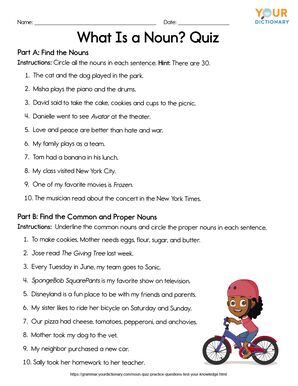
This noun quiz is for students beginning to learn about nouns. Focusing more on the basics of nouns and how to use them, these noun questions cover the fact that a noun is a person, place, thing, or idea. It also covers the difference between common nouns and proper nouns.
What Is a Noun? Practice Questions
Explore a few practice questions from the noun quiz to test your current knowledge. See if you can identify the noun or nouns in each sentence.
- The cat and the dog played in the park.
- Misha plays the piano and the drums.
- David said to take the cake, cookies and cups to the picnic.
What Is a Noun? PDF Download
Designed for 2nd and 3rd grades, this quiz tests students beginning knowledge of nouns. The quiz itself consists of two parts. In Part A, students are asked to circle all the nouns in 10 sentences. In Part B, students are asked to underline the common nouns and circle the proper nouns across 10 sentences. Simply click on the easy-to-use link to access the free downloadable noun quiz for beginning learners.
Practice Question Answers
Check out the answers to the first few questions on the beginner noun quiz. The nouns in each sentence are in bold. Did you identify them all?
- The cat and the dog played in the park.
- Misha plays the piano and the drums.
- David said to take the cake, cookies and cups to the picnic.
Advertisement
Advanced Noun Test: Types of Nouns Quiz
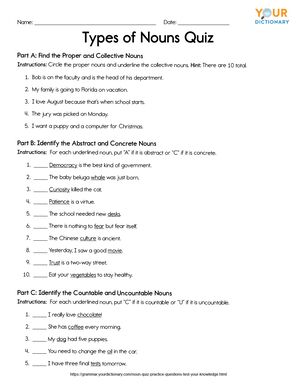
The second quiz available is designed for a more advanced student body. With this noun test, students can expect to be quizzed on additional noun forms, including proper nouns, collective nouns, uncountable nouns, countable nouns, abstract nouns, and concrete nouns.
Example Questions in Types of Nouns Quiz
How well do you know the different types of nouns? Check out a few sample questions on proper and collective nouns to test yourself. See if you can identify all the proper and collective nouns in these sentences.
- Bob is on the faculty and is the head of his department.
- My family is going to Florida on vacation.
- I love August because that's when school starts.
Types of Nouns Quiz Downloadable PDF
The advanced noun test has three different sections. The first section has 5 questions covering proper and collective nouns. In the second section, students explore 10 sentences where they must identify abstract and concrete nouns. The final section has 5 sentences full of countable and uncountable nouns. For ease of use, this quiz offers a downloadable PDF version of the advanced noun test. You can print it or save it for later.
Advertisement
Types of Nouns Quiz
Click to View & DownloadPractice Question Answers for Types of Nouns Quiz
Explore the answers to the sample questions on proper and collective nouns. The proper nouns are bolded, and the collective nouns are underlined. Were you able to identify them all?
- Bob is on the faculty and is the head of his department.
- My family is going to Florida on vacation.
- I love August because school starts.
More Noun Testing Practice
After tackling the two sets of noun quizzes provided, students may want to try their hand at some additional practice worksheets for this vital part of speech. Select from a huge variety of plural noun worksheets at different levels of skill, or try some collective noun worksheets for practicing this sometimes confusing variation too. Practice makes perfect!