Nouns don’t always like to share. But when more than one noun owns the same thing, they have to be a little more generous than they’d like. You can show that nouns share ownership with plural possessive nouns, but be careful — one wrong apostrophe move, and those nouns go back to being selfish.
What Is a Plural Possessive Noun?
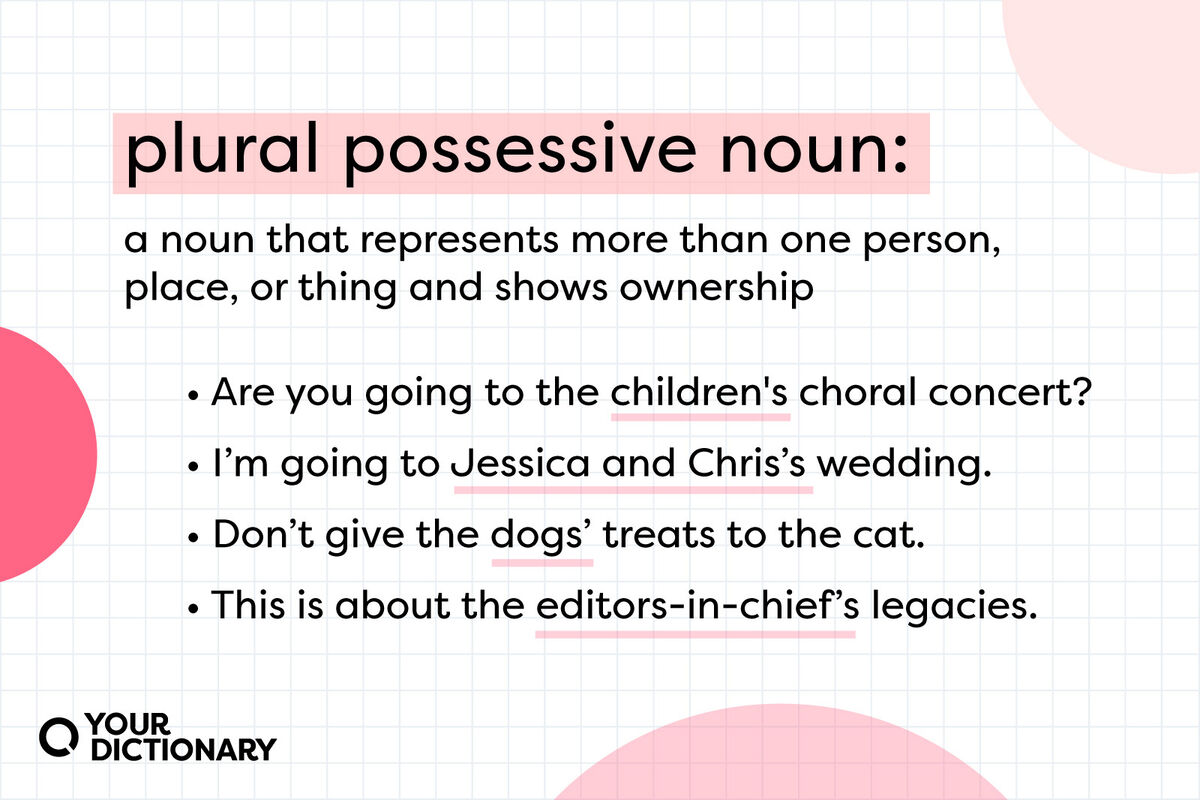
A plural possessive noun is a plural noun that owns something. It uses a possessive ending to show that more than one noun owns the same thing.
Examples of plural possessive nouns include:
- the Smiths’ house
- our cats' beds
- the companies’ logos
- your children’s friends
- the actresses’ fans
- my teachers’ opinions
- the producers’ concern
Notice that the noun each plural possessive noun owns can be singular when the nouns share it (as in the Smiths’ house — one house total), or plural when each noun has their own version (as in our cats’ beds — one bed for each cat).
How To Construct a Plural Possessive Noun
Most of the time, you can make a plural noun possessive by adding an apostrophe to the end, since they already end in “s.” But what happens when a plural noun doesn’t end in “s”?
Add an Apostrophe to Plurals That End in “s”
Most English plurals end in "s” to show that there are more than one of that thing. In these cases, adding an apostrophe after the “s” is all you need. Don’t put the apostrophe before the “s” — that makes it look like the noun is singular.
- Did you buy more of the dogs' treats?
- The employees keep complaining about the stores' different management styles.
- Based on the executives' decision, we are shutting down the project.
- Have you graded the students’ essays?
Add an Apostrophe and “s” to Irregular Plural Nouns
For plural nouns that don't end in "s" (known as irregular plural nouns), make them possessive by adding an apostrophe followed by an "s.”
- There was a line to the men's room at the children's choral concert.
- What do you use the sheep's wool for?
- We must listen to the people's will.
- Have the scientists discovered the fungi's origin?
Add an Apostrophe and “s” to Hyphenated and Compound Nouns
Making a hyphenated or compound noun plural involves two changes. First, add an “s” to the first noun (even if it’s hyphenated). Then, add an apostrophe and “s” to the last word.
- The women exchanged stories about their mothers-in-law’s comments.
- We could hear the passers-by's voices from our balcony.
- The reporter honored their editors-in-chief's legacies.
For open (unhyphenated) compound nouns that already end in “s,” you can just add an apostrophe.
- I heard the fire trucks’ sirens blocks away.
- These bus stops’ signs are hard to read.
- Our mountain bikes’ tires are too narrow for this path.
Add an Apostrophe to Proper Plural Nouns That End in “s”
If you’ve ever gotten a holiday card with a questionable apostrophe after the family’s last name, you know the struggle. When do you add the apostrophe after plural proper nouns — and when is an “s” good enough?
Add an apostrophe only when the plural noun ends in “s,” and when the plural noun possesses something. Don’t add an apostrophe otherwise.
- Did you hear about the Wells’ vacation?
- You’ll have to ask for the Patels’ opinion.
- I never knew that was the Andersons’ dog.
If you were saying “Happy holidays from the Andersons,” you wouldn’t use an apostrophe because the Andersons don’t own anything in this sentence. (Keep that in mind this holiday season.)
Common Possessive Noun Confusion
Regular vs. irregular nouns aren’t too tricky when it comes to possession. But nouns that don’t own the same thing (and nouns that do own the same thing) can confuse even the most self-possessed writer. Are these nouns plural — or are they just complicated?
Multiple Nouns With Shared Possession
What happens when a sentence has two nouns that share ownership? They’re not plural; they’re a compound possessive. The apostrophe and “s” go after the second noun only.
- That’s Jack and Jill's hill. (The hill belongs to Jack and Jill)
- George, Jerry, and Elaine's relationship is not always friendly. (The relationship belongs to George, Jerry, and Elaine)
- Have you been to Mom and Dad's house lately? (The house belongs to Mom and Dad)
Multiple Nouns With Different Possession
When a sentence has two nouns that each have their own version of the thing they own, each noun needs their own apostrophe and “s.”
- Jan's and Tony's cars are both acting up. (Jan and Tony own two separate cars)
- George's and Harriet's grades were good enough for them to graduate. (George and Harriet receive separate grades)
- Matilda's, Yvette's, and Carlos’s ambitions led them to their careers. - (Matilda, Yvette, and Carlos each have different ambitions)
Notice that Carlos, which ends in an “s,” also has an apostrophe and “s” after it. You can just add an apostrophe if you prefer; the meaning is clear both ways, since Carlos is never a plural noun.
Plural Possessive Nouns Quiz
Can you make these phrases into plural possessive nouns?
- a party for the teachers
- the feathers of the birds
- the jobs of students
- the barks of dogs
- the dressing room for women
- the uniforms of nurses
- the cage of more than one mouse
- zoos of Tennessee
- a cat jointly owned by Megan and Evan
- a car that mom and dad own together
Answer Key for Plural Possessive Nouns Quiz
Could you make those nouns share (in a grammatically correct way)?
- a party for the teachers - a teachers' party
- the feathers of the birds - the birds' feathers
- the jobs of students - the students' jobs
- the barks of dogs - the dogs' barks
- the dressing room for women - the women's dressing room
- separate uniforms of doctors and nurses - the doctors’ and nurses' uniforms
- the cage of more than one mouse - the mice's cage
- zoos of Tennessee - Tennessee's zoos
- a cat jointly owned by Megan and Evan - Megan and Evan's cat
- a car that mom and dad own together - mom and dad's car