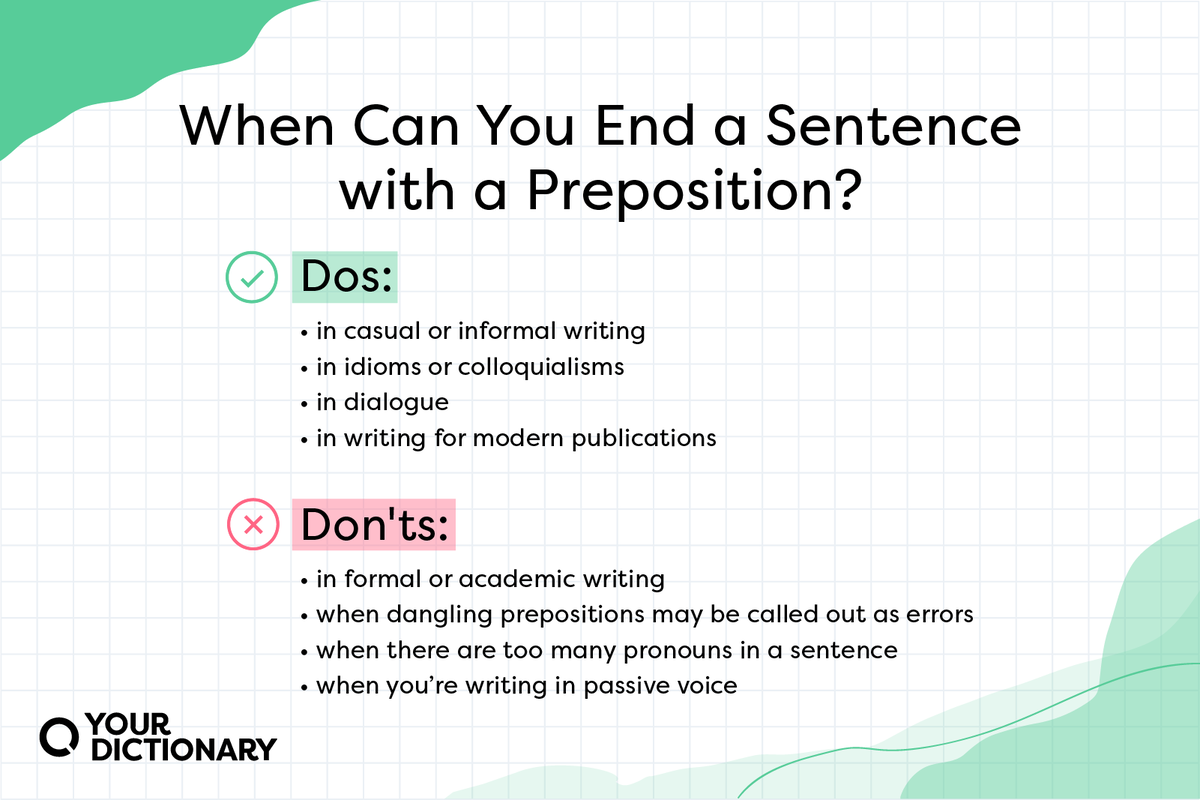
So, can you end a sentence with a preposition? The answer is: sometimes.
Ending a sentence with a preposition has long been considered grammatically incorrect. It's a rule from Latin grammar that was applied to English. However, while it’s still frowned upon by traditional readers, it’s not technically an error. Learn when ending a sentence with a preposition is okay — and how to fix those sentences when it’s not.
You Can End a Sentence with a Preposition in Casual or Informal Writing
It’s most acceptable to end a sentence with a preposition in casual or informal writing. This phrasing is more conversational, and therefore more appropriate in this setting, especially in questions. For example:
- What are you sitting on?
- I don’t know what I’m hungry for.
- This is the movie I told you about!
- Where are you from?
- Who is he going out with?
It's perfectly acceptable to end a sentence with a preposition if the alternative would create confusion or sound unnatural. “What are you sitting on?” and “This is the movie I told you about!” sounds much more natural than “On what are you sitting?” or “This is the movie about which I told you!”
You Can End a Sentence with a Preposition in Idioms or Colloquialisms
Several English idioms and colloquial expressions end in prepositions. When you put the expressions at the end of a sentence, the sentence therefore ends in a preposition. For example:
- What’d you do that for?
- Let your sister come along.
- Thanks for stopping by!
- The decorations are all set up.
- Tucker needs to calm down.
You can rewrite these sentences to avoid ending in prepositions (“Let your sister come along” becomes “Let your sister come with you”). But generally, this use is acceptable.
When Should You Move the Preposition from the End?
While informal writing doesn’t require you to move the preposition away from the end of the sentence, it may be best to do so in formal writing.
Phrases that sound natural in a conversation may feel overly familiar or awkward in a formal essay, article, or conversation.
Dangling Prepositions
Prepositions form relationships between words (the object of the preposition) and other words in a sentence. They can show connections of location, time or ideas. Examples of prepositions at work include:
- The remote is behind the couch.
- Tina can’t decide between soda or juice.
- I left my glasses at the movies.
- Let’s go home after dinner.
These prepositions all fall within the sentence, not at the end. But sometimes, prepositions find themselves at the end of a sentence. This is known as a dangling preposition (or a hanging preposition). Here are some examples of sentences that end with prepositions.
- What should I put the cookies in?
- You need to decide which friend you’re going with.
- Josephine left the radio on.
- Who is this gift for?
Strict grammarians may cringe at these sentences, but ending a preposition is a question of style, not proper grammar. There are specific instances in which you can end a sentence with a preposition in modern writing, and other contexts in which you should avoid these dangling prepositions.
Relative Clauses: Add a Pronoun, Move the Preposition
Splitting relative clauses is one of the most common ways to end a sentence with a preposition. They begin with relative pronouns (who, whom, that, which) and can function as the subject or object of a sentence. When they’re the object of the sentence, you can omit the pronoun — but this often results in a dangling preposition. For example:
- She’s the girl I’m going to the dance with.
- World War II is the era I’m focusing on.
- Love is a subject Thomas knows nothing about.
Each of these sentences has a relative clause, but you can’t find it because the pronoun is missing. When you put the relative pronouns back, the preposition moves as well.
- She’s the girl with whom I’m going to the dance.
- World War II is the era on which I’m focusing.
- Love is a subject about which Thomas knows nothing.
These new sentences sound more formal, but still correct. It’s worth adding the relative pronouns back to relative clauses in formal writing to make sure readers understand your meaning.
Infinitive Phrases: Change as Needed
Another common way to end a sentence with a preposition is to shorten an infinitive phrase. When infinitive phrases function as adverbs, they follow the noun that they modify. For example:
- We have so much in our lives to be grateful for.
- There’s nothing to be afraid of.
- I wish I had someone to talk to.
Adding relative pronouns in these sentences technically works, but they sound more awkward. (For example: “We have so much in our lives for which to be grateful” is correct, but doesn’t sound quite right). In formal writing, it’s best to rewrite the sentence and put the noun back after the preposition (“We are grateful for so much in our lives.”)
Passive Voice: Rewrite the Sentence
If you don’t know the subject of a sentence or who is performing the action, you may find yourself writing in passive voice. In addition to ending a sentence in a preposition, writing in passive voice is also a no-no to traditional grammarians. For example:
- The game was called off.
- These children are unaccounted for.
- The issue has been dealt with.
As with all passive writing, rewriting the sentence can clear up any doubt of grammatical correctness (“The game was called off” becomes “The game was canceled,” for example). But if you need to write in passive voice, be sure that you actually need to end the sentence in a preposition.
Unnecessary Prepositions: Remove the Preposition
Many times, sentences end with a preposition because there are simply too many prepositions in it! These are the easiest sentences to edit. For example:
- I don’t know where my shoe is at.
- This laundry needs to be separated out.
- Kyle doesn’t know where he’s going to.
In these cases, you simply take out the last prepositions. The sentences still function in the same way.
- I don’t know where my shoe is.
- This laundry needs to be separated.
- Kyle doesn’t know where he’s going.
Be Clear and Communicative in Your Writing
Like many grammar rules, the idea of avoiding prepositions at the ends of sentences is a rule you can break — if you know why you’re doing it. Clear up any other preposition misunderstandings with these tips on determining whether to use in or on in your writing.