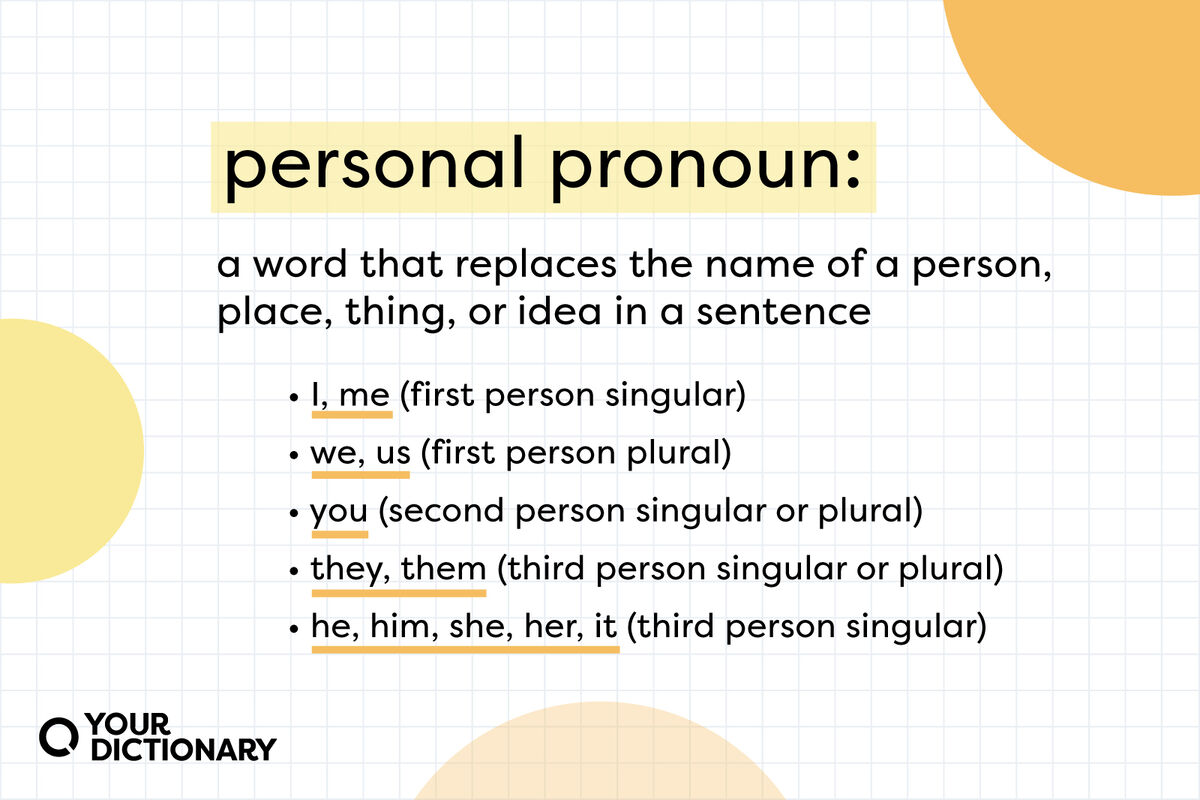
When you think of a pronoun, you’re probably thinking of a personal pronoun. Personal pronouns replace the names of people in a sentence. They can also replace other nouns (such as places, things, and ideas) based on the speaker’s point of view.
Examples of personal pronouns include:
- I
- me
- they
- we
- us
- them
- you
- he
- him
- she
- her
- it
List of Personal Pronouns by Point of View
You can divide personal pronouns into singular and plural categories, depending on the number of items they refer to. You can also divide them into first, second, and third person points of view.
- I went to the movies last night. (I replaces the name of the speaker)
- Have you talked to Tom yet? (you replaces the name of the listener)
- Don’t listen to Gordon. He really does like that song. (He replaces Gordon)
- My shoes are missing. I can’t find them anywhere. (them replaces shoes)
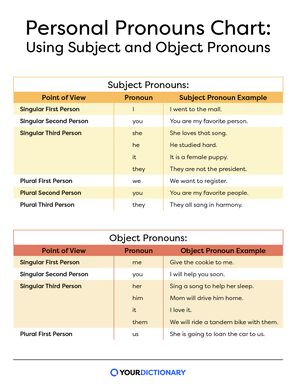
To keep all your personal pronouns straight, use our printable chart as a reference guide.
“They” and “Them” as Gender-Neutral Singular Pronouns
Traditionally, the pronouns they and them were used as plural third person pronouns. But style guides have recently accepted them as singular pronouns where the speaker’s gender is neutral or unknown.
When a person’s gender identity is nonbinary, they may prefer they/them as their personal pronouns. However, note that even the singular form of they/them uses plural verbs (they are vs. they is).
- All I know about the new student is that they are named Marion.
- Did you ask each person if they want to stay for dinner?
Some people may prefer personal pronouns that better reflect their gender identity (such as ze/zir). Although these pronouns may not appear on traditional grammar lists, they are still grammatically correct (as long as you watch the subject-verb agreement).
Advertisement
How To Use Personal Pronouns
Identifying personal pronouns is only part of the grammar journey. But how — and where — do you use them in a sentence?
Pronoun-Antecedent Agreement
The noun that a pronoun replaces is called the antecedent. The pronoun selected must agree with its antecedent.
- President Obama delivered a speech on health care reform. He spoke for more than an hour. (President Obama is the singular antecedent to the personal pronoun he)
- Paul and Jane were new to the area, but they already felt at home. (There are two subjects, so use the plural pronoun they)
Examples of Subject Pronouns
Subject pronouns include I, you, she, he, it, we, and they. Subject pronouns replace the name of the subject in the sentence.
- I love reading science fiction.
- You are the love of my life.
- He studied hard but still failed the test.
- She went to a party with friends.
- Is the puppy male or female? It is a girl.
- We want to register to vote.
- They are not in charge here.
Advertisement
Examples of Object Pronouns
Object pronouns include me, you, her, him, it, us, and them. Object pronouns take the place of the object in the sentence (the noun that receives the action in a sentence).
- Give the cookie to me.
- Dad will help you soon.
- Sing a song to help her sleep.
- My mom will drive him home.
- I had to pay full price for it because I lost the coupon.
- She is going to loan her car to us.
- The carrots went bad, so we had to throw them away.
Notice that you use I when you are the one performing the action (I love reading science fiction) but me when you are the one receiving the action (He read science fiction to me).
Be Pro-Nouns with Pronouns
Pronouns improve your writing — as long as you use them correctly. Once you’ve got your personal pronouns in order, learn how relative pronouns (who, which, that) and reflexive pronouns (myself, yourself, ourselves) work to support those important nouns in your sentences.