It can be confusing to keep all your types of pronouns straight. Which is which? What is what? Learn about nominative pronouns through examples; and discover tips and tricks for using them.
Defining Nominative Pronouns
Nominative case pronouns are often called nominative pronouns or subjective pronouns. When a noun or pronoun is used as the subject of a verb, the nominative case is used.
The list of nominative case pronouns includes:
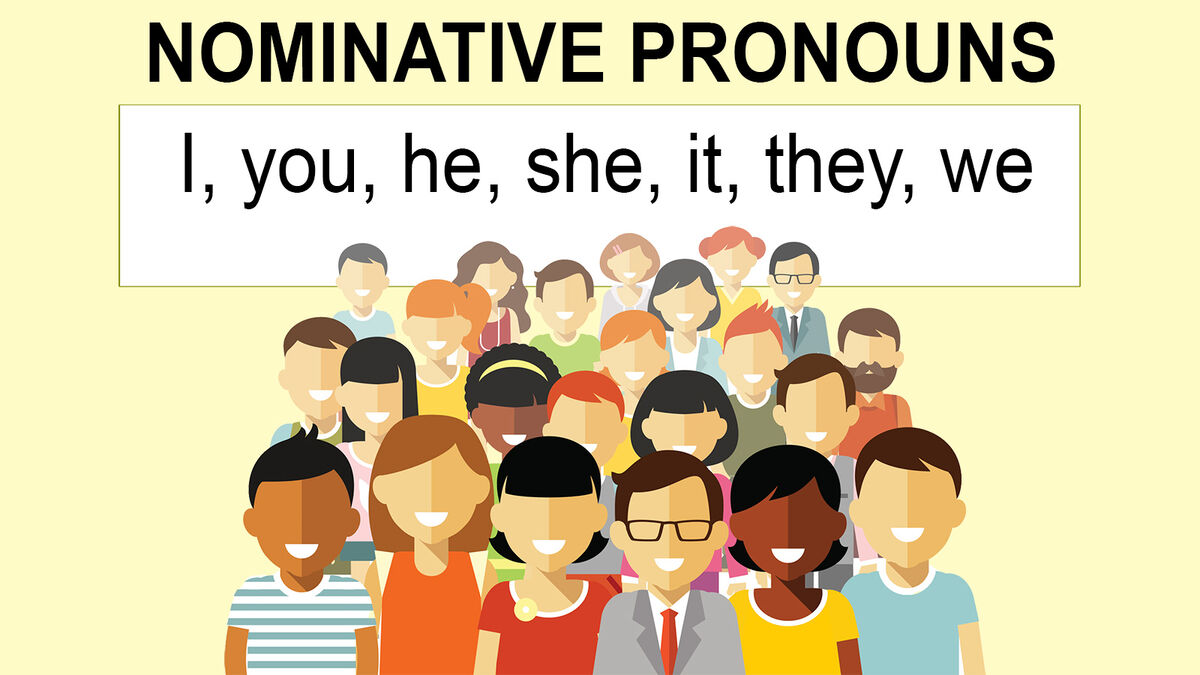
I, you, he, she, it, they and we
These are the pronouns that are usually the subject of a sentence and perform the action in that sentence.
Examples of Nominative Case Pronouns
Check out these examples of nominative pronouns acting as the subject of a sentence:
- I went to the store today.
- She talked to her brother on the phone.
- You ran five miles yesterday.
- They are not very happy about what happened.
- We work together as a team.
- It is my favorite color.
- He is my best friend.
Pronoun Cases
Personal pronouns have three cases. Each case is used when the pronoun acts as a different part of speech in a sentence. Besides the nominative case, the other two cases are objective case and possessive case.
Pronouns That Are Not Nominative
These pronouns are not usually nominative because they are being affected by the subject and verb in a sentence:
me, them, her, him and us
Check out these examples of pronouns that aren’t in the nominative case. Can you understand why they are not nominative pronouns?
- My mom told me to go to the store today.
- The coach ordered her to go for a run.
- The students don't understand him.
- Nobody will listen to me!
- The maid doesn't want to do the cleaning for them.
These are not nominative pronouns because they are not the subject of the sentence, and they are just being affected by the subject.
Mistakes With Nominative Pronouns
Many people struggle when labeling pronouns by their type, but they usually use these pronouns correctly in a sentence.
I and Me as Nominative Pronouns
There are typical mistakes even native English speakers make with nominative pronouns. This usually involves using “I” and “me” interchangeably. Look at the following two sentences:
- Sally and me are doing our homework together. (incorrect)
- Sally and I are doing our homework together. (correct)
The second sentence is correct, because "Sally and I" is the subject of the sentence, so the nominative pronoun must be used for the sentence to make sense grammatically. However, the example below completely changes the situation. Can you understand why?
- The teacher told Sally and me to do our homework. (correct)
- The teacher told Sally and I to do our homework. (incorrect)
Remember that "I" is a nominative pronoun. This means you can't use it when it is an object in a sentence. "The teacher" is the subject, which makes "Sally and me" the correct object. Try not to confuse your nominative pronouns with other pronouns.
Examples of Nominative Pronouns in Sentences
A look at more examples of nominative pronouns can help you master this concept. Each of the following sentences correctly uses the nominative case of pronouns.
- She likes chocolate ice cream.
- It is a beautiful day outside.
- He is very tall.
- They live near my house.
Pronoun Practice
Determine whether the pronouns are used correctly in the following sentences. If the pronouns are not used correctly, how could you change the sentence to make the pronoun correct?
- I am the team leader.
- Me like to eat cookies.
- Her is a very nice lady.
- Him go to the store to buy milk for breakfast.
- Them are my neighbors.
- Everyone has to follow what me says.
- If you want to understand he, then you will have to listen very carefully.
- Not many people know that her is an astronaut.
Nominative Pronoun Practice Answers
The correct answers to the previous section are:
- Correct
- Incorrect. I like to eat cookies.
- Incorrect. She is a very nice lady.
- Incorrect. He goes to the store to buy milk for breakfast.
- Incorrect. They are my neighbors.
- Incorrect. Everyone has to follow what I say.
- Incorrect. If you want to understand him, then you will have to listen very carefully.
- Incorrect. Not many people know that she is an astronaut.
When Pronouns Are Subjective
If you remember that nominative pronouns are also called subjective pronouns, it will help you remember to use them as the subject of a sentence. For more pronoun practice, use a few pronoun worksheets.