You made cookies for Taylor and me — or did you make cookies for Taylor and I? Only one version is correct, and your knowledge of object pronouns can help you figure out which one. (Thanks for the cookies, though. Taylor and I enjoyed them — or did Taylor and me enjoy them?)
What Is an Object Pronoun?
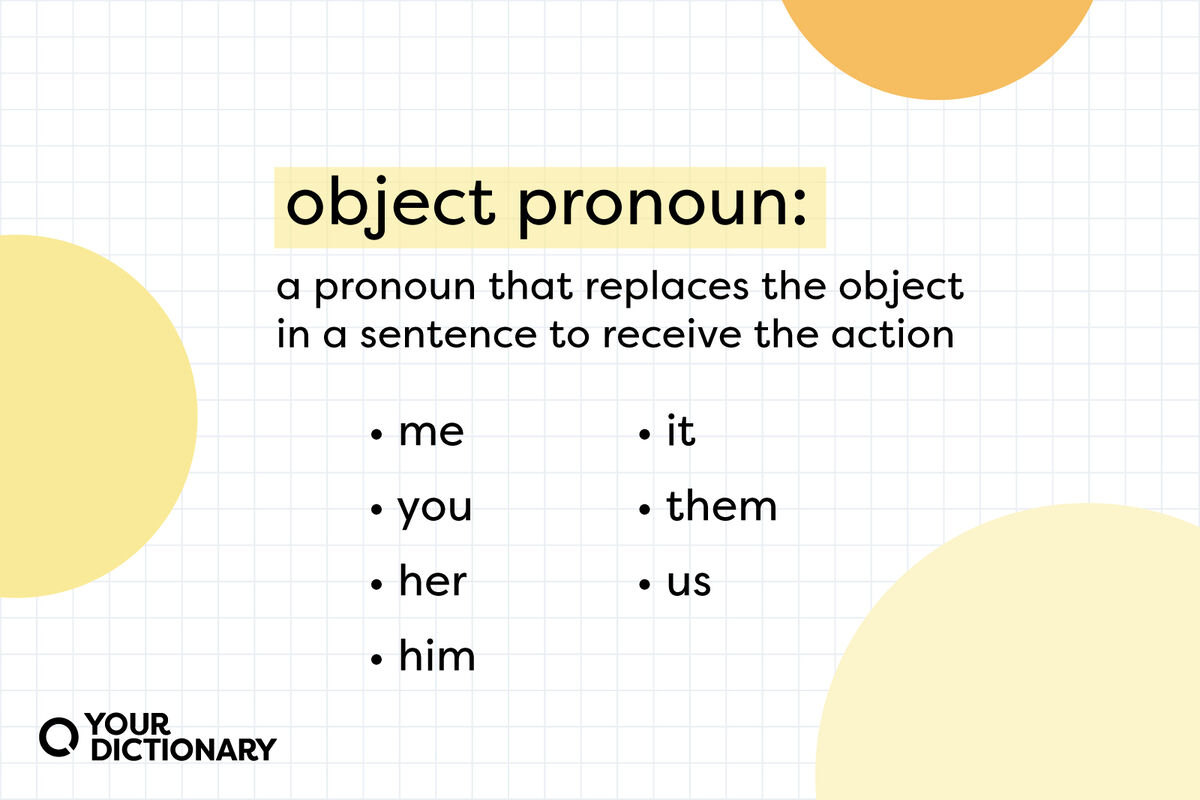
Object pronouns receive the action in a sentence. They’re a type of pronoun that replaces object nouns — nouns that receive the action.
- My dad fixed my screen door. We made a cake to thank him. (Him replaces my dad)
- Mary ordered chocolate ice cream. She really enjoyed it. (It replaces chocolate ice cream)
- I spent the week with my family. I love them so much. (Them replaces my family)
In the last sentence, the verb is love and the object is my family, because they’re the ones receiving your love (aww). If you replace the object noun my family with the object pronoun them, the meaning is the same.
List of Object Pronouns
The object pronouns (also called objective pronouns) in English are:
- me
- you
- him
- her
- it
- them
- us
Try starting out a sentence with these pronouns. Except for you and it (which have the same subject and object pronoun forms), they don’t sound right — because object pronouns usually appear at the ends of sentences.
Object Pronouns vs. Subject Pronouns
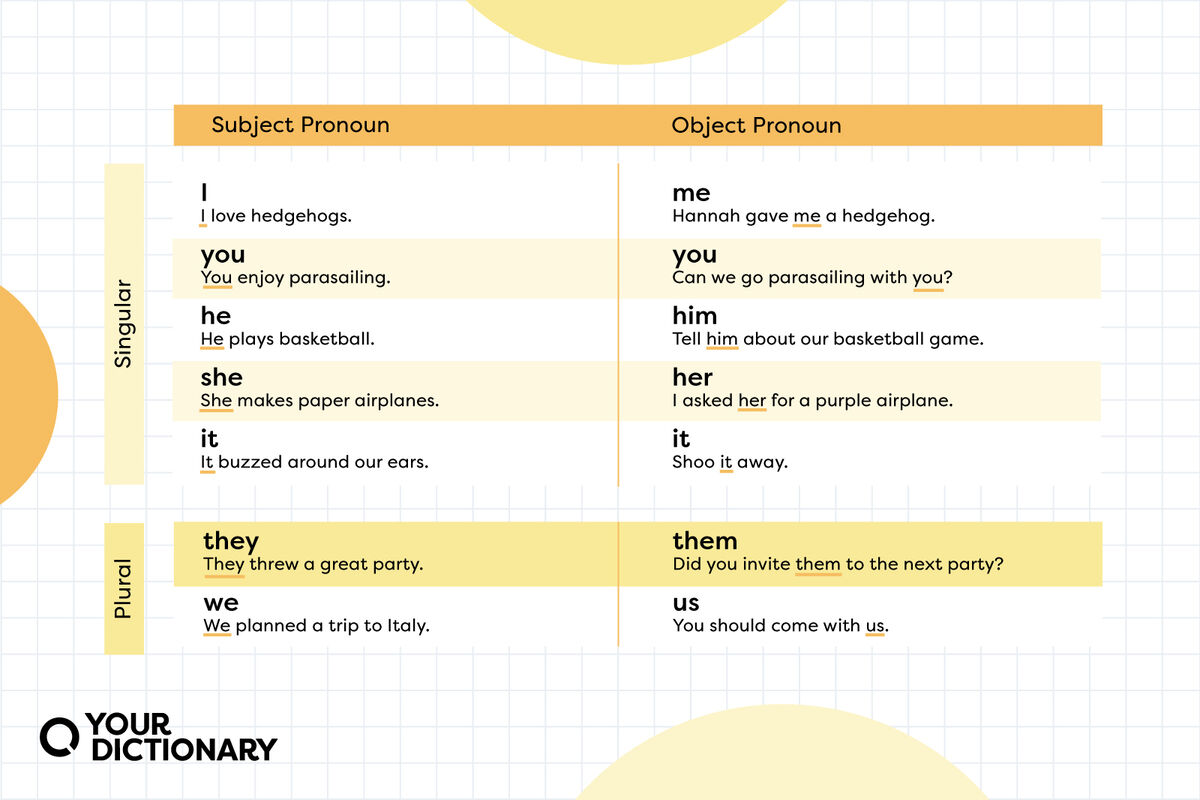
For pronouns that appear at the beginning of sentences, you need subject pronouns (I, you, he, she, they, we). They replace a sentence’s subject to perform the action — object pronouns merely receive the action.
How To Use Object Pronouns in a Sentence
Like all objects in a sentence, object pronouns enhance meaning by receiving the action. But they can function as different types of objects — namely, direct objects, indirect objects, and objects of a preposition.
Examples of Object Pronouns as Direct Objects
Direct objects directly receive the action from the sentence’s verb. When object pronouns function as direct objects, they usually appear right after the verb itself.
- The baby was tired, so I carried her.
- Look at this sculpture. Barry made it.
- Can you help us?
Examples of Object Pronouns as Indirect Objects
Object pronouns as indirect objects go even further — they receive the direct object. They can also appear right after the verb, but are followed by the direct object (italicized in the sentences below).
- Katie bought me a beautiful dress.
- I told you the truth.
- Don’t give them the answer.
Examples of Object Pronouns as Objects of a Preposition
Object pronouns may also appear after a preposition (underlined in the examples below) as the object of a preposition. While they may still receive the direct object, they’re still functioning as part of a prepositional phrase.
- Did you make this raspberry pie for me?
- Gary went to the movies with her.
- The kids want to sit next to us.
What Happens When There’s Two Objects?
When you have two objects in a sentence (known as compound objects), choosing the best way to write them can be tricky. Should you use I or me after a verb? Is there a way to figure it out?
The trick is to remove the other object from the sentence. If it still makes sense, then use me. If it sounds odd, it’s probably a compound subject, and you should use I.
- Incorrect: Perry invited Casey and I to the party. (I is a subject pronoun — if you remove Casey, Perry invited I to the party doesn’t sound right)
- Correct: Perry invited Casey and me to the party. (Me is an object pronoun — if you remove Casey, Perry invited me to the party sounds right)
- Incorrect: Is there enough pizza for she and the kids? (She is a subject pronoun — if you remove the kids, Is there enough pizza for she doesn’t sound right)
- Correct: Is there enough pizza for her and the kids? (Her is an object pronoun — if you remove the kids, Is there enough pizza for her sounds right)
Note that you only need to worry about this issue with singular object pronouns that change form (me, her, him).
Object Pronoun Practice
Can you identify the correct object pronoun for each sentence?
- Please make (I, me) an ice cream sundae.
- Ask (he, him) and his wife if they’d like a soda.
- Can Rory join (we, us) on our trip?
- We should hire (she, her) for the job.
- I never want to see (he, him) again.
- You can sit with Andrew and (I, me).
Answers for Object Pronoun Practice
Were you able to find all the subject pronouns in bold below?
- Please make (
I, me) an ice cream sundae. - Ask (
he, him) and his wife if they’d like a soda. - Can Rory join (
we, us) on our trip? - We should hire (
she, her) for the job. - I never want to see (
he, him) again. - You can sit with Andrew and (
I, me).