You don’t have to agree with everyone you know. You can even “agree to disagree” (which typically means “I think you’re wrong, but I don’t want to talk about this anymore”). But pronouns don’t have that option — they always have to agree with their antecedents. Luckily, grammatical agreement is different from agreeing in a conversation, so those pronouns don’t need to worry too much.
What Is Pronoun Agreement?
A pronoun refers back to a noun that appeared previously in the sentence or conversation.
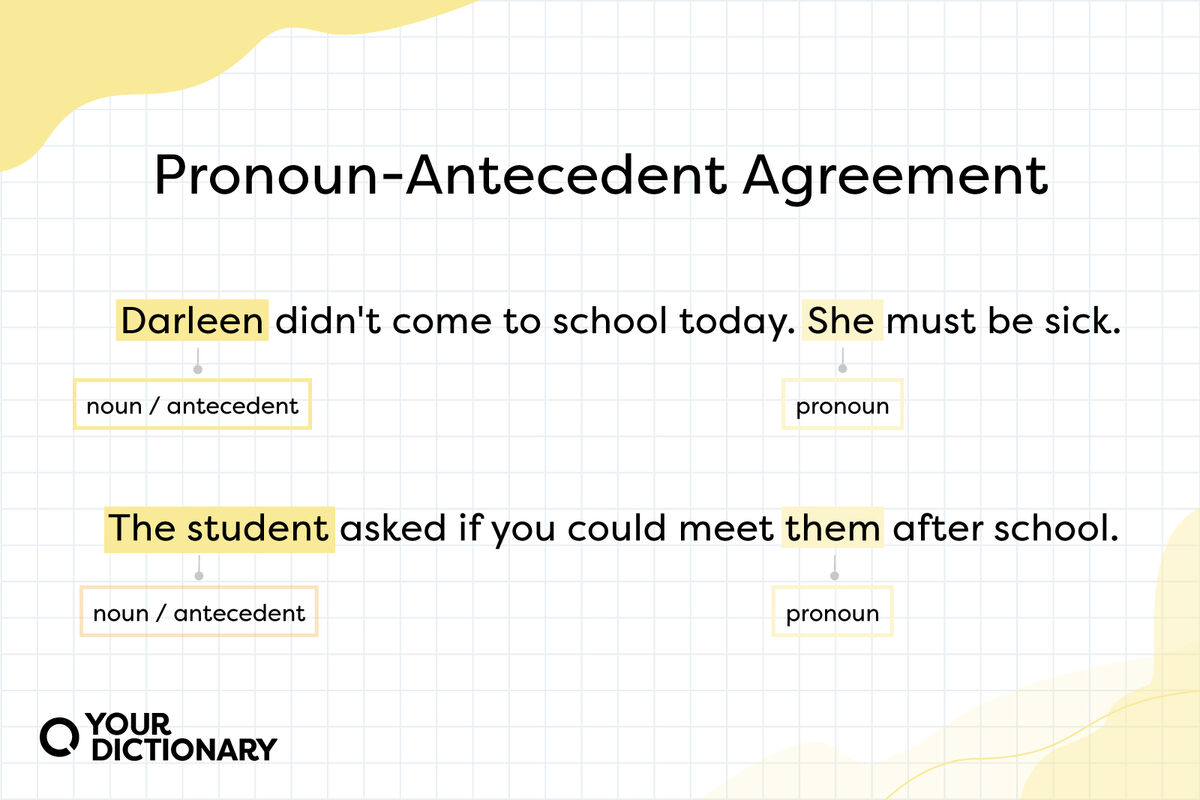
Pronoun agreement means that a pronoun and its antecedent (the noun a pronoun replaces) agree in number and gender. If the antecedent is singular, the pronoun must be singular. If the antecedent refers to a woman, the pronoun should also refer to a woman — and so on.
- Amelia never thought she would get the job.
(The singular feminine she refers to Amelia) - Please tell Frank that I love him.
(The singular masculine him refers to Frank) - My sisters like to put up their Christmas decorations in October.
(The plural their refers to my sisters) - Gary and I would like to see a movie, but we are too busy tonight.
(The plural we refers to Gary and I)
Pronoun-antecedent agreement helps the reader understand what noun a pronoun is replacing. Saying “Gary and I would like to see a movie, but she is too busy tonight” could confuse a reader. (Who is “she”? What does she have to do with our plans?)
What About Neutral or Non-Binary Nouns?
While English is typically not a gendered language, it does have one gendered element — feminine and masculine pronouns (she/her, he/him) to refer to female and male nouns. However, they/them functions as a singular gender-neutral pronoun if you don’t know a noun’s gender, or if the noun refers to a person who identifies as non-binary (neither male nor female).
- The student asked if you could meet them after school. (Them refers to a gender-neutral noun, student, when you don’t know the student’s gender)
- Percy would like you to call them immediately. (Them refers to Percy, who identifies as non-binary)
Using she/her or he/him in these cases would not be correct pronoun-antecedent agreement, and could even be considered misgendering.
Examples of Pronoun Agreement in Sentences
See a noun, pick the right pronoun — it seems simple enough. But is there a difference between a subject pronoun and an object pronoun? Do demonstrative pronouns and indefinite pronouns also need to agree with their antecedents? (The answer is yes to both.)
Subject Pronoun Agreement
Personal pronouns replace names of nouns in a sentence. When they function as the subject of the sentence, replace them with subject pronouns (I, you, she, he, it, they, we).
- Darleen didn't come to school today. She must be sick.
- The rain is driving me crazy. It just won’t stop.
- My family loves baseball. We always buy season tickets.
Object Pronoun Agreement
If the pronoun appears later in a sentence and receives the action, rather than performing it, it’s an object pronoun (me, you, her, him, it, them, us).
- Let’s visit Jack. I haven’t seen him in a long time.
- Can you save some seats for my friends and me? There’s no room for us here.
- Ask the Thompsons if they want a couch. We have one we can give them.
Possessive Pronoun Agreement
Possessive pronouns replace nouns that show ownership over another noun. They also need to agree with their antecedents to avoid misunderstandings.
- Can you ask the Smiths if this dog is theirs?
- Melody told me that the missing shoe was hers.
- You handle your part of the project, and I will handle mine.
Demonstrative Pronoun Agreement
Demonstrative pronouns replace specific nouns in a sentence to draw attention to them. While you don’t need to worry about gender agreement with demonstrative pronouns (since they’re neutral), you should match singular demonstrative pronouns this and that with singular antecedents, and plural demonstrative pronouns these and those with plural antecedents.
- Listen to the next instruction. This matters a lot.
- The cactus is sharp. You shouldn't touch that.
- Do you like my earrings? Bill gave me these last Christmas.
- I didn’t know there were cookies here. Where did you get those?
What About Pronoun-Verb Agreement?
Pronouns not only have to agree with their antecedents — they have to agree with their verbs, too. (Good thing pronouns are pretty agreeable.)
Pronoun-verb agreement rules are the same as subject-verb agreement rules: Since English verbs don’t take a gender, you only need to make the pronoun and verb agree in number.
- She swims 50 laps every morning. (She and swims are both singular)
- He studies for every test. (He and studies are both singular)
- They stay at the same hotel. (They and stay are both plural)
- We know the truth about Todd. (We and know are both plural)
Pronoun Agreement Quiz
Which pronouns would you use to make sure each sentence uses proper pronoun-antecedent agreement?
- Everyone should have (his, her, their) pencil down.
- Did Joseph make (his, her, their) special chili this year?
- I don’t agree with Mr. Gherry. (He, She, They) thinks we should forfeit the game.
- Nobody can decide what kind of ice cream (he, she, they) want.
- I haven’t spoken to the police officer. Can you ask (him, her, them)?
- My friends and I thought that you could help (we, them, us).
Answer Key for Pronoun Agreement Quiz
Were you able to identify all the correct pronouns?
- Everyone should have (
his, her, their) pencil down. - Did Joseph make (his,
her, their) special chili this year? - I don’t agree with Mr. Gherry. (He,
She, They) thinks we should forfeit the game. - Nobody can decide what kind of ice cream (
he, she, they) want. - I haven’t spoken to the police officer. Can you ask (
him, her, them)? - My friends and I thought that you could help (
we, them, us).