It may sound strange to compare pronouns to mirrors. After all, pronouns replace nouns — they don’t let you see that little piece of kale between your teeth. But reflexive pronouns reflect the subject of a sentence just the way that bathroom mirror reflects your face back at you. They can’t do much about the kale, though.
What Is a Reflexive Pronoun?
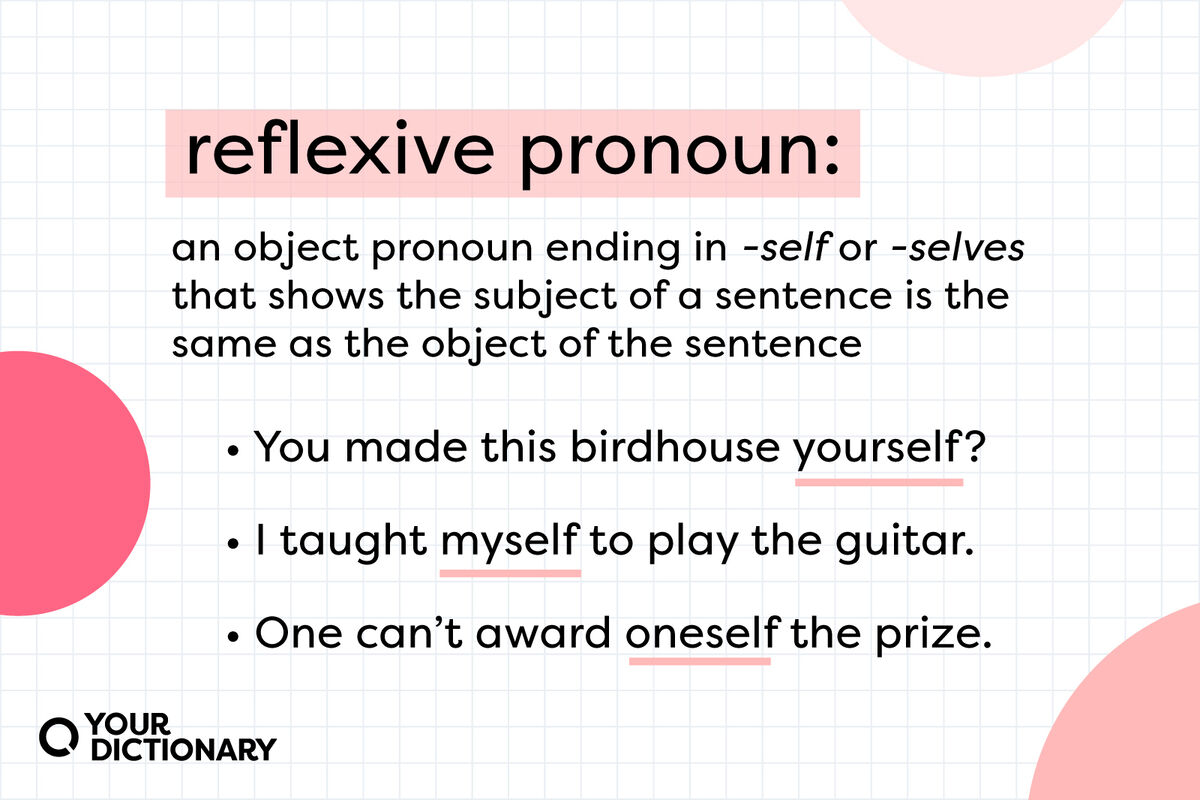
Reflexive pronouns show that the object of a sentence is the same as the subject. Reflexive has a similar meaning to reflect — “turning back.” These types of pronouns always end in -self for singular nouns or -selves for plural nouns.
- I bought myself a new car. (Subject I and object myself are the same person)
- You made this birdhouse yourself? (Subject you and object yourself are the same person)
- Jack learned how to care of himself in college. (Subject Jack and object himself are the same person)
- Thanks for the offer, but we would rather drive ourselves. (Subject we and object ourselves are the same people)
List of Reflexive Pronouns
Compare a list of 10 reflexive pronouns to their corresponding personal pronouns. (Note that some personal pronouns, such as you and they, have both singular and plural reflexive pronouns.)
|
Personal Subject Pronoun |
Personal Object Pronoun |
Reflexive Pronoun |
|
I |
me |
myself |
|
you (singular) |
you |
yourself |
|
you (plural) |
you |
yourselves |
|
he |
him |
himself |
|
she |
her |
herself |
|
it |
it |
itself |
|
one |
one |
oneself |
|
they (singular) |
them |
themself |
|
they (plural) |
them |
themselves |
|
we |
us |
ourselves |
Oneself and themself may not seem like real words, but they are. One is an indefinite pronoun to mean “an unknown or hypothetical person.” Themself corresponds to the singular them, and has been in the dictionary since 2019. (If you don’t like themself, no one will mind if you use the more traditional themselves, even in a singular context.)
How To Use Reflexive Pronouns
Reflexive pronouns function just like any other object pronoun: They show who receives the action of a sentence. In this case, the subject is both performing and receiving the action — and reflexive pronouns make that clear.
Examples of Reflexive Pronouns as Direct Objects
When a reflexive pronoun is the direct object of a sentence, it receives the action of a transitive verb.
- I taught myself to play the guitar. (Who did I teach? Myself.)
- We have been preparing ourselves for flu season. (Who did we prepare? Ourselves.)
- The dog scratched itself before falling asleep. (Who did it scratch? Itself.)
- Did you diagnose yourself over the internet? (Who did you diagnose? Yourself.)
Examples of Reflexive Pronouns as Indirect Objects
Reflexive pronouns can also function as indirect objects. Like direct objects, they follow transitive verbs, but they’re not receiving the action — they’re receiving the direct object.
- They made themselves some cookies. (Who did they make the cookies for? Themselves.)
- You gave yourself a raise? (Who did you give the raise to? Yourself.)
- Katie bought herself a new purse. (Who did she buy the purse for? Herself.)
- One can’t award oneself the prize. (Who can’t one award the prize to? Oneself.)
Examples of Reflexive Pronouns as Objects of the Preposition
Objects of the preposition are similar to indirect objects in that they often receive the direct object. But while indirect objects follow transitive verbs, objects of the preposition follow prepositions (for, to, etc.) It’s just a matter of reorganizing the sentence.
- They made cookies for themselves.
- You gave a raise to yourself?
- Katie bought a new purse for herself.
- One can’t award the prize to oneself.
Examples of Reflexive Pronouns in Requests and Commands
In imperative sentences (requests and commands), the subject is always you. Use yourself in these sentences when you’re telling someone to do something to themselves.
- Give yourself one gold star.
- Treat yourself well this week.
- Buy yourself a new shirt.
- Remind yourself about the rules in our house.
Examples of Reflexive Pronouns To Show Independence
You can use reflexive pronouns with the preposition by to create a prepositional phrase that means "alone" or "without any help.”
- I went to the movie by myself.
- The children tidied up their rooms by themselves.
- Did you make this cake all by yourself?
- We prefer studying by ourselves.
Reflexive Pronouns vs. Intensive Pronouns
Intensive pronouns call attention to a noun or pronoun in a sentence. Typically, they come right after a noun or pronoun (the antecedent) to add emphasis, or they appear at the end of a sentence.
Intensive pronouns also end in -self and -selves, but unlike reflexive pronouns, they don’t function as an object in a sentence.
- Reflexive pronoun - I cooked dinner by myself. (I cooked dinner alone.)
- Intensive pronoun - I cooked dinner myself. (I am the amazing person who cooked this dinner.)
- Reflexive pronoun - Marjory picked herself some flowers. (She picked flowers for herself.)
- Intensive pronoun - Marjory herself picked some flowers. (Marjory was the one who picked the flowers.)
- Reflexive pronoun - President Biden attended our banquet for himself. (He attended the banquet because he wanted to.)
- Intensive pronoun - President Biden himself attended our banquet. (The one-and-only President Biden attended the banquet.)
Common Reflexive Pronoun Errors
Using reflexive pronouns shouldn’t be too tricky. After all, how often do you really need words that end in -self and -selves? It happens often — and many times, incorrectly. Sometimes, you really just need a regular old personal pronoun.
Don’t Use Reflexive Pronouns in Compound Subjects
Reflexive pronouns only function as objects in a sentence. However, many writers mistakenly use reflexive pronouns in compound subjects (sentences with more than one subject).
- David and myself will be going to the movies. (Incorrect)
- David and I will be going to the movies. (Correct — replace with a subject pronoun)
If you remove David and from the sentence, only the second example (“I will be going to the movies”) makes sense. “Myself will be going to the movies” is incorrect.
Don’t Use Reflexive Pronouns in Compound Objects
The same rule applies to compound objects — two objects that receive the same action. Only use a reflexive pronoun if the subject is the same person.
- You can give your essay to Dr. Gall or myself on Friday. (Incorrect)
- You can give your essay to Dr. Gall or me on Friday. (Correct — replace with an object pronoun)
Try the same trick here. Remove Dr. Gall or from the sentence. “You can give your essay to myself” doesn’t make sense because the object (myself) doesn’t match the subject (you).
Don’t Say “Hisself” or “Theirselves”
Many writers get confused between hisself vs. himself. It’s easy to see why: Myself uses the possessive determiner my, and yourself uses your. But hisself isn’t a word — himself uses the object pronoun him instead.
The same goes for themselves vs. theirselves. Use the object pronoun them to create themselves, not the possessive their for theirselves (also not a word).
Reflexive Pronouns in Common Expressions
If reflexive pronouns seem a little complicated — don’t worry. You use them all the time in common idioms and expressions without even realizing it.
- I kept to myself. (I didn’t talk to other people.)
- I couldn’t help myself. (I didn’t resist temptation.)
- I ran myself into the ground. (I worked too hard and became exhausted.)
- Pull yourself together. (Stop being emotional.)
- Just be yourself. (Act in an authentic way.)
- Keep your hands to yourself. (Don’t touch other people.)
- Fend for yourself. (Provide for yourself without help from others.)
- Make yourself at home. (Relax and be comfortable.)
- Speak for yourself. (I don’t agree with what you just said.)
- Suit yourself. (Do what you want.)
- Put yourself out there. (Take risks.)
- Don’t sell yourself short. (Don’t undervalue yourself.)
- You’re in a class by yourself. (You’re uniquely superior to others.)
- He is a law (or country) unto himself. (He doesn’t respect or listen to others.)
- He’s so full of himself. (He’s arrogant.)
- She fell over herself to help. (She was very eager to help.)
- He’s digging himself into a hole. (He’s getting into worse trouble.)
- She feels sorry for herself. (She feels self-pity.)
- She reinvented herself. (She changed a lot about herself.)
- He made a fool of himself. (He acted in an embarrassing way.)