They’re not called relative pronouns because they show up on holidays and at family weddings. In fact, relative pronouns are around a lot more often than any distant aunts or cousins you’ll see on Thanksgiving — you probably use them in conversation every day. The key is knowing what they are and how to use them correctly (and they won’t even judge your lifestyle choices).
What Is a Relative Pronoun?
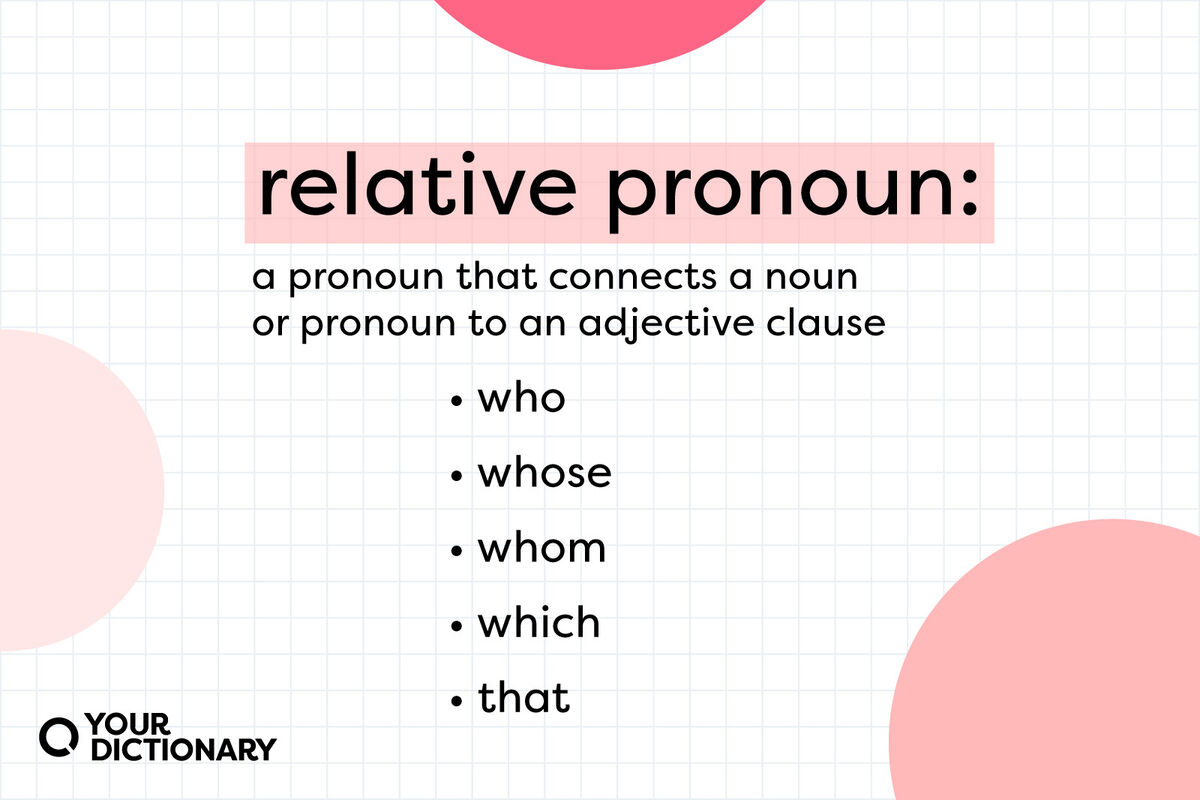
A relative pronoun connects a noun or pronoun to a group of words that provide more information (known as a relative or adjective clause). It functions like a conjunction to combine parts of a sentence.
- The teacher who gave me an A thinks I should be an engineer. (Who connects the teacher to the clause gave me an A)
- The children, whom we love dearly, need better educational systems. (Whom connects the children to the clause we love dearly)
Like all pronouns, relative pronouns replace nouns. Who replaces the teacher, and whom replaces the children. They relate to their antecedent — hence the relative part of their name.
List of Relative Pronouns
The most common relative pronouns are who, whom, whose, which, and that.
|
Relative Pronoun |
Usage |
Example |
|
who |
replaces subject pronouns (people only) |
It was my husband who broke the car door. |
|
whose |
shows possession or relationship |
The girl whose notes I borrowed is really nice. |
|
whom |
replaces object pronouns (people only) |
The man whom they found was my uncle. |
|
which |
adds detail to a noun or pronoun in non-essential clauses |
The robots, which were made in Japan, work well. |
|
that |
adds detail to a noun or pronoun in essential clauses |
The piggy bank that was on my desk got broken. |
How To Use Relative Pronouns
Relative pronouns come right after a noun or pronoun to introduce a modifying clause. But they also replace the noun or pronoun to keep your writing from sounding repetitive.
- I bought a house. The house is closer to my school.
- I bought a house that is closer to my school. (That replaces the house)
- Olivia wants a boyfriend. The boyfriend won’t lie to her.
- Olivia wants a boyfriend who won’t lie to her. (Who replaces a boyfriend)
Chances are, you use relative pronouns so often that you don’t think twice about it. But when should you really include a relative pronoun in a sentence — and when do they need commas?
Relative Pronouns in Essential Phrases and Clauses
Essential clauses, also known as defining or restrictive clauses, are important to the meaning of a sentence.
Don’t use commas with these clauses.
- I don't like people who interrupt me.
- Never go to a doctor whose office plants have died.
- Police officers and firefighters are people whom Andy admires.
- Gifts that have a special meaning are the best of all.
If you remove these clauses from the sentence, the meaning changes so much that they’re not the same sentence anymore. “I don’t like people” is much different from “I don’t like people who interrupt me.”
Relative Pronouns in Non-Essential Phrases and Clauses
Non-essential clauses (also known as non-defining or nonrestrictive clauses) add information that's nice to have but isn't essential to the sentence's overall meaning. If you removed them, the sentence would convey basically the same information.
That’s why you need commas to separate these clauses from the rest of the sentence.
- Byron, who once told me I look like a giraffe, works at the zoo.
- My cat, whose bed I am not allowed to touch, terrifies everyone in our family.
- The president, whom I did not vote for, raised taxes yet again.
- The painting, which Hannah adores, is worth over a million dollars.
In the examples, you could cut out the non-defining clause and still understand the point of the sentence. In the last sentence, the important part is that the painting is worth a million dollars; the fact that Hannah adores it is just nice to know.
Mistakes Using Relative Pronouns
Now that you know how to use relative pronouns correctly, there’s just one issue left — how do you choose the right one and avoid annoying grammar mistakes?
Should You Use "That” or “Which” in Relative Clauses?
Many writers mix up that and which when describing objects and non-human beings. That clarifies the noun you’re talking about in essential clauses — which adds more information in non-essential clauses.
- The Corvette that Dad’s owned for 30 years stopped working. (Essential clause — we need to know which Corvette isn’t working)
- The Corvette, which is Dad’s favorite car, isn’t working. (Non-essential clause — It’s nice to know that it’s Dad’s favorite, but we’d understand the sentence anyway)
- The test that I failed brought my grade down to a C. (Essential clause — we need to know which test brought the grade down)
- The test, which was mostly about feudal Japan, brought my grade down to a C. (Non-essential clause — we don’t need to know what it’s about to understand the sentence)
What About “Who” and “That”?
Another common grammar mixup happens between who and that (or who, that, and which). Who describes people only; that describes objects and non-human things only.
- I like the girl who runs fast.
- I like dresses that have pockets.
- Is that the neighbor who yelled at you?
- Is that the dog that barked at you?
- My sister, who wants to be an architect, built a city out of marshmallows.
- My marshmallows, which I was planning to eat, are now gone.
Can Relative Pronouns Start Noun Clauses?
Relative pronouns typically begin adjective clauses to describe a noun (that’s what adjectives do). But can they ever appear in a noun clause?
The answer is yes — if their clause functions as a noun, not an adjective. These clauses come after the verb in the sentence.
- Do you know who stole my bike?
- I’m trying to decide which dessert I want.
- George heard that he didn’t get the job.
Whoever, Whomever, Whichever, Whatever
When you add -ever to relative pronouns, you get words that function as relative pronouns to introduce noun clauses. Use these words when you’re not sure who (or what) you’re talking about.
- Whoever stole my bike should return it.
- Whichever dessert you choose will be delicious.
- George will take whatever job he can get. (Note that you replace that with whatever in these cases, rather than thatever.)
Can Relative Pronouns Ask a Question?
With words like which, who, and whom, you’d think that relative pronouns are actually question words. You’d be right — sort of.
When those words ask a question, they’re functioning as interrogative pronouns which replace nouns in interrogative sentences. Relative pronouns add information; interrogative pronouns ask questions to gather more information.
- Relative pronoun - The birthday cake, which Freya made herself, exploded in the oven.
- Interrogative pronoun - Which exploded in the oven?
- Relative pronoun - The person who rang the bell was selling magazines.
- Interrogative pronoun - Who rang the bell?
When they come before a noun in a question, they're functioning as interrogative determiners. In the question "Which cake exploded in the oven?", which modifies cake.
Are “When,” “Where,” and “Why” Relative Pronouns?
It may seem as though there are a few words missing from the list above. But when, where, and why aren’t relative pronouns; they’re relative adverbs. Relative adverbs function like relative pronouns, but they refer to time, places, and reasons.
Most of the time, they replace adverbs in a sentence to add more detail. But they can also function as relative pronouns when wording gets confusing, especially with the pronoun which.
- Grandma remembers a time in which radio shows were popular. (Relative pronoun in which feels awkward)
- Grandma remembers a time when radio shows were popular. (Relative adverb when functions the same way, and sounds better)
- The company for which I work has great benefits. (Relative pronoun for which feels awkward)
- The company where I work has great benefits. (Relative adverb where sounds better)
- That’s the reason for which I’m late. (Relative pronoun for which feels awkward)
- That’s the reason why I’m late. (Relative adverb why sounds better)
Relative Pronoun Quiz
Can you find the relative pronouns in each sentence?
- Umberto loves movies that have a lot of action.
- My brother, who hates flying, took an hour to get onto the plane.
- Whoever bought me this lovely necklace has wonderful taste.
- Here’s the part in the book where the main character fights a dragon.
- We invited people whom we feel are fun at a party.
- This weekend I watched romantic movies, which always make me cry.
Relative Pronoun Quiz Answer Key
Check your answers below.
- Umberto loves movies that have a lot of action.
- My brother, who hates flying, took an hour to get onto the plane.
- Whoever bought me this lovely necklace has wonderful taste.
- Here’s the part in the book where the main character fights a dragon. (Where functions as relative pronoun in this case)
- We invited people whom we enjoy being around.
- This weekend I watched romantic movies, which always make me cry.