Why is “Josh and I are afraid of dinosaurs” correct, but “Dinosaurs scare Josh and I” isn’t correct? Sentences can be fussy when it comes to the pronouns you use and where you put them. But learning about subject pronouns doesn’t have to be scary — at least, not as scary as a dinosaur.
What Is a Subject Pronoun?
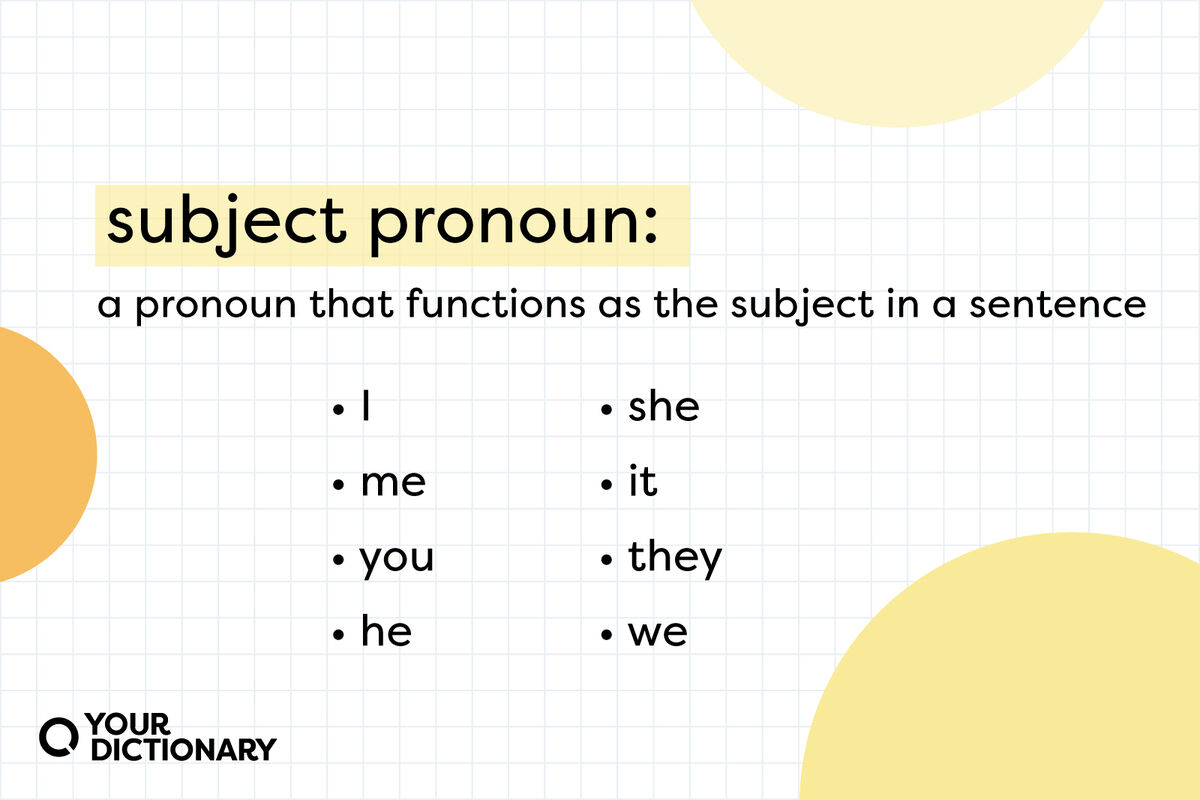
Subject pronouns function as the subject of a sentence. Like all types of pronouns, they replace a noun — in this case, the noun that was the subject of a sentence.
- Sheila really makes me laugh. She is too funny. (She replaces Sheila)
- My teacher is very strict. He won't let us turn in late work. (He replaces my teacher)
- The bear growled at the wolf. It was protecting its cubs. (It replaces the bear)
Subject pronouns, also known as subjective pronouns, tell us who performs the action in a sentence. They keep our writing from being repetitive — as long as the reader understands who or what the antecedent (the word the pronoun replaces) is.
List of Subject Pronouns
There are only seven subject pronouns to remember. They are:
- I
- you
- he
- she
- it
- they
- we
Subject Pronouns vs. Object Pronouns
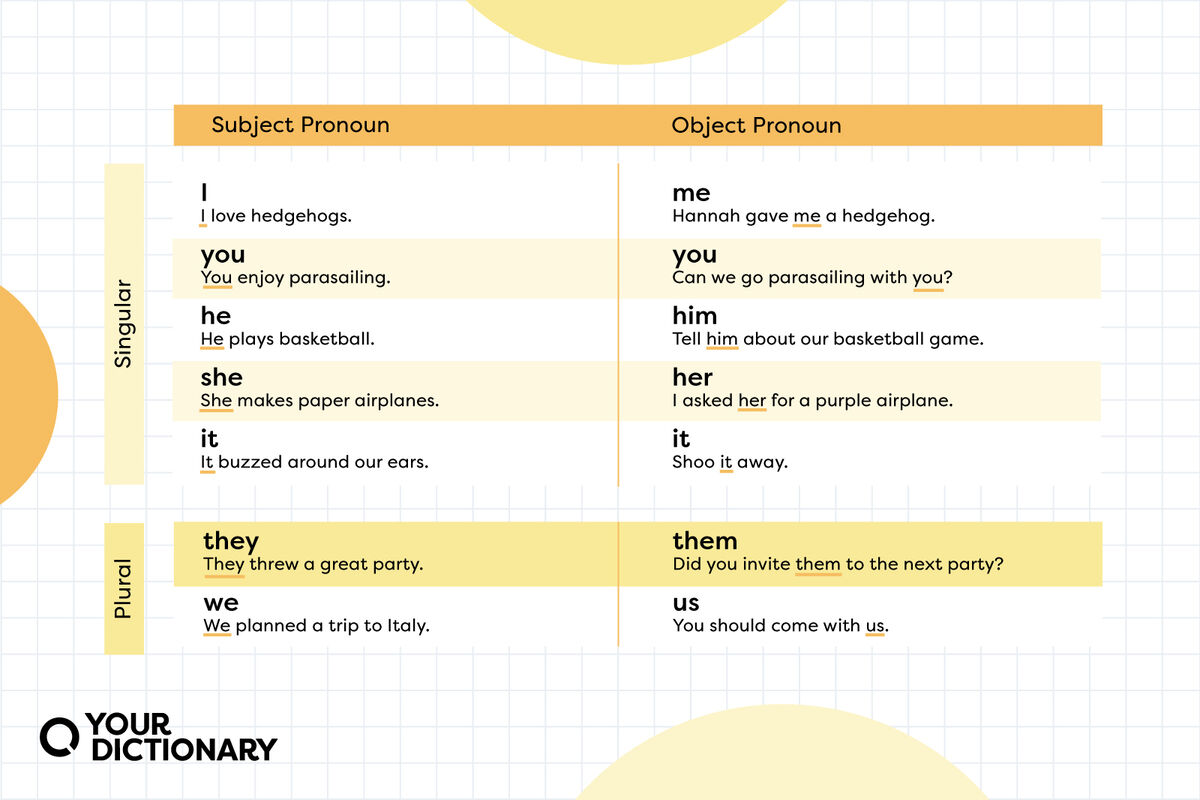
While subject pronouns perform the action in a sentence, object pronouns receive the action — just like the noun they’re replacing. You need both subject and object pronouns for your writing, but you can't use them interchangeably.
Note that you and it are the same in both subject and object forms. All other subject pronouns change when they’re acting as subjects.
How To Use Subject Pronouns in a Sentence
Typically, you’ll find subject pronouns at the beginning of a sentence. But don’t count on that — some sentence structures are trickier than others.
Examples of Subject Pronouns in Simple Sentences
Simple sentences have one subject that performs the action. Readers understand what noun the subject pronoun replaces because it was stated in a previous sentence.
- Rachel is my best friend. She really understands me.
- This boat is getting low. It might be sinking.
- My family came to my dance recital. They are so embarrassing.
Examples of Subject Pronouns in Compound Sentences
When you combine simple sentences into compound sentences, you may use both a noun and a subject pronoun (or even more than one subject pronoun).
- Dave doesn’t like to drive, but he had no choice.
- Our family loves Halloween, so we always decorate the house.
- The dog prefers to sleep on the couch, and it always curls up on the pillows.
The same rule applies for complex sentences and compound-complex sentences: As long as the antecedent noun is clear, feel free to use subject pronouns to streamline your writing.
Examples of Subject Pronouns in Questions
You can also use subject pronouns in questions (also called interrogative sentences) about a noun performing an action. Like other sentences, the subject should be clear to the reader in a previous sentence or by context clues.
- I called George earlier. Did he call back?
- Our team has been waiting for a while. Can we play yet?
- You seem angry with me. Did I do something wrong?
How To Use a Subject Pronoun in a Compound Subject
One of the most confusing parts of subject pronouns is when to use I vs. me — or any other combination of nouns and singular subject pronouns. If you’re using the pronoun as one of the subjects, you use I, you, he, she, it, they, or we. (not me, him, her, them, or us).
- Incorrect: John and me have known each other for years. (Me can’t function as the subject)
- Correct: John and I have known each other for years. (I is a subject pronoun)
- Incorrect: Have her and Melissa worked together? (Her can’t function as the subject)
- Correct: Have she and Melissa worked together? (She is a subject pronoun)
What Are Nominative Pronouns?
Nominative pronouns and subject pronouns are the same thing. When you use a pronoun as a subject, it’s in the nominative case — the grammatical case that describes the subject of a sentence.
Just like subjective pronouns, nominative pronouns are I, you, his, her, it, they, and we.
Subject Pronoun Practice Quiz
Read through the following sentences. See if you can identify which words are the subject pronouns in each.
- When Lucy housesat for us, she watered the plants.
- I wanted to go to the party. He wanted to stay at home.
- The puppies are cute, but sometimes they act crazy.
- You can go to the game, as long as you finish the dishes.
- Are they going to Spain this summer?
Answers for the Subject Pronoun Practice Quiz
Were you able to find all the subject pronouns in bold below?
- When Lucy housesat for us, she watered the plants.
- I wanted to go to the party. He wanted to stay at home.
- The puppies are cute, but sometimes they act crazy.
- You can go to the game, as long as you finish the dishes.
- Are they going to Spain this summer?