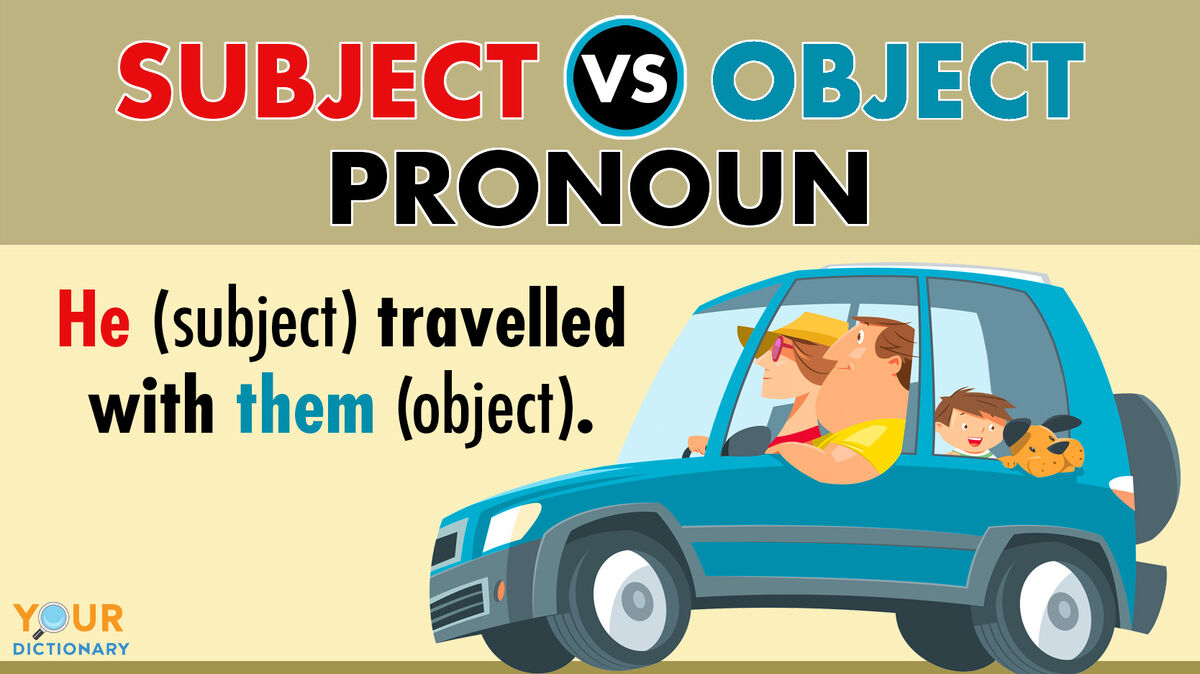
The correct use of subject and object pronouns can be challenging to remember. English teachers and professors all across the globe explain the use and misuse of a pronoun, where it goes in a particular sentence, and why it is being used over a regular noun. A quick review will remind you to look for the subject and the action in the sentence, and then the pronoun will not be far behind.
Purpose of a Pronoun
In the English language, pronouns are used to help minimize repetition in everyday language. Take, for instance, the sentence "The boy went to school." If the phrase "the boy" had to be used every single time the same young man is referenced, there would be too much repetition of the same phrase. Every time the phrase "the boy" is repeated, it takes away from the originality of the sentence and the listener becomes bored. Pronouns let writers and speakers change things up a bit. The pronoun “he” can be substituted for "the boy" in some instances.
Two Types of Pronouns: Subject vs. Object
Pronouns are used to substitute for nouns that are the subject of the sentence as well as nouns that are the object of the sentence. Discover the difference between subject vs. object pronouns.
Subject Pronouns
Subject pronouns are exactly what they sound like; they are pronouns that replace the subject in the sentence. Once you understand what a subject is, it will be very easy to tell what type of pronoun to replace it with.
- Consider the sentence, "The boy traveled with friends." In this sentence, "the boy" is performing the action, which means that the boy is the subject.
- If you want to use a pronoun to replace this subject, choose the best subject pronoun for this sentence.
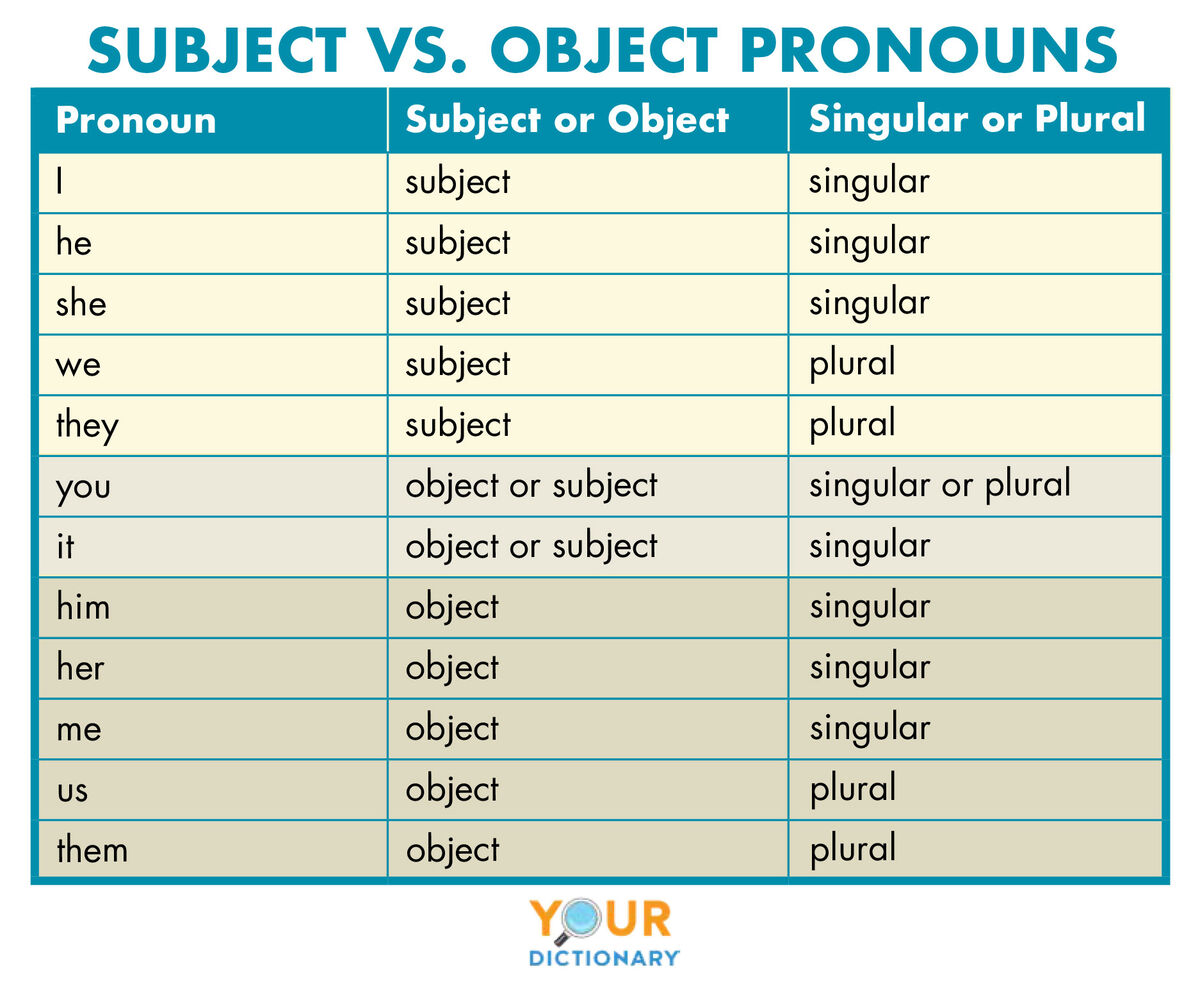
- The subject pronouns are we, you, he, she, it, and they.
- Read the sentence out loud to yourself and instead of saying "the boy," try replacing the subject with one of the pronouns. In this example, a good subject pronoun would be "he." The sentence becomes "He traveled with friends."
Object Pronouns
Object pronouns are not the same as subject pronouns. They do not replace the subject. Instead, an object pronoun would replace the object in the sentence. The object is the part of the sentence that is being done to, from or with the action.
- Consider the sentence, "The boy traveled with friends." The object of this sentence is "friends."
- To replace “friends” with a pronoun, choose the best word from the list of object pronouns.
- The object pronouns are me, you, him, her, it, us, and them.
- Select an appropriate object pronoun to replace "friends.” You could say "The boy traveled with them." Another option would be to say, "The boy traveled with us." Both options could be correct, depending on what actually took place.
Dual-Duty Pronouns
The pronouns “you” and “it” can function as either subject or object pronouns in a sentence, depending on how they are used. In the examples below, the underlined pronouns function as subjects and the bold pronouns function as objects.
- Did you bake that cake? It is delicious.
- Did it rain today?
- I gave it to you yesterday.
- You can drive my car after you get a driver’s license.
Singular vs. Plural
Both subject and object pronouns can be singular or plural.
- If the subject is "the boy," the pronoun is singular. This is because the pronoun refers to only one person.
- If the subject is, "the children," the pronoun is plural. This is because the pronoun refers to more than one person.
Singular Subject Pronoun Examples
The following examples illustrate each of the singular subject pronouns, which are I, he and she. It and you sometimes function as this type of pronoun.
- I went to the store yesterday.
- He is babysitting his little sister.
- She is planning to study all weekend.
- You are not very funny.
- It is very beautiful.
Plural Subject Pronoun Examples
The examples below demonstrate proper usage of plural subject pronouns, which include we and they. The word you sometimes functions as this type of pronoun.
- We are planning a vacation.
- They will be visiting Florida soon.
- I like your family. You are a great group.
Singular Object Pronoun Examples
The following examples illustrate each of the singular object pronouns, which are him, her and me. It and you sometimes function as this type of pronoun.
- She told her deepest secret to him.
- You should explain the procedure to her.
- Susie made me laugh.
- You should give it to mom.
- I am bringing a pie to you tomorrow.
Plural Object Pronoun Examples
The examples below demonstrate proper usage of plural object pronouns, which include us and them. The word you sometimes functions as this type of pronoun.
- Grandma is visiting us next month.
- Explain what you did to them.
- As my siblings, you mean the world to me. I hope you know how much I love you.
Person (First, Second and Third Person)
Each subject and object pronoun falls under a particular "person," consistent with general usage of personal pronouns.
First Person Examples
The first person pronouns are I, we, me, and us. I and we are subject pronouns, while me and us are object pronouns. When you are talking about something that happened to you or something you did, you would use a first person pronoun.
- I am surprised by the result. (subject pronoun in first person singular)
- We are looking forward to vacation. (subject pronoun in first person plural)
- What did you say to me? (object pronoun in first person singular)
- Did he lie to us? (object pronoun in first person plural)
Second Person Examples
The word you is the only second person pronoun. It can be a subject or an object pronoun and it can be plural or singular. If you are speaking to someone or about someone, you would use a second person pronoun.
- You are responsible for your own actions, Susie. (subject pronoun in first person singular)
- You are the best brothers and sisters anyone could have. (subject pronoun in first person plural)
- I gave fresh vegetables to you last week. (object pronoun in first person singular)
- Friends, there are some things that need to be explained to you. (object pronoun in first person plural)
Third Person Examples
The third person pronouns are she, he, her, him, it, them, they, and it. She and he are singular subject pronouns. Her and him are singular object pronouns. It is singular and can be either an object or subject pronoun. The word they is a plural subject pronoun and the word them is a plural object pronoun. If you are talking about something that someone outside of the conversation did or that something was done to, you would use a third person pronoun.
- She is a very nice person. (subject pronoun in third person singular)
- He is quite trustworthy. (subject pronoun in in third person singular)
- It is beautiful outside today. (subject pronoun in third person singular)
- That game belongs to her. (object pronoun in third person singular)
- What is she going to do about him? (object pronoun in third person singular)
- She lost yet another job. I’m not sure what to make of it. (object pronoun in third person singular)
- They are bringing my new puppy tomorrow. (subject pronoun in third person plural)
- Someone will need to explain what happened to them. (object pronoun in third person plural)
Proper Pronoun Usage Strategy
It can be a bit challenging to differentiate between subject and object pronouns. If you have a tough time remembering the type of pronoun, just remember to ask yourself what is the subject and what is being done to, from or with the action in the sentence. If you can remember those two things, you will be on your way to being a personal pronoun master. Use these pronoun worksheets to continue building your skills with this part of speech.