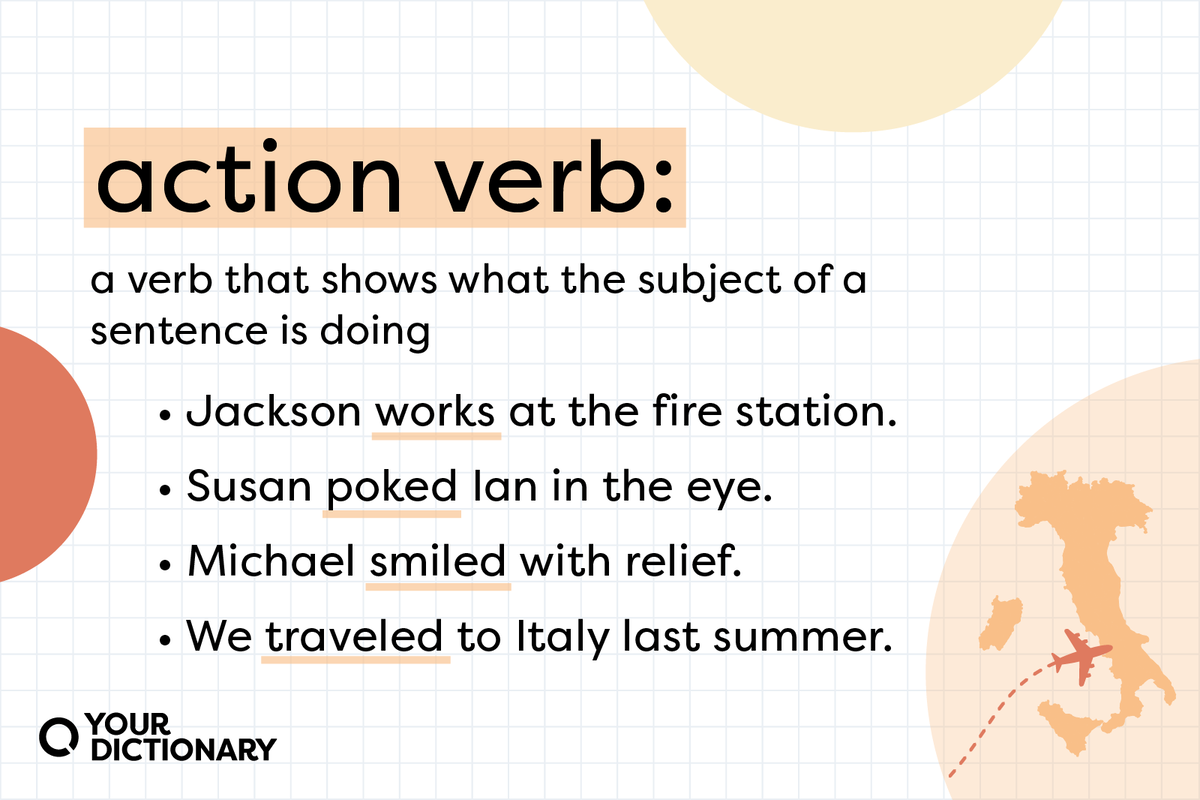
An action verb shows what the subject of a sentence is doing. Examples of action verbs include:
- Jackson works at the fire station.
- Susan poked Ian in the eye.
- Michael smiled with relief.
- We traveled to Italy last summer.
Words like smiled are action verbs because someone can perform them. However, action verbs don’t have to be visible — they include mental tasks as well (such as think, wonder, or dream).
Action Verbs vs. Linking Verbs
While action verbs create movement in a sentence by showing what the subject is doing, linking verbs establish a connection between words. Nouns don’t perform these verbs.
|
Linking Verb Examples |
Action Verb Examples |
|
Lynn is angry. |
Lynn shouted at her brother. |
|
I look terrible in this dress. |
I frowned at my appearance in the mirror. |
|
The cookies were delicious. |
The kids smelled the cookies baking |
|
Ron and his girlfriend seemed happy. |
Ron and his girlfriend hugged affectionately. |
While strong writing does involve both linking verbs and action verbs, most readers prefer sentences with action verbs, since they are more interesting to read.
Types of Action Verbs
Action verbs fall into two categories: transitive verbs and intransitive verbs. Depending on which one you use, your sentence may provide even more information and detail to the reader.

Action Verb Examples
Examples of Transitive Verbs
Transitive verbs transfer their action to another noun in the sentence, known as the direct object. These action verbs directly affect things and people around them.
- My dog chewed his toy. (What did he chew?)
- Jonathan chose me to be his best friend. (Who did he choose?)
- Why did your grandmother call my house? (What did she call?)
- Rick painted the fence green. (What did he paint?)
- Ellie married her best friend. (Who did she marry?)
Examples of Intransitive Verbs
Intransitive verbs don't act upon another noun or pronoun in the sentence. They only describe something the subject of the sentence does. Intransitive verbs may come before other phrases and clauses, but they don’t take a direct object.
- Charles swam in the pool.
- My dog barked at the mail carrier.
- The twins whispered instead of sleeping.
- The elephant sleeps soundly.
- Two shoes fell in the lake.
Examples of Verbs That Are Both Transitive and Intransitive
Some verbs in English can be transitive or intransitive, depending on their context. You can add a direct object after them and they make sense, or you can leave a direct object off and they also make sense.
| Action Verb | Transitive | Intransitive |
|---|---|---|
| eats | Charles eats breakfast in the morning. | Charles eats quickly in the morning. |
| met | My family met my girlfriend. | My family met for dinner. |
| walk | Let’s walk the dog. | Let’s walk to the store. |
| drive | I’ll drive the RV to the campsite this weekend. | I’ll drive to the campsite this weekend. |
Notice how each transitive verb acts upon an underlined direct object. If you remove the direct object, it completely changes the meaning of the sentence. However, each verb does work as both a transitive and an intransitive verb.
Use Action Verbs To Show, Not Tell
When your teacher says “Show, don’t tell,” it could mean that you're using too many linking verbs. Revise your writing to include verbs that are lively and express action to improve your prose. Circle all the "to be" verbs in your writing and think about the action in the sentence. Do these verbs convey the action accurately, or are they only setting up description?
Practice showing and not telling with action verb practice worksheets. You can also put yourself (or your students) to the test with a collection of action verb games and activities.