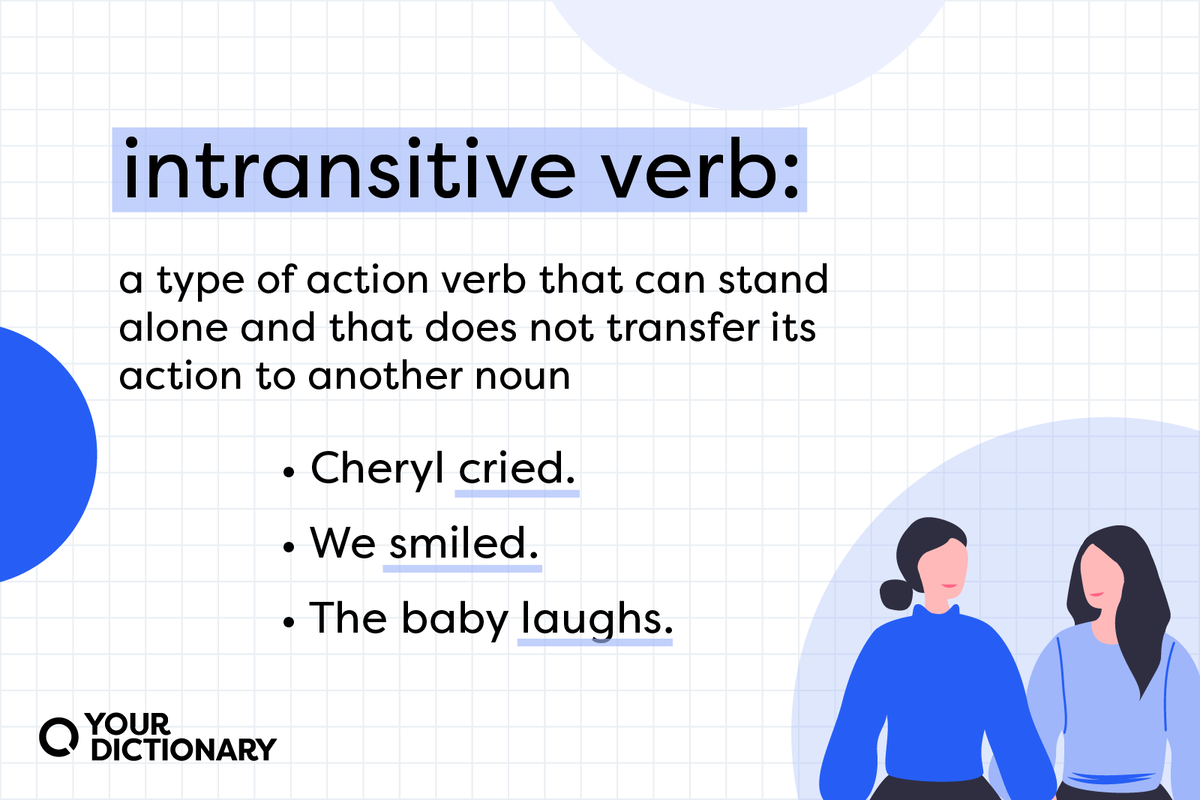
What do the verbs cry, smile, and laugh have in common? Besides being actions that we all do (sometimes all in the same day), they are intransitive verbs. Identifying intransitive verbs is simple when you know what they are.
What Is an Intransitive Verb?
An intransitive verb is a type of action verb that does not transfer its action to another noun. That’s why it’s called intransitive — “not transferring.”
Intransitive verbs only need a subject to be a complete sentence.
- Cheryl cried.
- We smiled.
- The baby laughs.
If you added a direct object (a noun that receives the action) to the ends of these sentences, they wouldn’t make sense. They stand alone as full sentences.
For example, “The baby laughs the dog” isn’t correct. You need the preposition at to make the sentence correct — “The baby laughs at the dog.”
Examples of Intransitive Verbs
Intransitive verbs make sense without direct objects. While some intransitive verbs also make sense with direct objects, they don’t need them to function correctly.
Common examples of intransitive verbs include:
- agree
- arrive
- continue
- cry
- die
- exist
- float
- happen
- leave
- lie
- listen
- panic
- smile
- speak
- talk
- work
- yell
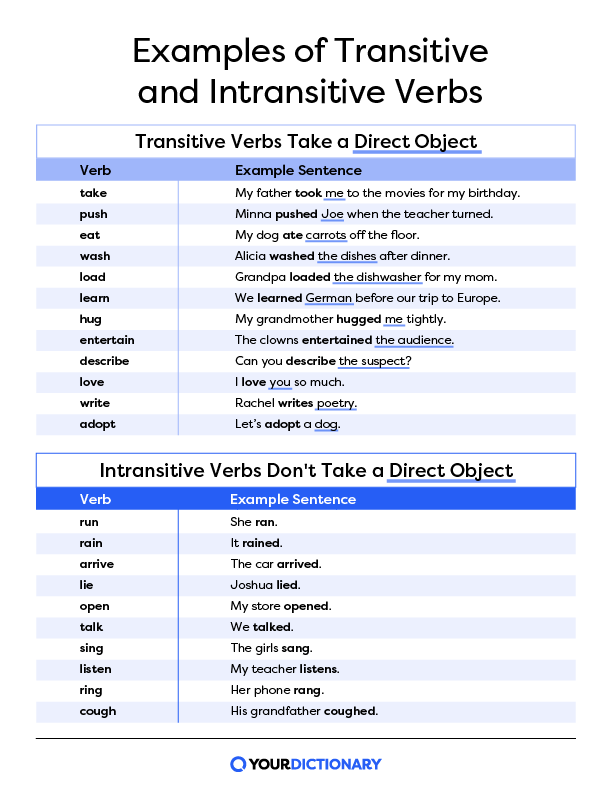
How To Use Intransitive Verbs in a Sentence
An intransitive verb only needs a subject to be a full sentence.
But you can also add adverbs to modify an intransitive verb, or you can add prepositional phrases to include more detail. Because adverbs and prepositional phrases aren’t nouns, the verbs are still intransitive.
|
Subject + Intransitive Verb |
With Adverb |
With Prepositional Phrase |
|
She ran. |
She ran quickly. |
She ran across the street. |
|
It rained. |
It rained a lot. |
It rained in Florida. |
|
The car arrived. |
The car arrived late. |
The car arrived at 3:00. |
|
Joshua lied. |
Joshua lied again. |
Joshua lied to me. |
|
My store opened. |
My store opened last week. |
My store opened on Main Street. |
|
We talked. |
We talked happily. |
We talked in the hallway. |
|
The girls sang. |
The girls sang well. |
The girls sang with the choir. |
|
My teacher listens. |
My teacher listens intently. |
My teacher listens to her students. |
|
Her phone rang. |
Her phone rang frequently. |
Her phone rang at midnight. |
|
His grandfather coughed. |
His grandfather coughed loudly. |
His grandfather coughed into a handkerchief. |
Intransitive Verbs vs. Transitive Verbs
Unlike intransitive verbs, transitive verbs do transfer their action. Without direct objects, they don’t make sense.
For example:
- That toy costs.
- Tanya got.
- I borrowed.
- Thomas put.
When you add nouns after these transitive verbs, the sentences are now correct.
- That toy costs fifty dollars.
- Tanya got a new car.
- I borrowed Maria’s perfume.
- Thomas put his pencil down.
Verbs That Can Be Transitive or Intransitive
Some verbs can be both intransitive and transitive, depending on their context. They can take a direct object in some cases, but don’t need it in others.
- Intransitive - I ran to school.
- Transitive - I ran the mile at the track meet.
- Intransitive - The author writes at the coffee shop.
- Transitive - The author writes novels.
- Intransitive - Ava moved over the weekend.
- Transitive - Ava moved her purse out of the way.
- Intransitive - You should sing professionally.
- Transitive - You should sing the solo.
Tip for Remembering Intransitive Verbs
When trying to determine whether a verb is transitive or intransitive, just look at the word after the verb.
- Is it a noun (or pronoun)?
- The verb is transitive.
- Is it an adjective?
- The verb is transitive.
- Is it an adverb?
- The verb is intransitive.
- Is it a preposition?
- The verb is intransitive.
For example, in the sentence “I can’t see Susan through the crowd,” the noun Susan follows the transitive verb see.
However, in the sentence “Susan waved at me,” the preposition at follows waved, so waved is intransitive.
Quick Tip
For a visual hint, think of a “transitive” train that has a “direct” stop at the next direct object.
The “intransitive” train isn’t stopping anywhere!