When it comes to the parts of speech, nouns and verbs are among the best known and intuitively understood. However, there are complications worth discussing, as things aren't always as straightforward as you might expect. Keep reading for the definition of compound verbs and examples of the four different types of compound verbs.
What Is a Compound Verb?
A compound verb is made up of one or more words. They’re sometimes called serial verbs because one verb follows another. You’ll often find compound verbs that share a subject, such as in these examples.
- John swims and runs for exercise.
- I cook and clean when I get home from work.
- The children write their name and read the instructions on the worksheet.
In these sentences, the verbs are joined by the conjunction and. But there are four forms of compound verbs that do not use conjunctions at all. These compound verbs use multiple words to form a single verb.
Forms of Compound Verbs
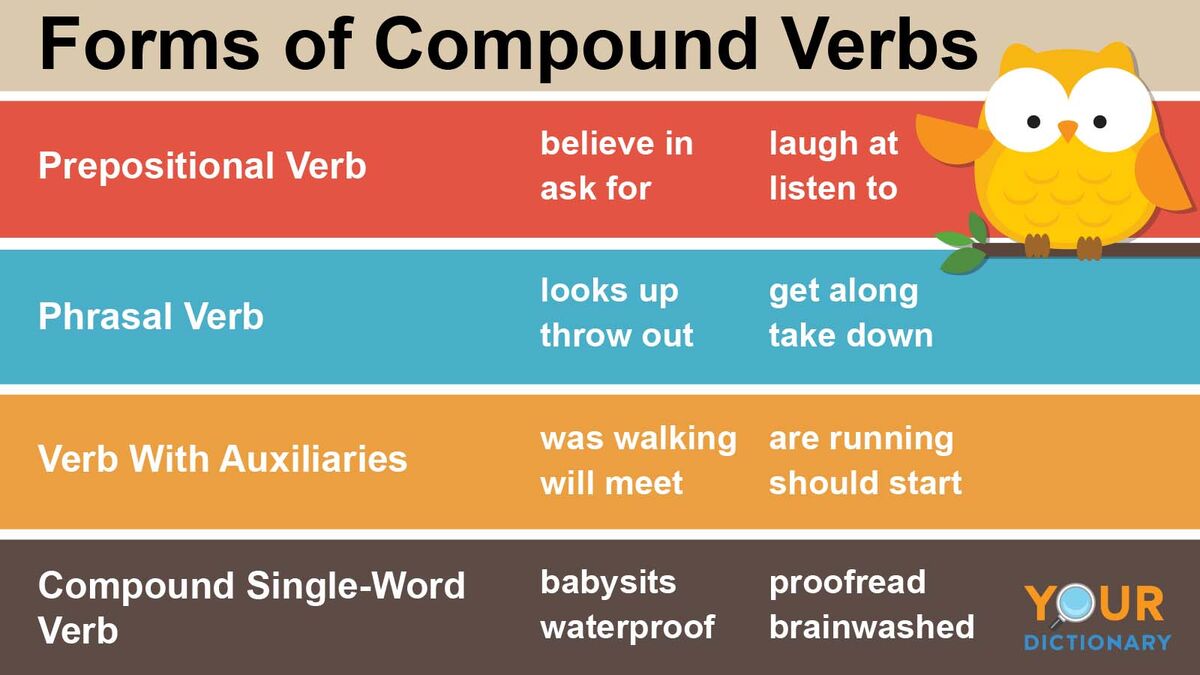
Compound verbs are formed in several ways. You can add a preposition in prepositional verbs, make a phrase with a phrasal verb, add a "helping" verb in a verb with auxiliaries, and make a phrase or combine two words together into a compound single-word verb. Each of these results in a different form of compound verb.
Prepositional Verb
When a preposition combines with a verb to form a new verb, the result is a prepositional verb. Prepositional verbs usually follow a noun and precede another noun or verbal phrase.
Some examples include:
- I believe in respecting our elders.
- Why does Timmy always ask for more ice cream?
- The success of this campaign relies upon voter turnout.
- Don’t laugh at my dad’s new haircut.
- Listen to my question before coming up with a response.
Phrasal Verb
When a verb combines with an adverb, the result is a phrasal verb. Words like up, in, out, and down are common adverbs in phrasal verbs, even though they can also be used as prepositions in other contexts. Unlike prepositional verbs, phrasal verbs are idiomatic and aren’t translated literally.
Some examples of phrasal verbs include:
- Sharon looks up to her older sister.
- Can you throw out the garbage?
- Try to get along with your brother.
- Most people take down their holiday decorations by January 1.
- Let’s turn off the television after this show.
Verb With Auxiliaries
In this form, a verb combines with another verb called a helping, or auxiliary, verb. Common helping verbs are have, has, had, am, be, been, is, are, was, or were, and modal helping verbs include can, could, may, should, and will. Together with another verb, they form a compound verb.
For example:
- Joe was walking down the street last night.
- The council will meet to discuss the issue tomorrow.
- Jack and Jill are running up the hill.
- My friends are planning a big surprise party for me.
- I should start my homework soon.
Compound Single-Word Verb
Sometimes a single verb is a combination of multiple words. Both words might be verbs or one of the words might be a descriptor word. The words may run together as one word or they may be joined by a hyphen. Regardless of the spelling, when used together, the words function as a single verb.
For example:
- Jessica babysits Carson and his sister Stella on Saturday nights.
- Gerald really wants to waterproof the deck this weekend.
- Can you have someone proofread your essay before turning it in?
- It’s important to check your facts and not become brainwashed by misinformation.
- The airline overbooked our flight, so we received vouchers for the next one.
Greater Than the Sum
Compound verbs give the reader a bigger understanding of the action taken by the subject of the sentence. Now that you've familiarized yourself with the different forms of compound verbs, why not explore some other types of compounds in the English language? Learn more about compound subjects and compound nouns to elevate your command of the language.