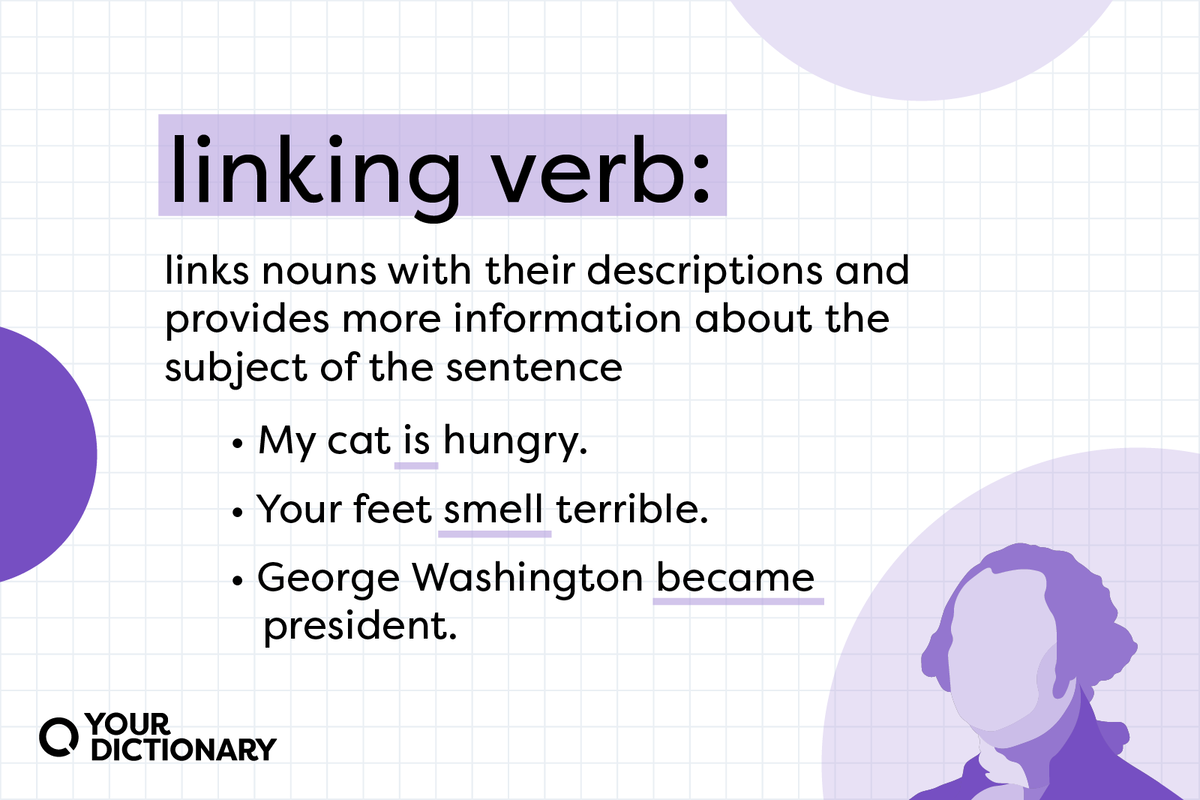
Linking verbs, also known as copular verbs, connect nouns with their descriptions. The subject of the sentence performs them, but instead of showing an action, they provide more information about the subject.
Linking Verbs Connect Subjects to Complements
The extra information on the other side of a linking verb is called a subject complement. Together, the linking verb and the subject complement form the predicate of the sentence.
- My cat is hungry.
(The linking verb is links my cat and its description — hungry) - Your feet smell terrible.
(The linking verb smell links feet and their description — terrible) - George Washington became president.
(The linking verb became links George Washington and his description — president)
Quick Tip
If you can replace the verb with an equal sign, it’s a linking verb.
- My cat = hungry
- Your feet = terrible
- George Washington = president
List of Common Linking Verbs
The forms of to be can function as linking verbs. But other linking verbs show states of being or the five senses in a sentence.
|
Forms of “Be” |
States of Being |
Five Senses |
|
is |
become |
appear |
|
am |
get |
feel |
|
are |
has |
look |
|
was |
remain |
smell |
|
were |
seem |
sound |
|
being |
stay |
taste |

Examples of Linking Verbs
How To Use Linking Verbs in a Sentence
Linking verbs connect two types of subject complements: predicate adjectives and predicate nouns — to their subjects.
The linking verb you choose depends on the description you’re trying to create.
How To Use Linking Verbs With Predicate Adjectives
Adjectives often come before nouns to describe them, but sometimes you’ll find them after the noun. These adjectives are known as predicate adjectives (because they’re in the predicate).
- My teacher is strict.
- The orchestra sounds amazing.
- Carlos seems upset.
- Maria’s cake tasted delicious.
You can also use linking verbs when an adverb or intensifier modifies the predicate adjective.
- My teacher is incredibly strict.
- The orchestra sounds so amazing.
- Carlos seems very upset.
- Maria’s cake tasted perfectly delicious.
How To Use Linking Verbs With Predicate Nouns
Linking verbs can also connect predicate nouns (also called predicate nominatives) to rename or identify the subject of a sentence. Predicate nouns can be one word or they can be longer noun phrases.
For predicate nouns, you’re more likely to use forms of be or become in a sentence.
- They are friends.
- We became a family.
- Laura was a neurologist.
- Joe became a trombone player.
Note that when you add an adjective in front of the predicate noun, it’s still a predicate noun (and you still use a linking verb).
- They are good friends.
- We became a loving family.
- Laura was a famous neurologist.
- Joe became a skilled trombone player.
Linking Verbs vs. Helping Verbs
While linking verbs function as the main verb in a sentence, helping verbs “help” other verbs create the verb tense of a sentence.
The three main helping verbs (forms of be, have, and do) appear in verb phrases, such as:
- I am swimming
- I have been swimming
- I do swim every day.
Of these helping verbs, forms of be (is, am, are, was, were) can also function as linking verbs if they’re the only verb in the sentence. Otherwise, they’re helping verbs.
- Linking verb - I am a doctor.
- Helping verb - I am studying to be a doctor.
- Linking verb - You were so mean yesterday.
- Helping verb - You were yelling at everyone yesterday.
Using Helping Verbs With Linking Verbs
You can use be, have, and do with linking verbs in a sentence, since linking verbs are the main verbs.
Additionally, you can use other types of helping verbs, including modal verbs (could, would, can, will, may, etc.) with linking verbs.
- I became interested in marine biology. (Linking verb only)
- I will become interested in marine biology.
- I have become interested in marine biology.
- I may become interested in marine biology.
- Mike is a firefighter. (Linking verb only)
- Mike has been a firefighter.
- Mike might be a firefighter.
- Mike can be a firefighter.
Can Linking Verbs Also Be Action Verbs?
Linking verbs aren’t as showy as action verbs. Action verbs make people talk, dogs bark, and phones ring — behavior that you can hear, see, and do. But are there any linking verbs that are also action verbs?
Forms of be, seem, and become never function as action verbs. But many other linking verbs can act as action verbs when they’re transitive verbs — meaning that they take a direct object instead of a subject complement.
Linking verbs that refer to senses describe the subject of the sentence. When they’re used as action verbs, they refer to what the subject is doing.
|
Linking Verb |
Action Verb |
|
The soup tasted spicy. |
Hank tasted the soup. |
|
That bridge looked dangerous. |
I looked at the bridge. |
|
Her perfume smells sweet. |
She smells her perfume. |
|
I don’t feel well. |
My mom feels my forehead. |
|
The house appeared fine. |
He appeared in the doorway. |
Likewise, when a linking verb describes a state of being, it connects the subject to its description. But when it functions as an action verb, it’s meant more literally.
|
Linking Verb |
Action Verb |
|
We got too cold outside. |
We got our jackets. |
|
The crowd went wild. |
The crowd went home. |
|
I’m growing impatient. |
I’m growing tomatoes in the backyard. |
|
Lucy fell silent. |
Lucy fell down. |
|
They stayed friends. |
They stayed in town. |