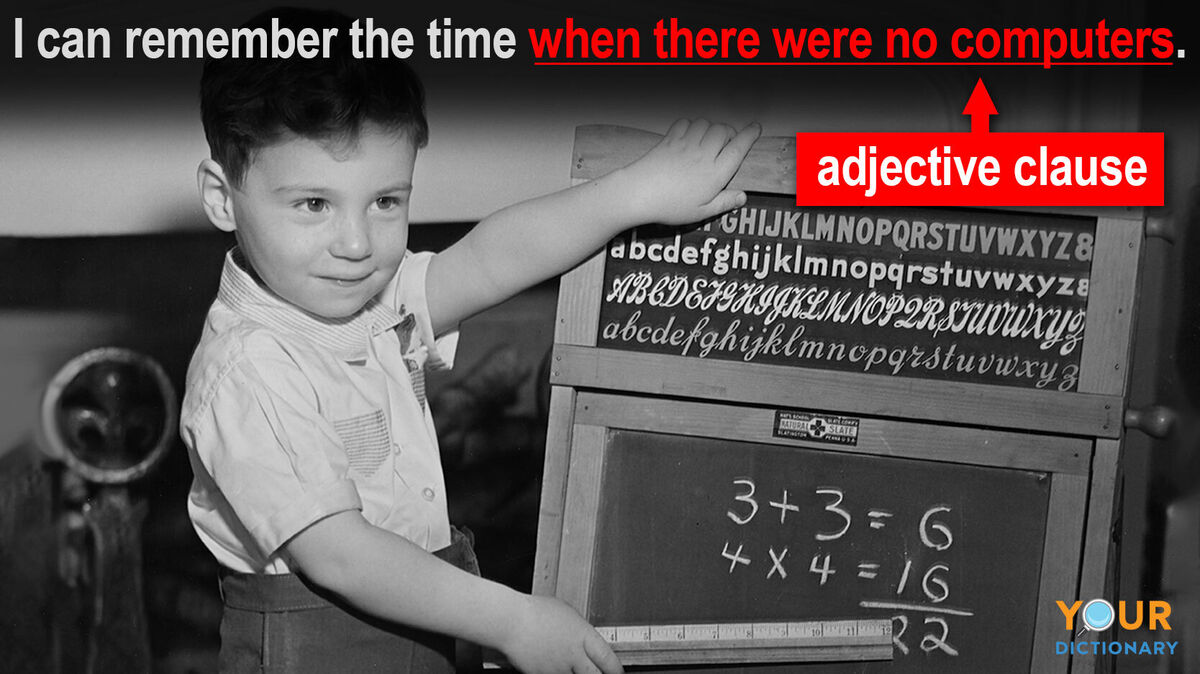
Get a clear answer to the question, "What is a relative clause?" An adjective clause, which is also called a relative clause, is used within a sentence to provide essential and non-essential information to the reader. View several adjective clause examples using them in sentences.
What Is an Adjective Clause?
An adjective clause, or relative clause, is a type of dependent clause that works to describe a noun in a sentence. It functions as an adjective even though it is made up of a group of words instead of just one word. In the case of an adjective clause, all the words work together to modify the noun or pronoun.
Examples of Adjective Clauses
Now that you know what an adjective clause is, it can be helpful to view a few examples of adjective clauses before getting into the nitty-gritty of adjective clause use. Check out a few example sentences using adjective clauses.
- The flowers that we picked up last week have died.
- My friend, who has glasses, wasn't at school today.
- The boy, who claimed to have a broken arm, caught the ball.
- Bobby's cat that ate the mouse had a stomachache.
- The robber who broke into my house is in court today.
Relative Clause Components
Now that you've gotten a basic understanding of adjective clauses and what they look like, it's time to learn how to find them. Adjective clauses typically have a few different components.
In a sentence, adjective clauses:
- are dependent clauses, which is a group of words that consists of a subject and a verb, yet it is not a complete sentence that can stand alone
- generally start with a relative pronoun, but it can be omitted
- provide additional information about the noun
- come after the noun they describe
Adjective Clauses and Relative Pronouns
Adjective clauses begin with a relative pronoun, which connects them to the word they describe. Relative pronouns include the words that, where, when, who, whom, whose, which and why. Once you remember the relative pronouns, it's easy to pick out an adjective clause in a sentence.
- Chocolate, which many people adore, is fattening.
- People who are smart follow the rules.
- I can remember the time when cell phones didn't exist.
- Charlie has a friend whose daughter lives in China.
- The wine that vintners produce in Tuscany is not cheap.
- The reason why Sandra went to law school is that she didn't want to be a doctor.
Each of the adjective clauses begins with a relative pronoun. This connects it to the noun being described, which comes directly before the relative pronoun in the sentence.
Subject and Verb in Adjective Clauses
Each adjective clause also contains a subject and a verb, all of which work together to describe the original noun being modified. For example, the clause "which many people adore" contains the subject people and the verb adore, yet it is not a complete sentence by itself. Instead, its job is to provide more information to describe the noun chocolate in the sentence, "Chocolate, which many people adore, is fattening."
In some cases, the relative pronoun also serves as the subject of the clause. For example, in the adjective clause "who are smart," the relative pronoun who also acts as the subject.
Essential vs. Non-Essential Adjective Clauses
Sometimes, the information included in an adjective clause is very important to the meaning of the sentence, sometimes it's not. See essential and non-essential adjective clauses.
Essential Adjective Clauses
For cases where the sentence wouldn't hold the same meaning without the clause, the adjective clause is called an essential clause.
Example: I don't like children who eat ice cream with their hands.
In this case, the adjective clause gives essential information to describe which children the speaker doesn't like. If you got rid of that clause, the sentence would simply say, "I don't like children," which is very different from not liking messy children who eat with their hands! One quick way to pick out an essential clause is that an essential adjective clause does not require any additional punctuation.
Non-Essential Clauses
A non-essential adjective clause, on the other hand, gives an extra description that is not strictly required to understand the writer or speaker's intent.
Example: The kitten, which was the smallest of the litter, finally found a foster home.
In this case, the adjective clause gives extra information, but it isn't necessary to get the gist of the sentence about the cat finding a home. Non-essential adjective clauses are set off with commas to show that they aren't as strongly connected to the rest of the sentence.
Adjective Clauses in Use
Dive into a few more examples of adjective clauses. See if you can determine which ones are essential and which are non-essential as you review them. Ask yourself, is the information necessary to the meaning of the sentence? Is punctuation required?
- The dog that I brought home from the pound was soon fast asleep.
- The time will come when you feel sorry for the things you've done.
- The smart teenager, whose parents are my neighbors, went to a prestigious college.
- The used car, which my dad bought last week, broke down yesterday.
- The reason that Penelope failed the test is that she didn't study.
Hopefully, you were able to pick out that numbers 3 and 4 were non-essential adjective clauses.
Adjective Clauses Add Detail
Adding adjective clauses to your writing is a good way to provide additional detail about the nouns and pronouns in your work. This extra description will enrich your writing and help the reader understand your message more clearly. When you know the relative pronouns and how to distinguish between essential and non-essential clauses, you'll have no trouble identifying adjective clauses and punctuating them correctly in your writing. With all this talk of clauses, this may also be a good time to refresh your memory on independent and dependent clauses.