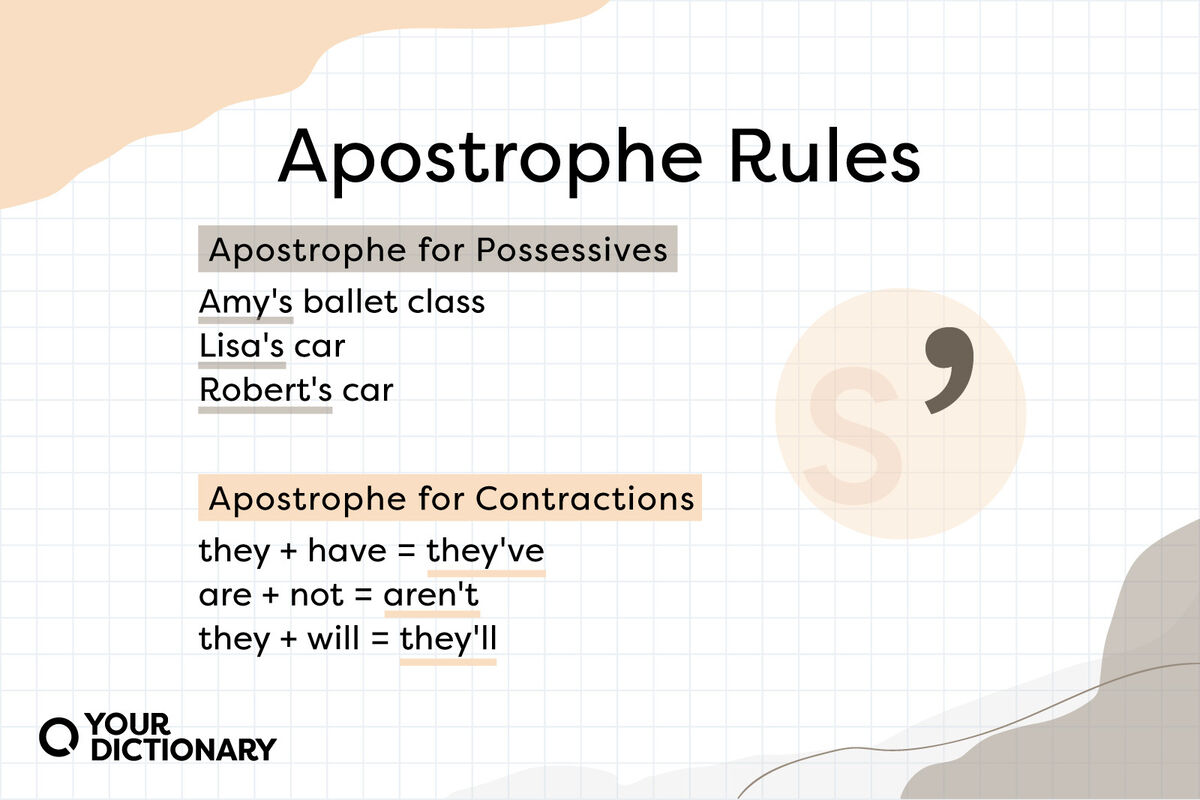
An apostrophe (pronounced ah-pah-stroh-fee) is a small punctuation mark near the top of a line of writing ('). Apostrophes look like single quotation marks, but they’re used alone rather than in pairs.
Apostrophes mainly indicate that letters have been omitted, or they show a noun’s possession. Occasionally, they can show that a single letter or number is plural.
Quick Tips for Using Apostrophes
Deciding when to use an apostrophe can seem trickier than determining when not to use an apostrophe, but it’s really not.
Some quick tips to remember before diving in are:
- Is the apostrophe replacing anything?
- No? Then don’t use it.
- Is the apostrophe showing the noun owning anything?
- No? Then don’t use it.
- Would the sentence be confusing without an apostrophe?
- No? Then don’t use it.
- Are you writing a holiday card and adding an -s or -es to your last name?
- Don’t use an apostrophe (it's always wrong).
How To Use an Apostrophe for Possession
The main function of an apostrophe is showing possession.
Writers used to show possession by adding -es to the end of a noun, long before spelling conventions made -es a plural noun form.
They began using apostrophes to omit the “E” in these possessive nouns — which is how we get possessive nouns with an apostrophe and “S” at the end.
Use Apostrophe + “S” With Nouns That Don’t End in “S”
When a singular noun has possession over another noun (such as Mom’s hat or the boy’s dog), add an apostrophe + “s” to the end of the noun.
The same goes for collective nouns and plural nouns that don’t end in “s.”
- The cat’s kittens all began meowing at once. (cat is singular)
- Something’s wrong with Lyle’s computer. (Lyle is singular)
- Our team’s uniforms are green and blue. (team is collective)
- My friend’s family eats dinner together every right. (family is collective)
- The waiter served the women’s meals. (women is plural, but doesn’t end in “s”)
- The children’s room was perfectly clean. (children is plural, but doesn’t end in “s”)
Only Use an Apostrophe With Plural Nouns That End in “S”
When the noun is plural and already ends in “s,” just add the apostrophe at the end.
- My parents’ house is just around the corner.
- Let’s go meet the Smiths’ new baby.
- Don’t throw away the kids’ art project.
Use an Apostrophe With Singular Nouns That End in “S” (Sometimes)
It’s the age-old question: Should you add apostrophe + “s” to singular words that already end in “s” (such as James, cactus, or dress), or just an apostrophe?
The answer is that both solutions are correct. It depends on your style guide and your personal preference.
- Curtis’ teacher asked for his homework. (Correct)
- Curtis’s teacher asked for his homework. (Correct)
- The class’ pet bunny was missing. (Correct)
- The class’s pet bunny was missing. (Correct)
The only exception is for words that are the same in singular and plural forms, such as scissors or Mercedes.
Add only an apostrophe after these words, since adding another “s” would result in an incorrect pronunciation (such as scissors’s becoming scissorses, which is not a word).
Use an Apostrophe When Two Nouns Own Something
What happens when two nouns possess the same thing? Add an apostrophe + “s” to only the second noun if they both own the exact same item.
- Dave and Alice's car needs service. (Both Dave and Alice own the car)
- Tim and Jane's trip was amazing. (Tim and Jane went together on the trip)
- Darnell and Dylan's business is doing well. (Darnell and Dylan own the same business)
However, if each noun owns their own version of the same item, then add an apostrophe + “s” to each noun (and make their items plural).
- Dave’s and Alice's cars need service. (Dave and Alice each own a different car)
- Tim’s and Jane's trips were amazing. (Tim and Jane took separate trips)
- Darnell’s and Dylan's businesses are doing well. (Darnell and Dylan each have a separate business)
How To Use an Apostrophe To Omit Letters
Another main function of apostrophes is to replace missing letters in a word.
These words are either contractions or shortened versions of other words.
Use an Apostrophe To Create Contractions
Contractions are combinations of two other words in informal writing. Most contractions combine the words have, will, would, are, is, and not with other words.
| Contraction | Words |
|---|---|
| I've | I have |
| He'll | He will |
|
They'd |
They would |
| We're | We are |
| Andre's | Andre is |
| Isn't | Is not |
| Let's | Let us |
Use an Apostrophe To Shorten Other Words
When you shorten other words in written dialect or casual writing, the apostrophe can replace those missing letters as well.
| Short Word | Original |
|---|---|
| swimmin' | swimming |
| 'tis | it is |
| 'fraid | afriad |
How To Use an Apostrophe for Plural Letters and Numbers
You may also see apostrophes when a writer is describing plural lowercase letters or numbers.
This is the only situation where apostrophes can show plurals, and it’s only to prevent confusion — though some style guides, including APA style, do not advise using apostrophes in this way.
- I added too many a’s to the “Happy Birthday” sign.
- Be sure to dot your i’s when writing in cursive.
- How many 2’s are in 2022?
What About “Its” and “It’s”?
One of the most common grammatical errors involves mixing up its and it’s. Its (no apostrophe) shows possession, and it’s (with an apostrophe) is a contraction for it is.
- The fish swims around its bowl. (Possessive)
- The fish swims around because it’s hungry. (Contraction)
But wait — if its shows possession, shouldn’t it have an apostrophe?
No, because its is a possessive modifier and pronoun, not a possessive noun. Possessive pronouns such as his, hers, yours, or ours also don’t include an apostrophe.
But it’s, like all contractions, does have an apostrophe.
Fast Fact
Derived from the Greek apostrephein, meaning “to turn away,” apostrophe was initially a literary device in which a character makes a speech to someone who isn’t present (“turning away” from the scene).
The punctuation definition of apostrophe comes from the absence of the letter replaced by an apostrophe. Just like the person a character is speaking to, the letter isn't there.