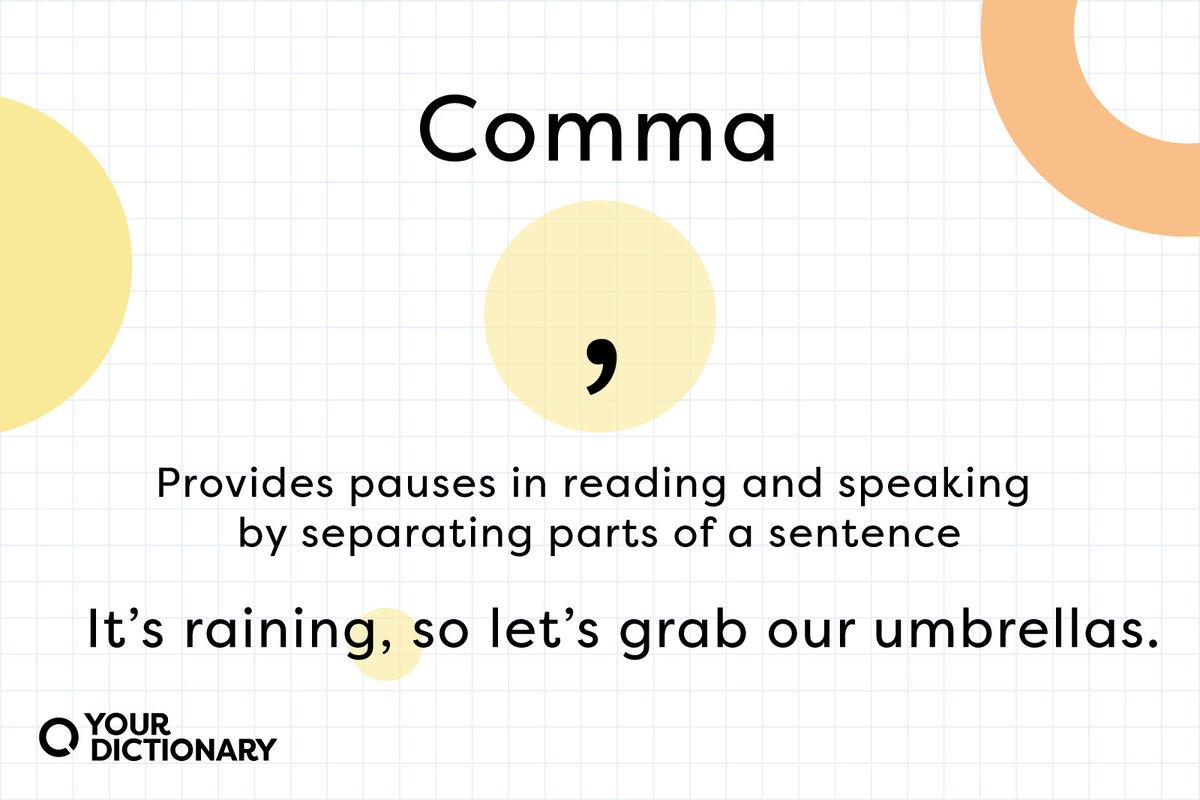
A comma (pronounced “cah-muh”) is a punctuation mark that provides pauses in reading and speaking by separating parts of a sentence.
You’ll find examples of commas in all sorts of sentences below.
- It’s raining, so let’s grab our umbrellas.
- I want to go home, but I have to finish soccer practice first.
- When the cat meows like that, it means he’s hungry.
- I love playing hockey; however, I need to study this weekend.
- Oh no, the concert was canceled.
- This class, which Howie didn’t even want to take, is really hard.
- My neighbor, Mr. Patel, borrowed our lawnmower.
- We toured Stanford, UCLA, and Cal Berkeley on our college trip.
- Bill’s cool, friendly cousin is in town.
- “Let’s climb higher,” said Jacob.
- What do you mean, Melissa?
9 Rules for Using Commas
Commas provide a nice pause in a sentence, but you can’t just throw a comma wherever you want.
Understanding comma rules can help you figure out when and how to use commas properly.
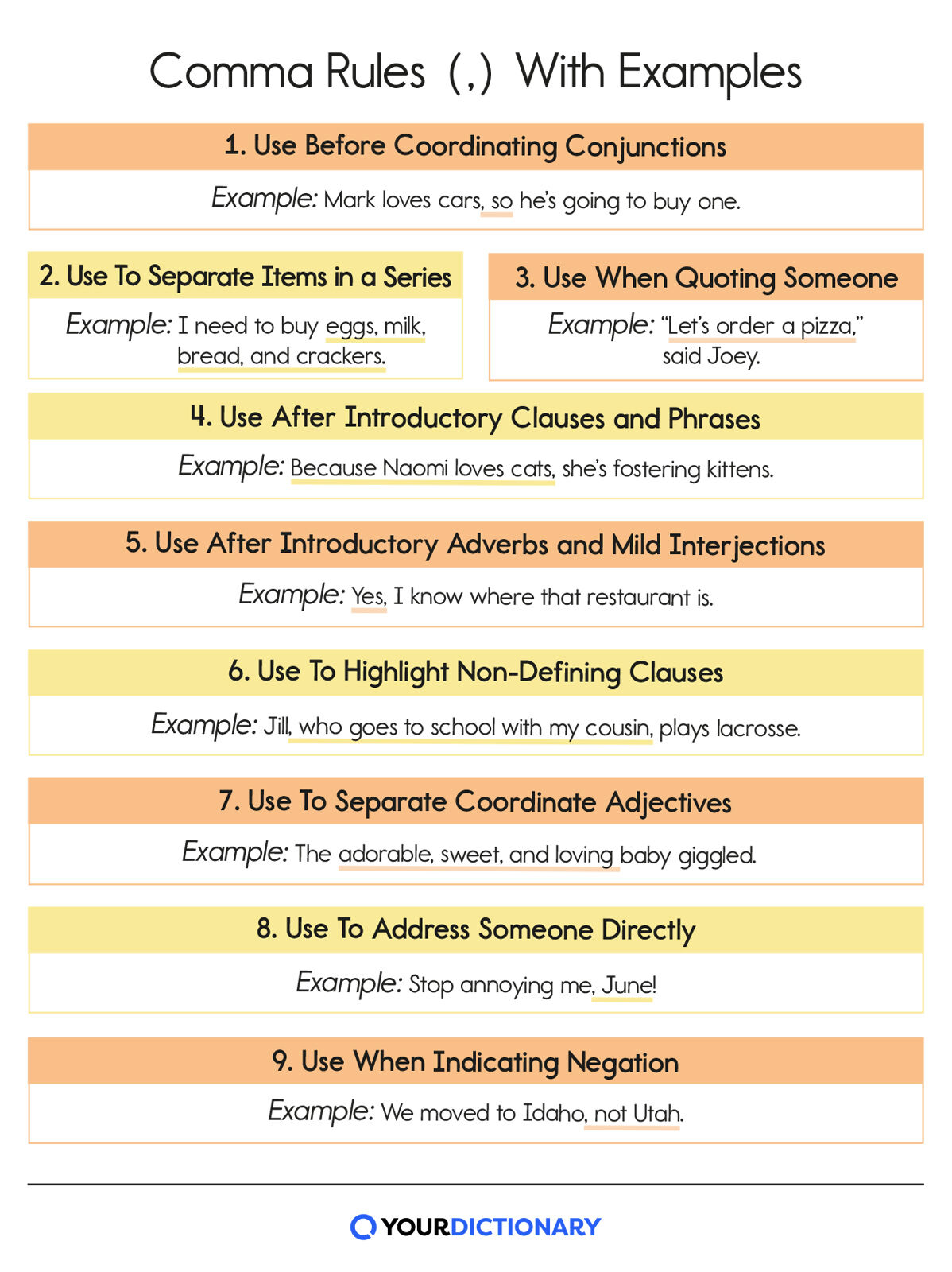
1. Use Commas Before Coordinating Conjunctions
When you're writing a simple sentence, you're using only one independent clause, which can stand alone as a complete sentence. These sentences don't require commas.
- Mark loves cars.
- My brothers shopped all day.
- The dog barked at me.
However, when you add another independent clause, separate them with a comma and a conjunction instead of a period.
That means that you will use a comma before the word but if it is the start of an indepenent clause (or a sentence that could stand on its own).
- Mark loves cars, so he’s going to buy one.
- My brothers shopped all day, and they are so tired.
- The dog barked at me, but I kept walking.
Each of these clauses has the same level of importance, and both are essential to the sentence. Without a comma, your sentence is a run-on.
2. Use Commas To Separate Items in a Series
When you’re writing a list of nouns, verbs, or any other part of speech, you’ll need to include commas to separate them. The same goes for a list of phrases and clauses.
- I need to buy eggs, milk, bread, laundry detergent, and crackers.
- Tanya has visited Turkey, Iraq, Egypt, and Armenia.
- Let’s bring Andrew, Mike, and Melissa to the stage.
The final comma (before the and) in these series is known as the Oxford or serial comma. Many people consider it correct to include the Oxford comma between the final two items in a list.
The choice depends on personal preference and your style guide. However, you should always use an Oxford comma if it prevents confusion.
3. Use Commas When Quoting Someone
Use a comma when you’re quoting someone or when a character is speaking in dialogue.
When the quote comes first in the sentence, put the comma inside the quotation marks.
- “I’m ten years old,” said Tyler.
- “We’re leaving,” announced Dad.
- “Let’s order a pizza,” said Joey.
Put the comma after the attribution when the quote comes second in the sentence. You also add a comma to both places when the attribution is in the middle of the quote.
- Tyler said, “I’m ten years old.”
- Dad announced, “We’re leaving.”
- “Let’s order a pizza,” said Joey, “because I’m hungry.”
Note that this rule primarily applies to American English. In British writing conventions, commas (and periods) go outside the quotation marks.
4. Use Commas After Introductory Clauses and Phrases
Introductory clauses and phrases are groups of words that come before an independent clause in a sentence.
When you start a sentence with a dependent clause, you follow it with a comma (just like that sentence!).
- Because Naomi loves cats, she’s fostering kittens.
- After we played basketball, we were too tired to go out.
- Even though our team lost, the game was still really fun.
Commas also follow introductory phrases, which can include prepositional phrases, infinitive phrases, and participial phrases.
- Like everyone in her family, Naomi loves cats. (prepositional phrase)
- Having played basketball all day, we were too tired to go out. (participial phrase)
- To have fun, you can’t care too much about winning. (infinitive phrase)
If you add these phrases to the end of the sentence, they don’t require commas.
For example, “The dog barked at me to scare me away” doesn’t need a comma to separate the infinitive phrase from the rest of the sentence.
5. Use Commas After Introductory Adverbs and Mild Interjections
You also need to add a comma after a conjunctive adverb, such as anyway, nevertheless, or however.
Commas also follow yes and no in the same context.
Examples of sentences with introductory conjunctive adverbs include:
- However, we’re still having a staff meeting.
- Anyway, Juan forgot my birthday.
- Yes, I know where that restaurant is.
Finally, if you’re starting a sentence with a mild interjection, you need to include a comma. (For stronger interjections, use an exclamation point.)
- Hey, that’s my seat.
- Wow, this sweater is expensive.
- Uh oh, I can’t find my wallet.
Unless you’re starting a sentence with an independent clause, it’s safe to assume that you need a comma. Otherwise, it’s difficult to know when your introductory clause or phrase ends and the rest of your sentence begins.
6. Use Commas To Highlight Non-Defining Clauses
Non-defining clauses add more details about a noun in a sentence, but they’re not essential. The sentence still makes sense when you remove them.
Use commas to separate non-defining relative clauses from the rest of your sentence.
- Jill, who goes to school with my cousin, plays lacrosse.
- My sisters, whom I told to study, are failing science.
- The dog, which looked like a Golden Retriever, licked my face.
You also need to add commas around appositive phrases, which function like relative clauses but don’t include relative pronouns.
- Jill, my cousin’s friend, plays lacrosse.
- My sisters, Hannah and Rachel, are failing science.
- The dog, a Golden Retriever, licked my face.
If you’re using a person’s name as an appositive (such as in “My cousin’s friend Jill plays lacrosse”), you don’t always need to add commas.
However, adding commas around non-defining clauses is a good way to clarify your meaning (“My cousin’s friend, Jill, plays lacrosse”). It’s a style choice.
7. Use Commas To Separate Coordinate Adjectives
When two adjectives describe the same noun, they’re known as coordinate adjectives. You should separate these adjectives using a comma.
- Maya slept on a cozy, comfortable, and roomy bed.
- My beautiful, funny, and considerate best friend always supports me.
- The adorable, sweet, and loving baby giggled.
When adjectives describe different attributes of a noun, they’re known as cumulative adjectives and don’t need commas.
For example, “Maya slept on a soft pink throw pillow” doesn’t require commas because each adjective describes a different part of the bed.
8. Use Commas To Address Someone Directly
When you’re talking to someone in person, it’s obvious that you’re talking to them.
But in writing, you need to directly address them — and you do so with a comma.
- I know you’re sixteen, Lilith, but you’re not ready to drive alone.
- Katie and Marie, you both need to help around the house.
- Stop annoying me, June!
Separating a name out with a comma shows the reader that you’re speaking directly to that person.
9. Use Commas When Indicating Negation
Commas are important when you’re adding a negative point to a complete sentence.
- Isaac owns a Jeep, not a truck.
- We moved to Idaho, not Utah.
- The parrot, not my sister, spoke rudely to me.
You can also use commas when the addition isn’t necessarily negative, but different.
For example, “Isaac owns a Jeep, and maybe a truck” should still include a comma.
Other Times To Use a Comma
Commas can also break up information, not just parts of a sentence. You need a comma:
- in letter and email salutations (Dear Aunt Carol,)
- in letter and email closings (Sincerely,)
- between cities and states (Portland, Oregon)
- when writing out dates (May 13, 2009)
- in numbers over 999 (97,452)
What Is a Comma Splice?
Commas are powerful, but they can’t function in the same way as a coordinating conjunction (for, and, nor, but, or, yet, so).
Using a comma instead of a conjunction is known as a comma splice, and it’s a common grammatical error.
It looks like this:
- We love each other, we want to get married. (Correct version: We love each other, so we want to get married.)
- The kids played video games all day, they’re still bored. (Correct version: The kids played video games all day, but they’re still bored.)
- Buckle your seatbelt, you’ll get hurt in a car accident. (Correct version: Buckle your seatbelt, or you’ll get hurt in a car accident.)
The way to easily fix a comma splice in a sentence is to add a coordinating conjunction after the comma to transition the sentence into the next clause.
Comma Rules Practice Quiz
Comma Down — It’s Just Punctuation
Now that you know the (many) ways to use a comma in a sentence, you’re on the right track to enhancing your writing with punctuation marks.
Figure out the difference between a comma and a period (or a comma and a semicolon, which isn’t as confusing as it seems) before unleashing your writing convention expertise onto your next blank page.