You use orthodontic braces to straighten your teeth. So do you use punctuation braces to straighten your sentences? In writing, braces can help you group information in a sentence. But if you’re not sure how to use them, good news: You don’t have to use them very much at all. (We can’t say the same for the teeth braces; those are quite helpful.)
What Are Braces?
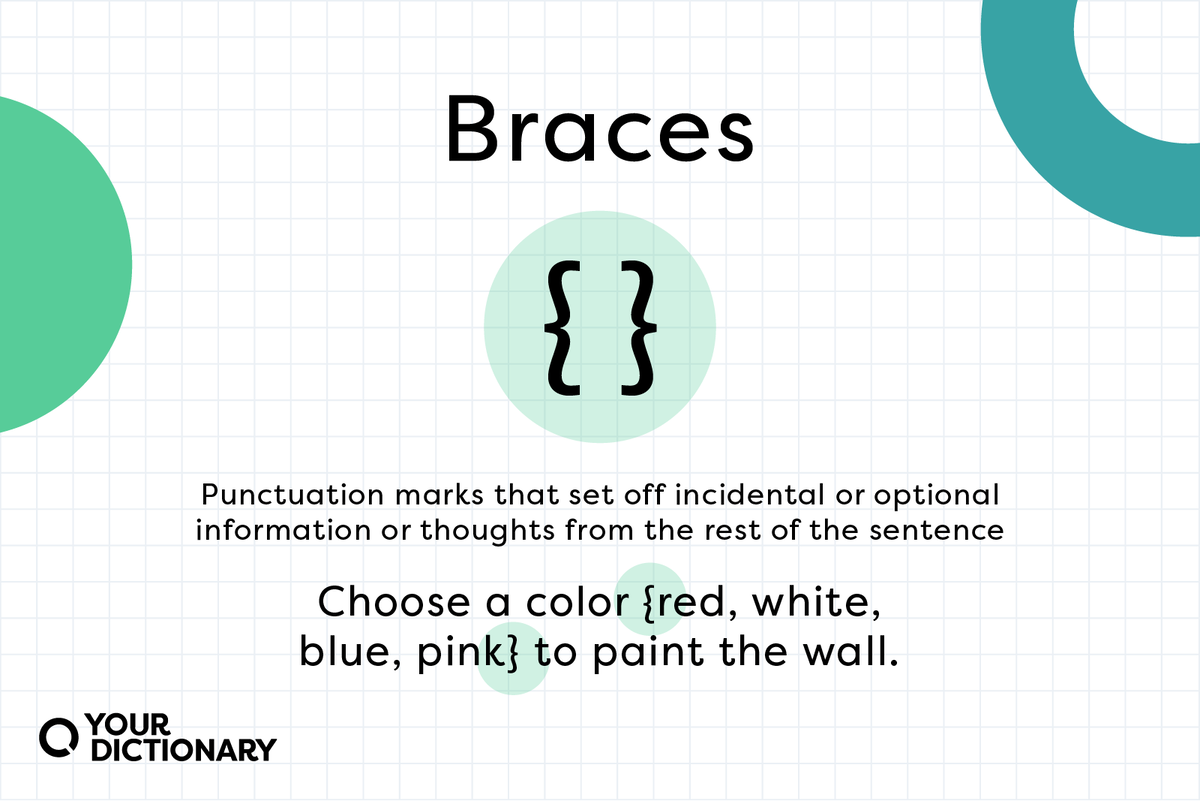
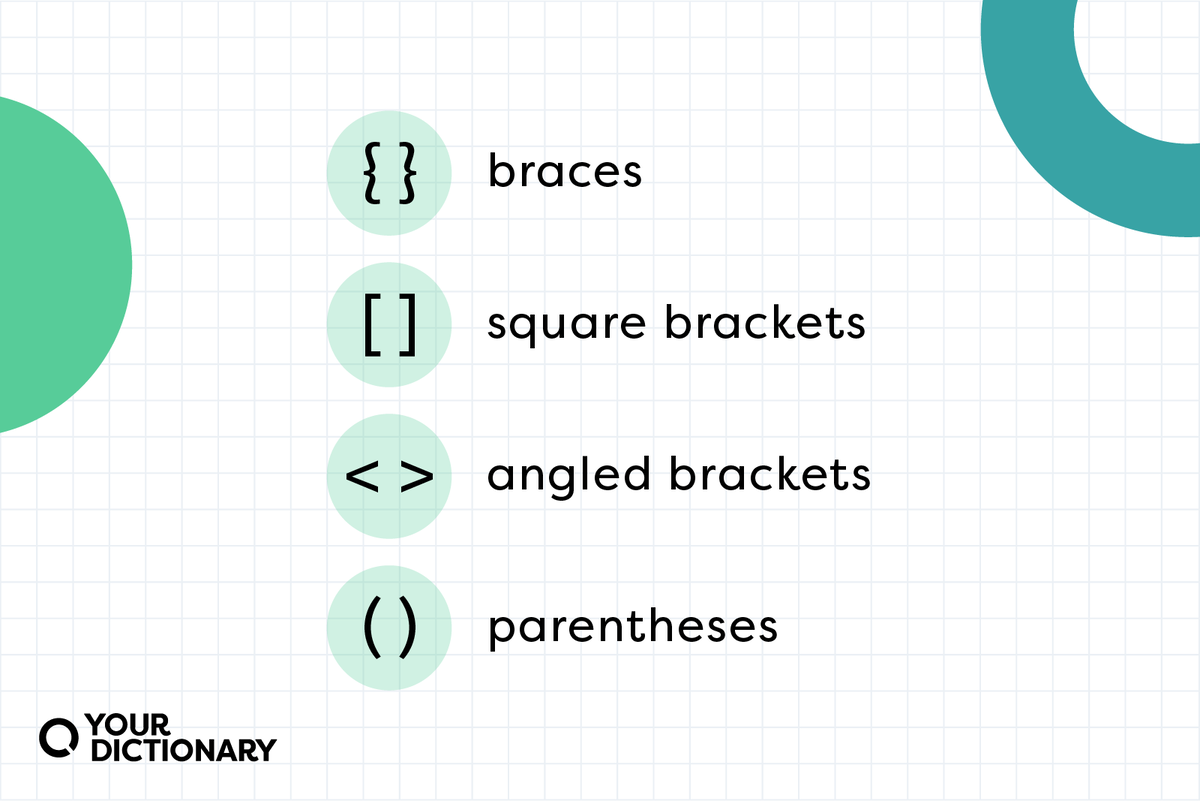
Braces { } are a punctuation mark that set off information from the rest of the sentence. Also known as curly brackets, these marks always appear in pairs, similar to parentheses (which are another type of bracket). They look like a blend of parentheses and square brackets with a little point in the middle.
Examples of Braces in a Sentence
Braces set off any incidental or optional information or thoughts. In formal writing, braces enclose math equations, music chords, computer programming commands, or lists of equal choices.
- She highlighted six numbers {2, 4, 6, 8, 10, 12} on the ruler she made.
- His behavior changed at pivotal ages {5, 11, 14, 20}.
- Choose a color {red, white, blue, pink} to paint the wall.
- Which ice cream topping is your favorite {chocolate sauce, sprinkles, caramel, cherries}?
How To Type Braces
On a qwerty keyboard, you can find the left and right curly braces on the same keys as the square brackets [ ]. To use them, hold down the “shift” key as you press the bracket button. Use the brace that points left at the start and the brace that points right at the end.
When To Use Braces in Grammar
If you can’t think of a time when you’d use these fancy little symbols, you’re not alone. Braces are more common in math than in writing.
But there are a few rare times when punctuation braces may appear in sentences. Adding commas to these lists are the only times you need to include punctuation in braces (unlike parentheses, braces do not include full sentences, so they don’t need end punctuation).
Use Braces To List Items of Equal Value
Occasionally, you may see braces around a list of items of equal value. You don’t need to include the word and in this usage.
- Choose between your friends {Sara, Taylor, Ann, Isadora} to bring to the movies.
- The lottery numbers were {5, 90, 82, 51, 1}.
Use Braces Inside Brackets (Inside Parentheses)
Also known as nesting parentheses, braces can go inside brackets when brackets appear inside parentheses. You could call it a parenthetical statement within a parenthetical statement within a parenthetical statement (if you must), but don’t add it to your formal writing — it’s for style only.
- My best friend Fiona (who used to live down the street [which was one street away from my grandmother {who was actually Fiona’s first grade teacher}]) usually comes over to play on Mondays.
- Do you think this food is (too [very {extremely}]) spicy?
Use Braces To List Music Chords
A very specific usage of braces involves lists of music chords, which can be confusing if listed otherwise.
- He played his favorite chords {c, e, g} {e, g, c2} {g, c2, e2} as he tried to write a love song.
- Please practice {f, a, c} {g, b, d} before our next lessons.
Using Braces in Math
You’ll primarily see braces in scientific writing and math equations. In these cases, they’re usually around sets of numbers {2, 3, 5, 7, 9, 10} or used to indicate the order of operations in math equations {6 + [(7 - 2) x (8 + 3)] - 10}.
Braces vs. Brackets
While braces, brackets, and parentheses are often used interchangeably, they are not the same thing. Each type of bracket has a slightly different use that is specific.
- Parentheses ( ) add additional information or provide information and detail that is helpful to have.
- Square brackets [ ] add information to a quotation that does not appear in the original quotation.
- Angled brackets < > denote a web address in citations.