Quotation marks are the only punctuation marks you can do with your fingers (insert “air quotes” here), which is possibly why they’re often used incorrectly. Quotation marks set off quotes, show dialogue, and can even add a sarcastic tone to your writing. You can keep the rules straight with a few tips and examples — and you can quote us on that.
What Are Quotation Marks?
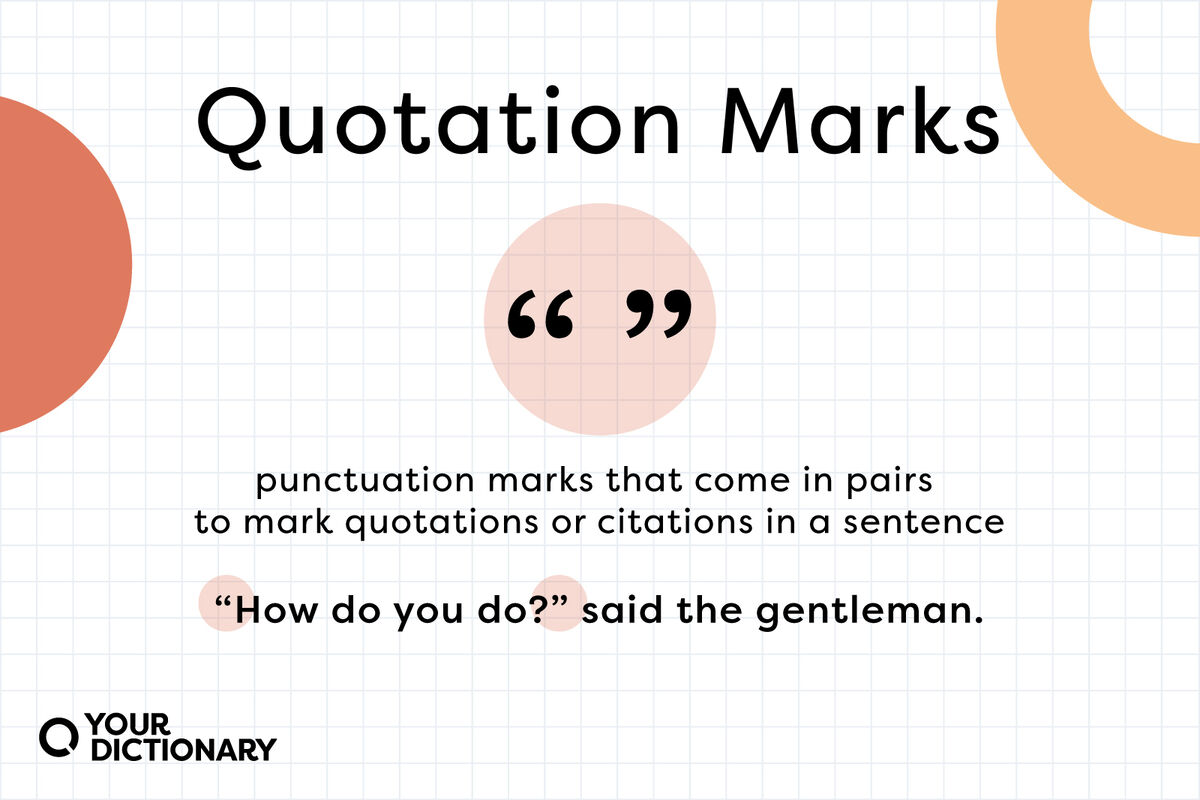
Quotation marks are punctuation marks that mark quotations or citations in a sentence. You’ll typically see them as double quotation marks that look like double apostrophes (“ ”), but they also appear in single quotation mark form (‘ ’), depending on their function in a sentence.
Also known as inverted commas, speech marks, quote marks, or just quotes, quotation marks always appear in pairs. There’s never a time when you use one quotation mark without the other.
Examples of Quotation Marks in a Sentence
Quotation marks appear where the author needs to set quoted words apart from the rest of the sentence.
- “How do you do?” said the gentleman.
- I’ve never heard the song “Blowin’ in the Wind” before.
- Benjamin Franklin once said: “There never was a good war or a bad peace.”
- Our “misunderstanding” ended up causing hundreds of dollars of damage.
Typing Quotation Marks
You can create quotation marks in your document by holding the Shift key and then pressing the apostrophe key (next to the Return or Enter key). Type your quote, then hold the Shift key and apostrophe key again to close the quotation.
Curly Quotes and Straight Quotes
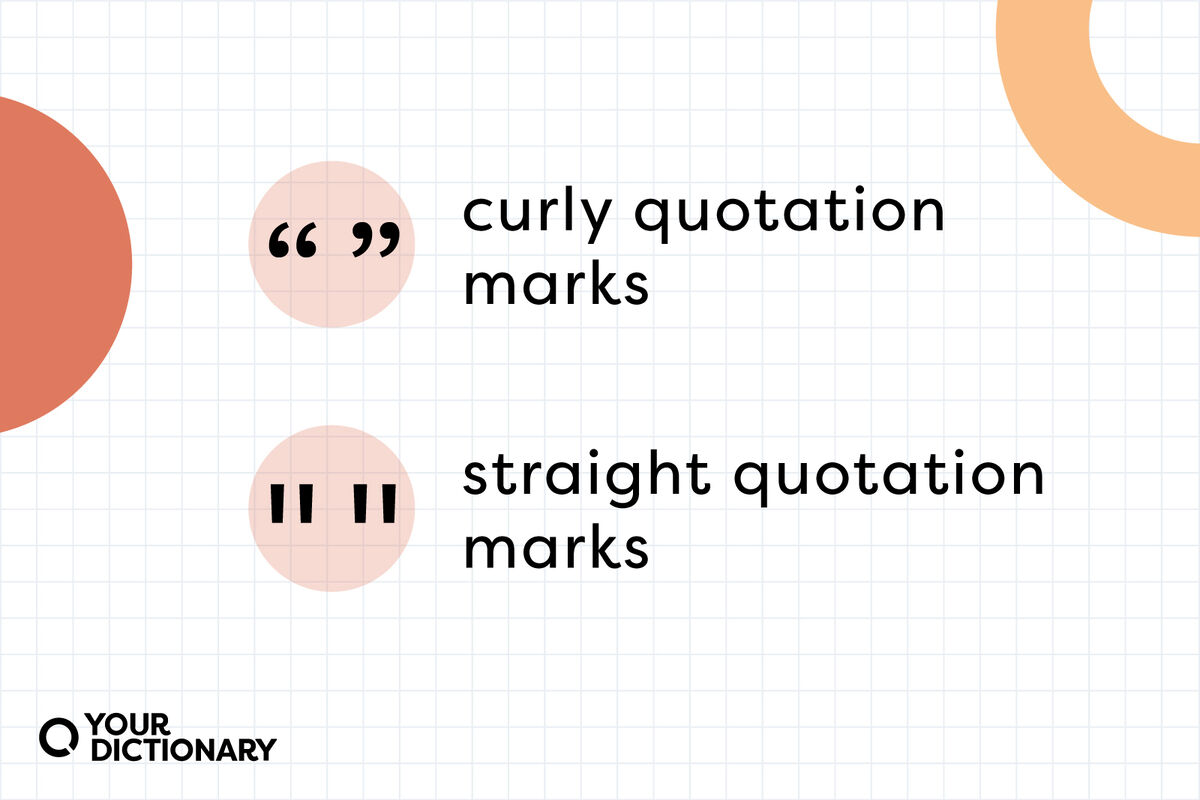
Depending on what you’re reading or writing, you may see both curly quotes or straight quotes. Curly quotation marks curve toward the text they’re enclosing, while straight quotes go straight up and down.
All quotation marks used to be curly before the invention of the typewriter, which introduced straight quotes as a matter of function. Today, the quote marks on your keyboard are probably straight, but your word processor program can format them as curly (depending on the font you’re writing in).
Advertisement
Quotation Mark Rules
There are definitely some times when quotation marks are necessary for a reader’s understanding. However, these times aren’t as often — or as random — as you may think.
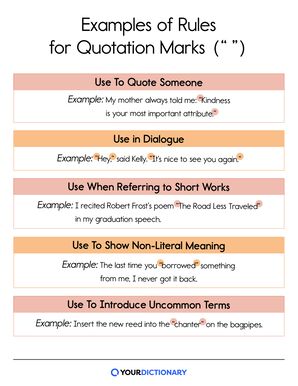
Use Quotation Marks To Quote Someone
Any time you’re writing words that someone else said, you need to put them between quotation marks. It tells the reader, “I didn’t write this part — someone else did.” This rule applies in research papers with formal citations, gossipy emails about what that guy said, and everything in between.
You can introduce a quote with your own words or even interrupt the quote with your own words, as long as the quotation marks are around any words you didn’t write yourself.
- In his book Walden, Henry David Thoreau writes, “Rather than love, than money, than fame, give me truth.”
- "Four score and seven years ago," Lincoln famously began, "our fathers brought forth on this continent, a new nation, conceived in Liberty, and dedicated to the proposition that all men are created equal."
- My mother always told me: “Kindness is your most important attribute.”
- Then Cody said “I’m already going to the dance with someone.”
Advertisement
Use Quotation Marks in Dialogue
Characters in stories like to talk. Quotation marks around dialogue let an author separate a character’s words from the rest of the narration, so readers can visualize the conversation on the page.
- “No way!” exclaimed Cheryl. “I can’t believe you won!”
- “Did you know about this?” Max questioned.
- Percy smiled. “I love you too,” he whispered.
- “Hey,” said Kelly. “It’s nice to see you again.”
Use Quotation Marks When Referring to Short Works
When you’re writing about short works or parts of a longer work, such as songs in an album, chapters in a book, or episodes of a television show, put the titles in quotation marks. Longer works are italicized, depending on the style guide you use (AP style puts quotation marks around all titles).
- I recited Robert Frost’s poem “The Road Less Traveled” in my graduation speech.
- My favorite song on the White Album is “Eleanor Rigby.”
- Did you read the article titled “Why Schools Need More Funding” in the Los Angeles Times?
- Paula’s never seen the I Love Lucy episode “Lucy Does a TV Commercial.”
Advertisement
Use Quotation Marks To Show Non-Literal Meaning
A more stylistic use of quotation marks can show an author’s skeptical or derisive tone. Sometimes known as scare quotes or sneer quotes, these quotation marks indicate that the word in question has a different meaning than it normally does.
(Use these sparingly; otherwise, your tone might be more sarcastic than you mean it to be.)
- The last time you “borrowed” something from me, I never got it back.
- Oh yeah, you’re a “genius” all right.
- Joe is working on his "art" (if you consider sleeping all day and spending my money to be art).
- Her “dress” was nothing more than a sewn-up potato sack.
Use Quotation Marks To Introduce Uncommon Terms
Quotation marks are helpful when introducing something technical or uncommon. Use them the first time you mention the new term, and then not again. Don't use quotation marks around technical terms that are commonly known.
- We're big fans of "parallax". We like to offer a scrolling web design that allows users to view our page like a story that's unfolding. Now that we're parallax pros, we'll never go back to a generic site design.
- Insert the new reed into the "chanter" on the bagpipes. You'll want to gauge its level of ease by sampling a few notes directly on the chanter before you reinsert it into the bag.
Advertisement
Punctuation for a Quote
Now that you know which words go inside quotation marks, it’s time for the ultimate challenge: What punctuation goes inside quotation marks? And does it matter where the quote falls in the sentence?
Ending a Sentence With a Quote
You can end your sentence with a quote or piece of dialogue. Any punctuation that comes at the end of the quote (such as periods, quotation marks, or question marks) stays inside the marks.
- Then he said, "How would you like to get some ice cream after the movie?"
- My dad shouted, “Come here right now!”
- Liza whispered, “Let’s go.”
No end punctuation is necessary after these quotes because they already have end punctuation. However, if the end punctuation applies to the whole sentence instead of just the quote, it goes outside the quotation marks.
- Did you hear that Ron yelled “I quit”? (The sentence is asking the question, not Ron)
- I love the song “Shake It Off”! (The sentence is exclaiming, not the song title)
Advertisement
Beginning a Sentence With a Quote
When a sentence begins with a quote, place the punctuation inside the quotation marks before continuing the sentence. If there’s no end punctuation, use a comma.
- "I would love to but I really ought to go home," I replied.
- "Where are you going?" she asked.
- “Clean your room!” my mom demanded.
Dashes, Colons, and Semicolons Go Outside Quotation Marks
If you have a sentence where another type of punctuation mark (such as a dash, colon, or semicolon) follows a quote, it goes outside the quotation mark.
- He said “I care about you” — but then he didn’t show up for our date.
- There’s only one song I like more than “Unchained Melody”: “Brown-Eyed Girl.”
- I don’t know “that weird guy who runs this place”; I’m actually the boss here.
Advertisement
Capitalize Complete Sentences in Quotes
If your quoted text is a complete sentence (or multiple sentences), capitalize the first letter, regardless of where you put the quote within the larger sentence.
- She said, "We went to the movies."
- “Have you met my cousin?” asked Marie.
- Pat said “Let’s go,” before noticing that everyone was already gone.
When the quote is a fragment or part of the sentence it’s in, you don’t need to capitalize it.
- Let’s discuss your decision to “skip school and just hang out.”
- Will claimed he couldn’t commit the crime because “he’s a good person.”
- Emily Dickinson believed that the finality of existence “is what makes life sweet.”
Can You Use Quotation Marks for Emphasis?
Style guides and editors are torn on whether quotation marks are effective ways to emphasize text. Those who support this usage argue that quotation marks make a word or phrase more visible, just like italicizing or underlining it.
But those against quotation marks for emphasis say that it’s too easy to misuse them in this way, especially because quotation marks can also show sarcasm or non-literal meaning. Just imagine someone saying these statements with air quotes, and determine whether they seem genuine or not.
- I’m “overjoyed” to see you. (Are you emphasizing overjoyed, or are you actually unhappy to see me?)
- Please review “all” of these documents before the meeting. (Do you really mean all, or do the quotation marks mean I only have to review some of the documents?)
- Mark is the “best” soccer player on the team. (Is he really the best, or is he actually the worst?)
Advertisement
What About Single Quotation Marks?
Now that you’ve got the quotation mark rules down, here’s a reminder: Those are only the rules for double quotation marks (“ ”) which don’t include single quotation marks (‘ ’). In American English, use single quotation marks:
- when adding a quote within a quote (Jane asked “Have you heard the song ‘Samba Pa Ti’ before?”
- when adding a quote within a headline (President Says Economy Is Fine — ‘Better Than Ever’)
Also noteworthy are the British English rules for quotation marks, which switch the use of single and double quotation marks. When quoting a person or writing dialogue in British English, use single quotation marks, and when adding a quote within a quote, use double quotation marks.
Advertisement
Tips for Remembering Quotation Mark Rules
Think of quotation marks as oven mitts, and the words between them as a very hot platter of cookies. You need an oven mitt on either side or you’ll be burned. That goes for the little punctuation cookies too — they’re hot!
But how can you remember when punctuation goes outside the quotation marks? If you were already eating a cookie before holding this hot platter (i.e., the sentence already had punctuation), that cookie doesn’t go on the hot platter. It can go on a plate next to the platter (outside the quotation marks).