You're probably familiar with quotation marks — those double scoops in the air (“ ”), used before and after we relay something someone said or wrote, verbatim. But what about their slimmer counterparts, the single quotation marks (‘ ’)? While single quotation marks aren’t used that frequently, they do serve an important purpose, and using them correctly can keep misunderstandings out of your writing.
What Are Single Quotation Marks?
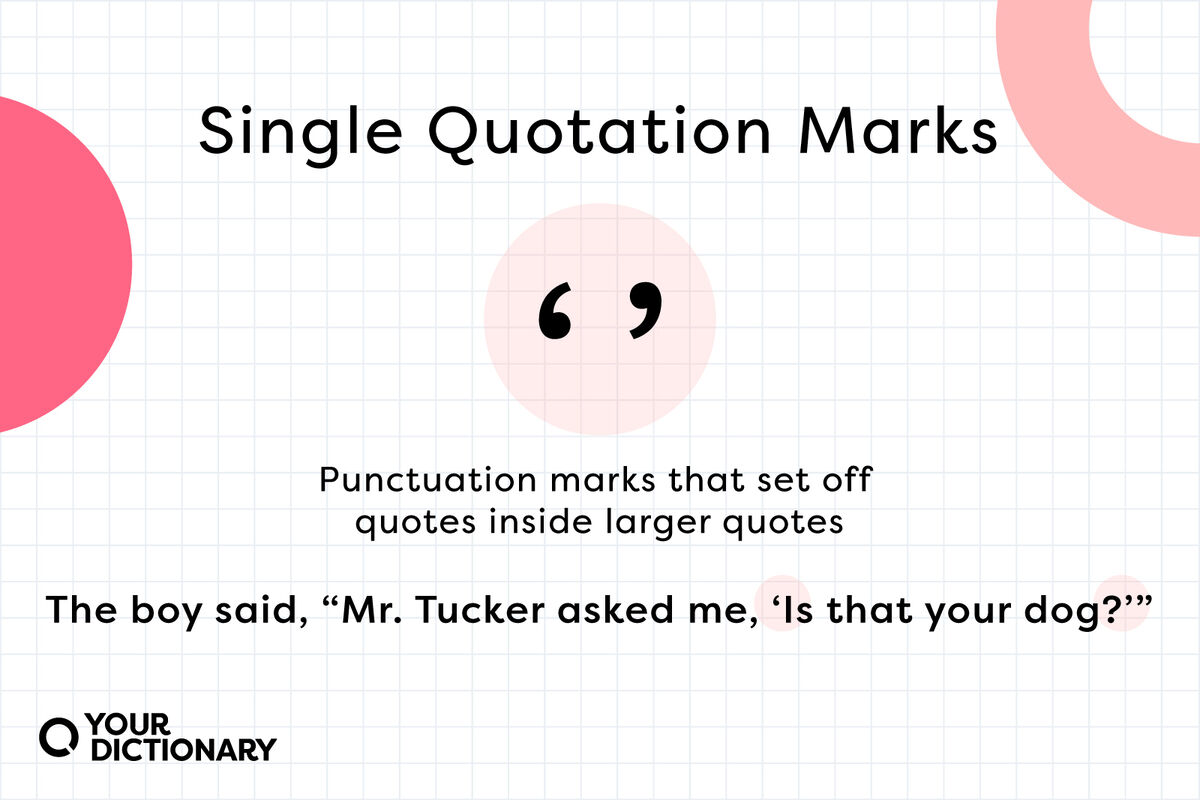
Single quotation marks are punctuation marks that set off quotes inside larger quotes. They look like two apostrophes on either side of a piece of text (‘like this’).
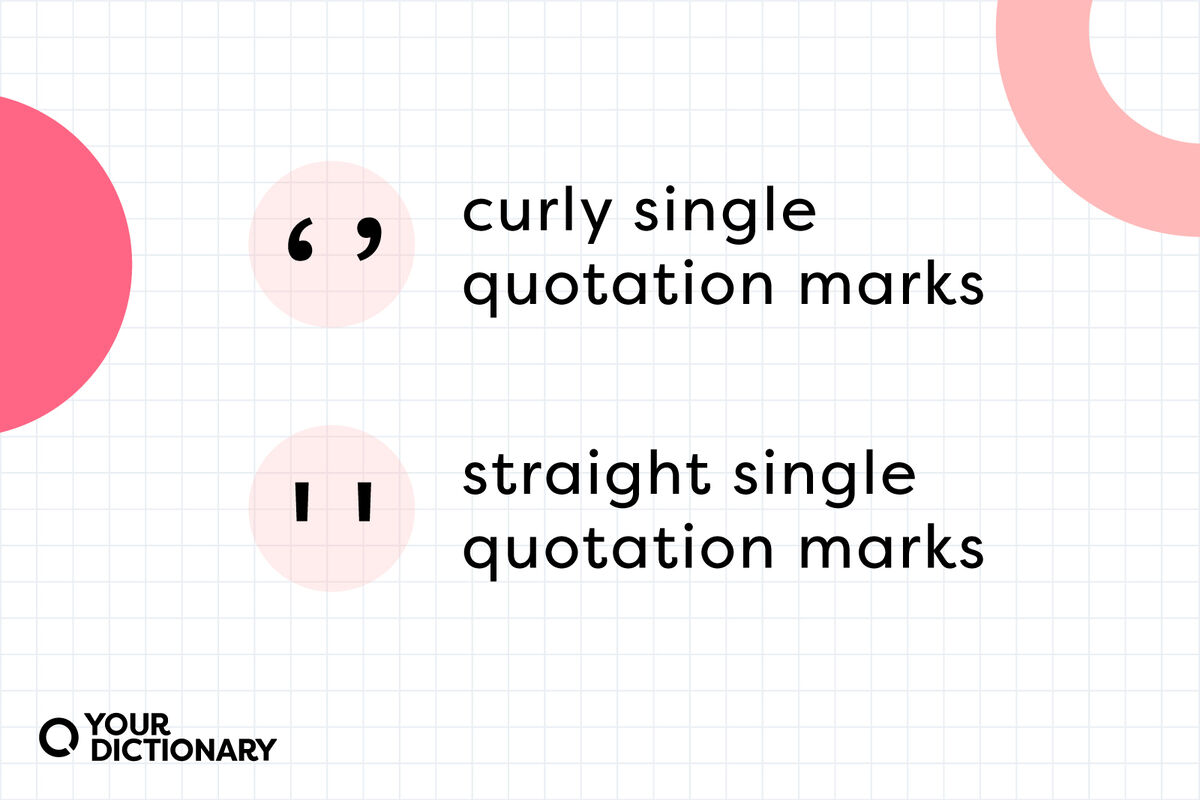
Like double quotation marks, single quotation marks can be curly (curved toward the text) or straight (up and down). It depends on the font you’re using.
Examples of Single Quotation Marks in a Sentence
Although you may not see single quotation marks as much as double quotation marks in American English, they still pop up now and then.
- The boy said, “Mr. Tucker asked me, ‘Is that your dog?’”
- “The Gettysburg Address starts off ‘Four score and seven years ago,’” began the history teacher.
- “She just said ‘See you later,’ and then left,” reported Kyle.
When To Use Single Quotation Marks
In standard American English, there are really only two times to use single quotation marks. One involves the more familiar double quotation marks, and the other has to do with headlines.
Use Single Quotation Marks Within a Quotation
The most common use of the single quotation mark is when you're quoting someone within a quotation. You've probably seen this format used in different types of essays, books, interviews, and news stories.
When the interior quote is at the end of the whole quotation, use both single and double quotation marks to close both quotes.
- Sam exclaimed, "Joe was at the store and bumped into Alexa. When he saw her, he said, 'I hope we'll see you at the party next Friday,' but she didn't know anything about it!"
- The news reporter said, "All of the stores on the block have burned down. One shop owner screamed, 'I cannot believe this is happening!' as the flames engulfed her store."
- Jason told Mark, "I saw Cynthia the other day, and she said, 'I'm really looking forward to Mark's graduation!'"
- Her daughter asked, "Why did you call that man a 'ridiculous idiot'?"
Use Single Quotation Marks in Headlines
In an article headline, use single quotation marks in place of the standard double quotation marks. If the headline includes the title of a song, short story, or a quote by someone, use single quotation marks.
- In the Words of The Beatles, 'Let it Be'
- The President Urges, 'Don't Worry, America'
- 'I Did it for My Kids,' Says Heroic Mom
- Candidate Promises 'No More Taxes'
Punctuating Single Quotation Marks
The rules for using punctuation marks with single quotation marks are the same for double quotation marks: If the punctuation belongs to the quote, it stays inside the quotation marks.
But when the punctuation belongs to the outer quote and not the inner quote, it’s a different story. In these cases, the punctuation mark goes outside the single quotation mark, but inside the double quotation mark.
- Suddenly Shelley yelled “Play ‘Twist and Shout’!” (Exclamation mark belongs to the outer quote, not the song title inside the quote)
- “Who called you ‘Mr. Meanie’?” asked the teacher. (Question mark belongs to the outer quote, not the inner quote)
British Usage of Single Quotation Marks
In British punctuation, single and double quotation mark usages are switched. Single quotation marks mark direct speech, and with quotes within quotes use double quotation marks.
- That’s not what Harry told me. He said, ‘I am going on holiday in June, so I’ll be able to help you move house in July.’
- My teacher said, ‘Sally, your mum always wears such lovely dresses.’
- Bridget explained, ‘I just love the Beatles. My motto is “we all live in a yellow submarine,” just like they said in my favorite song.’
- My mum won’t believe you. She said, ‘I don’t trust your friend. Last week she said, “my dad knows I’m staying for dinner,” and it turned out that he didn’t even know.’
Single quotes marks can also set off a specific word in British usage (I ‘truly’ cannot stand that woman), similar to italicizing for emphasis in American usage.
A Tip for Quoting Your Quotes
Think of quotes like Matryoshka dolls (Russian nesting dolls). Sometimes, all you need is the outer doll (double quotation marks) to play, and that’s just fine.
But occasionally, there’s another doll inside the larger doll. It’s smaller than the outer doll — the outer doll doesn’t fit inside that one. You need to put the smaller doll inside the larger doll for it to work, just like you need to put the smaller, single quotation marks inside the larger double quotation marks.