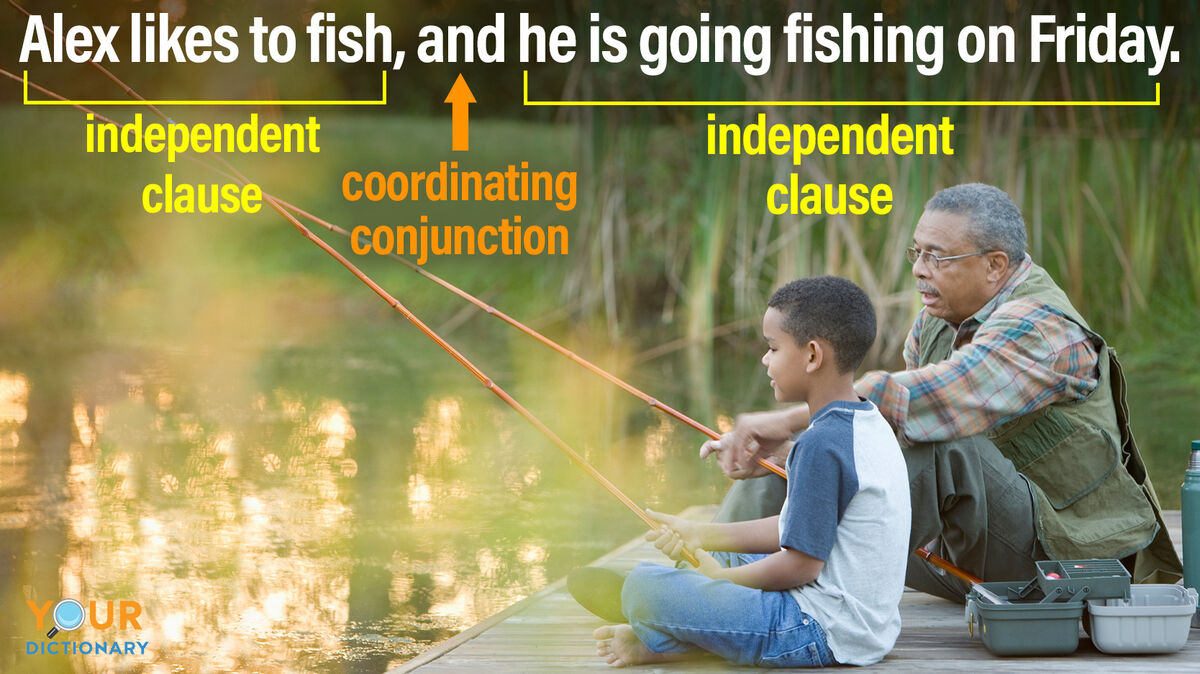
Compound sentences can make your writing rich and colorful. While beginning writers learn to put together simple sentences first, putting them together in compound sentences tends to make paragraphs more engaging. Check out these examples of compound sentences that are sure to give your sentence structure some variety.
Compound Sentence Definition
A compound sentence joins two or more independent clauses, also known as simple sentences. Independent clauses are phrases that can stand alone as a complete thought. They're not dependent upon one another to express a complete thought, but they tie together similar ideas.
For example:
- Two independent clauses - I love my dog. I never go anywhere without her.
- Compound sentence - I love my dog, for I never go anywhere without her.
- Two independent clauses - Pauline is late for work. The boss wants to talk to her.
- Compound sentence - Pauline is late for work, so the boss wants to talk to her.
- Two independent clauses - Salmon is delicious. It's good for you too.
- Compound sentence - Salmon is delicious, and it's good for you too.
Coordinating Conjunctions
In order to connect independent clauses, you need to use a coordinating conjunction. The seven coordinating conjunctions in the English Language are:
- for
- and
- nor
- but
- or
- yet
- so
You can use the acronym FANBOYS to help you remember the seven coordinating conjunctions. When you join two independent clauses with a coordinating conjunction, add a comma to prevent writing a run-on sentence.
Using a Semicolon
Semicolons come in handy when linking independent clauses, too. They function as coordinating conjunctions, especially and, for, yet, and so.
- I love my dog; I never go anywhere without her.
- Pauline is late for work; the boss wants to talk to her.
- Salmon is delicious; it's good for you too.
Examples of Compound Sentences
There are lots of ways to combine independent thoughts and create new meaning. Check out these compound sentence examples that take two independent clauses and make them into one sentence.
Alex likes to fish. He is going fishing on Friday.
Alex likes to fish, and he is going fishing on Friday.
Becky wishes she could be younger. Everyone else in the program is half her age.
Becky wishes she could be younger, for everyone else in the program is half her age.
She is going to the movies. She is going to the mall.
She is going to the movies, or she is going to the mall.
I am very smart. I do not enjoy school.
I am very smart, yet I do not enjoy school.
- The other school's swim team is very fast. We have to practice more.
- The other school's swim team is very fast, so we have to practice more.
- We like comedies. We didn't like this movie.
- We like comedies, but we didn't like this movie.
Compound vs. Complex Sentences
Compound sentences are distinct from complex sentences, which contain an independent clause joined by at least one dependent clause. A dependent clause does not form a complete thought and cannot stand alone. Complex sentences use subordinating conjunctions such as because, while, if, and unless.
- Compound sentence - My sister got a raise, so she's going on vacation.
- Complex sentence - My sister got a raise because she works hard.
- Compound sentence - You can watch the game, or you can read a book.
- Complex sentence - You can watch the game if you want.
- Compound sentence - Birds are great pets, and they're very friendly.
- Complex sentence - Birds are great pets unless you're allergic to them.
The biggest difference between compound and complex sentences is the relationship between their clauses. In compound sentences, both independent clauses are equally important. However, in complex sentences, the dependent clause functions to describe more about the independent clause. Compound-complex sentences combine these two sentence types, so get ready!
Compound Complexity
Compound sentences improve your writing. There's nothing worse than reading a page of simple sentences, so mix it up with some compound sentences! One of the best ways to become a master sentence constructor is to fall in love with sentence diagramming. When you're ready, try out these free diagramming sentences worksheets.