Learn how to fix a fragment sentence through a few simple tips. Get a clear idea of how to identify a fragment sentence in writing. Then, explore why some writers use sentence fragments to create a more conversational tone.
What Is a Sentence Fragment?
A sentence fragment is a group of words that look like a sentence, but they aren’t. Why? Because to be a complete sentence, every sentence must contain three components:
The sentence must express a complete thought; we need to know what it's about.
The sentence must have a subject: a person or thing that the sentence is about. This is usually a noun, a noun phrase or a pronoun.
The sentence must express an action. This is usually a verb.
If a sentence lacks one or more of these three essential components, it’s called a sentence fragment. The first step in learning how to correct a sentence fragment is knowing how to identify them.
Defining Characteristics of a Sentence Fragment
Before you can fix a sentence fragment, it's important to look at a few examples of sentence fragments. Use this checklist to help you understand different types of sentence fragments.
It lacks a subject.
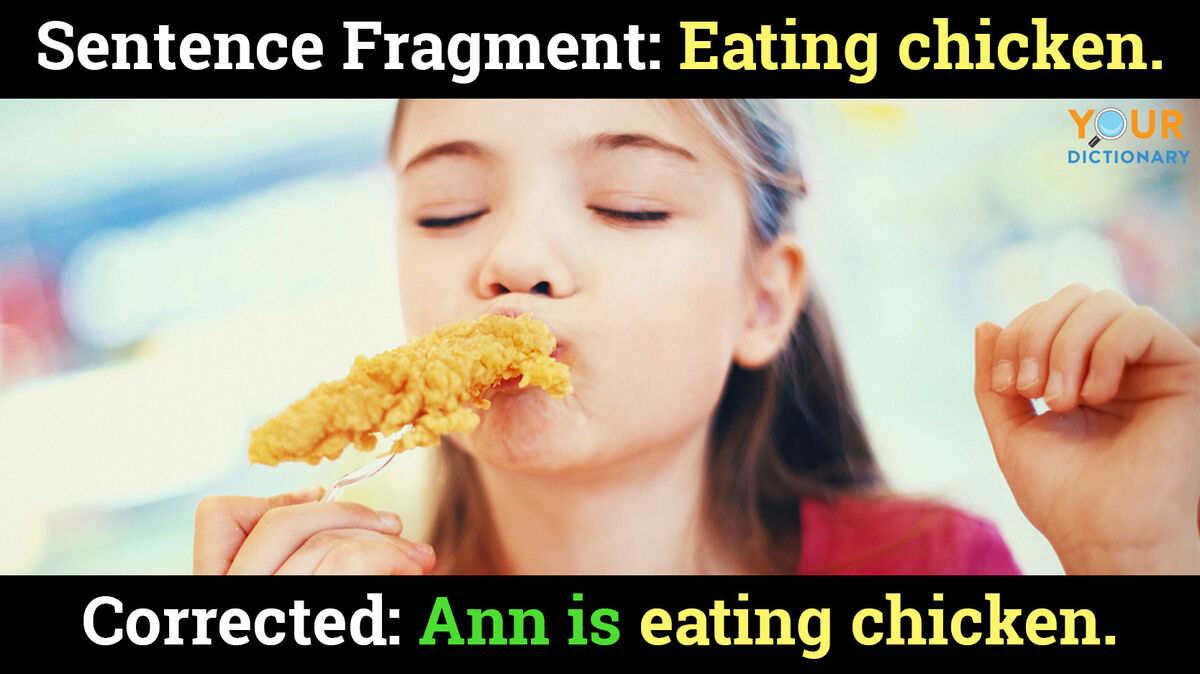
For example: Eating chicken.
This sentence is lacking a subject - who or what is eating chicken?It doesn't have a verb expressing an action.
For example: A book without a cover.
What about a book without a cover? Is the book doing something? Is someone doing something to the book? We don't know because there is no verb.It doesn't express a complete thought.
For example: For example, milk and eggs.
This sentence is lacking a complete thought — what are the milk and eggs examples of?It's a dependent clause standing alone.
For example: Because I went to the store.
The conjunction "because" makes this clause dependent. A dependent clause can't stand alone; it needs to be attached to an independent clause.
How to Fix a Fragment Sentence
Fixing sentence fragments depends on what it's lacking. Use these quick fixes to help make your sentences complete.
1. Add the Missing Parts
Add a subject or verb to complete the thought.
Sentence Fragment - Enjoying his latest self-development book.
Complete Sentence - Roland was enjoying his latest self-development book.
2. Join Clauses
Join the dependent clause with an independent clause to complete the thought.
Sentence Fragment - Because her puppy got sick.
Complete Sentence - Kelly was late for work because her puppy got sick.
In this example, you can also remove the subordinating word to complete the thought. Either a period or semicolon would work in the corrected thought.
Sentence Fragment: Kelly was late. Because her puppy got sick.
Complete Sentence: Kelly was late. Because Her puppy got sick.
Complete Sentence: Kelly was late; because her puppy got sick.
3. Rewrite the Sentence
Rewrite the sentence that isn’t making a complete thought.
Sentence Fragment: He ran through the door. Clenching his water bottle. When he reached the crib, he saw that the baby was okay.
Complete Sentence: He ran through the door. His hands clenched his water bottle. When he reached the crib, he saw that the baby was okay.
For more, check out these sentence fragment examples. There, you'll find a list of fragments followed by their proper revisions.
Intentional Sentence Fragments
Are sentence fragments always bad? The short answer to this question is no. However, don’t say that to your English teacher. While you want to avoid sentence fragments in formal situations, authors and media writers use sentence fragments intentionally in writing to make it more conversational. Sentence fragments are also extremely common in speech. Therefore, while it’s important to make sure to use complete sentences for your English paper, some sentence fragments you see in the world aren’t always errors.
Write Right Today!
With all the sentence fragment checkers out there, you might be wondering why you need to know how to identify and fix a fragment sentence. Well, it’s a great skill to have if technology fails you. In a hurried world filled with emails and texts, it can be easy to landslide into sentence fragments. But, save the fragments for a fun text with your pal. When writing for school or work, keep a keen eye on your potential for fragments.
To help you stay in tip-top shape, check out the definition of academic writing. It discusses the primary characteristics of academic writing, as well as the best way to structure this form. Likewise, for professional contexts, types of business communication writing will help you format your work properly and keep your emails looking right.