"It's the basis of ordinary etiquette / to be sure of your subject and your predicate." This lyric from a children's play about acceptable grammar is certainly true; however, not everyone can point out the predicate in a sentence (even if they are sure of the subject). Learn more about what a predicate is with the predicate meaning and how to identify one in a sentence.
What Is a Predicate in a Sentence?
The predicate of a sentence is the part that modifies the subject of a sentence or clause in some way. The predicate specifies what the subject is or does or tells what is done to the subject. Because the subject is the person, place or thing that a sentence is about, the predicate must contain a verb explaining what the subject does. It can also include a modifier, an object or a compliment.
- The verb (or verb phrase) alone is the simple predicate.
- The verb paired with all of the other words that describe its action form the complete predicate.
Basic Examples of One-Word Predicates
A predicate can be as simple as a single word that shows the action in a sentence. It is used to tell you what the subject of the sentence does. Look at a few of the shorter sentences in the English language. The subjects are underlined and the predicates are bold.
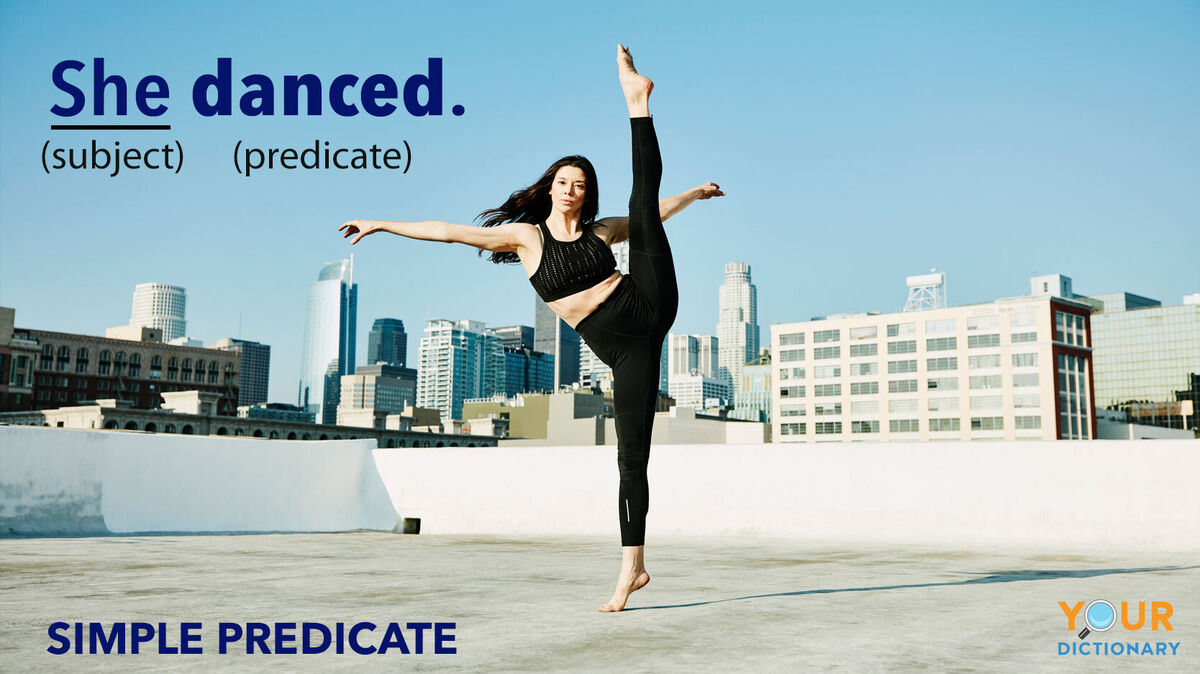
- She danced. - The subject of the sentence is "she," the person being spoken about. But what is being conveyed or expressed about this person? She performed an action, of course; she danced. The word that modifies the subject "she" is the past-tense verb "danced," which is the predicate.
- It talked! - "It" might be a baby saying a word for the first time, a parrot squawking "Hello" or even an inanimate object somehow bestowed with the power of speech. What you know about "it" is that, according to the sentence, it spoke. "Talked" modifies the subject "it," so "talked" is the predicate.
- I sing. - The subject of the sentence is "I." What is the point of the sentence? For the subject to specify an action that they perform, which is to sing. "Sing" is the verb that is the predicate of this sentence.
More Examples of Short Predicates
Predicates vary in length and complexity. The sentences below are very simple examples of what predicates are since the predicate is expressed entirely by one verb. A simple predicate may also be a short verb phrase.
In the examples below, the complete predicate is in bold in each example, while the subject is underlined. The simple predicate is noted in parentheses after each sentence.
- He was cooking dinner. (simple predicate - cooking)
- We saw the cat outside. (simple predicate - saw)
- I walked the dog. (simple predicate - walked)
- Anthony wrote to his friend. (simple predicate - wrote)
- They ate all the candy. (simple predicate - ate)
- My aunt moved. (simple predicate - moved)
- The house has a new roof. (simple predicate - has)
- Andrew threw the ball. (simple predicate -threw)
- He is sad. (simple predicate - is)
Examples of Longer Complete Predicates
A complete predicate is the verb that shows the action and the modifying phrase that completes the thought, basically everything in the sentence that isn't the subject.
As with the section above, the complete predicate is in bold in each example, while the subject is underlined. The simple predicate is noted in parentheses after each sentence.
- She is dancing on stage for the first time. (simple predicate - is dancing)
- My family is arriving early tomorrow. (simple predicate - is arriving)
- She was upset for a long time over the break-up. (simple predicate - was upset)
- I have been studying for hours. (simple predicate - have been studying)
- We are going to the movies later. (simple predicate - are going)
- My parents just finished repainting their house. (simple predicate - just finished)
- You were visiting us this time last year. (simple predicate - were visiting)
- He has left his hometown for the big city. (simple predicate - has left)
- The children believe in Santa Claus. (simple predicate - believe in)
- Our new puppy has been crying all night. (simple predicate - has been)
Examples of Compound Predicates
In addition to simple predicates, there are also compound predicates. A compound predicate gives two or more details about the same subject and has two or more verbs joined by a conjunction. For example: "She visited her cousins and met all their friends." In this example, "she" is the subject and "visited her cousins" and "met all their friends" are the compound predicates joined by the conjunction "and."
In the examples below, the subject is underlined, the complete predicates are bold and the simple predicate is noted in parentheses after each sentence.
- He did homework and played video games. (simple predicates - did, played)
- She likes dolls but hates trains. (simple predicates - likes, hates)
- The mail was late but arrived later that evening. (simple predicates - was, arrived)
- He lives in Italy and speaks English and Italian. (simple predicates - lives in, speaks)
- We completed the project and won a prize. (simple predicates - completed, won)
- She slept in and was late for work. (simple predicates - slept in, was late)
- My sister fell and hurt her shoulder. (simple predicates - fell, hurt)
- Mark broke his computer, so he borrowed one from his friend. (simple predicates - broke, borrowed)
- The cat chased the mouse and trapped it in the kitchen. (simple predicates - chased, trapped)
- We shopped and ate lunch at the mall. (simple predicates - shopped, ate)
Understanding Other Examples of Predicates
English grammar is known for exceptions and special circumstances, so you're probably not surprised to learn that there are a few special cases to consider with predicates.
Making Sense of 'I Am.'
"I am" is often described as the shortest sentence in the English language, but this is not exactly true. While it can be a complete thought and does contain a subject and a verb, it doesn't explain what "I am."
- An additional piece of the phrase is usually necessary to complement the verb. When you answer "I am," you are usually leaving out an implied word that completes the sentence.
- Whatever you add to "I am" technically forms the predicate of the sentence. For example: "I am playing guitar." You must add "playing guitar" to complete what you are doing in the sentence.
- Another example would be "I am tired." The word "tired" is used to describe what you are.
Now that you know "I am" is not technically a complete sentence, you'll probably be quick to notice other examples that seem like complete sentences but lack a predicate, such as "I can" and "I will." What might confuse you is the sentence that seems to lack a subject.
Making Sense of 'Go.'
As surprising as it may sound, the shortest complete sentence in the English language is the imperative statement, "Go!" How can this be? After all, "go" is a verb seemingly without a subject or a predicate. There are two things you'll need to understand before this example will make sense.
- If you tell a person to do something, they are the implied subject of the sentence. What the imperative (meaning, "do this!") form of the "to go" verb is addressing is the person to whom you are speaking. What you really mean when you shout "go!" is, "(You) go!"
- Unlike the "to be" verb used above in the "I am" example, "go" is an action verb, not just a state of being. "Go" is, therefore, a complete predicate in and of itself — it needs no further explanation or qualification to make sense. (You) can go anywhere, as long as (you) heed the imperative.
Finding the Predicate
Every sentence has two parts: a subject and a predicate. The predicate is used to tell the reader what the subject does. It contains a verb and shows action. Predicates can be one verb or verb phrase (simple predicate), two or more verbs joined with a conjunction (compound predicate), or even all the words in the sentence that give more information about the subject (complete predicate). To find the predicate, simply look for what the subject is doing. Now that you're familiar with predicates, take the time to explore different parts of sentences.